Doctor Who has long been my favorite show, but my actual viewing it over the years has been very on-again / off-again. Lately, it’s been all-on, as I’m actually closing in on finishing re-watching all of the classic episodes (at least the ones that are easily available for me to stream), whilst blogging about each serial.
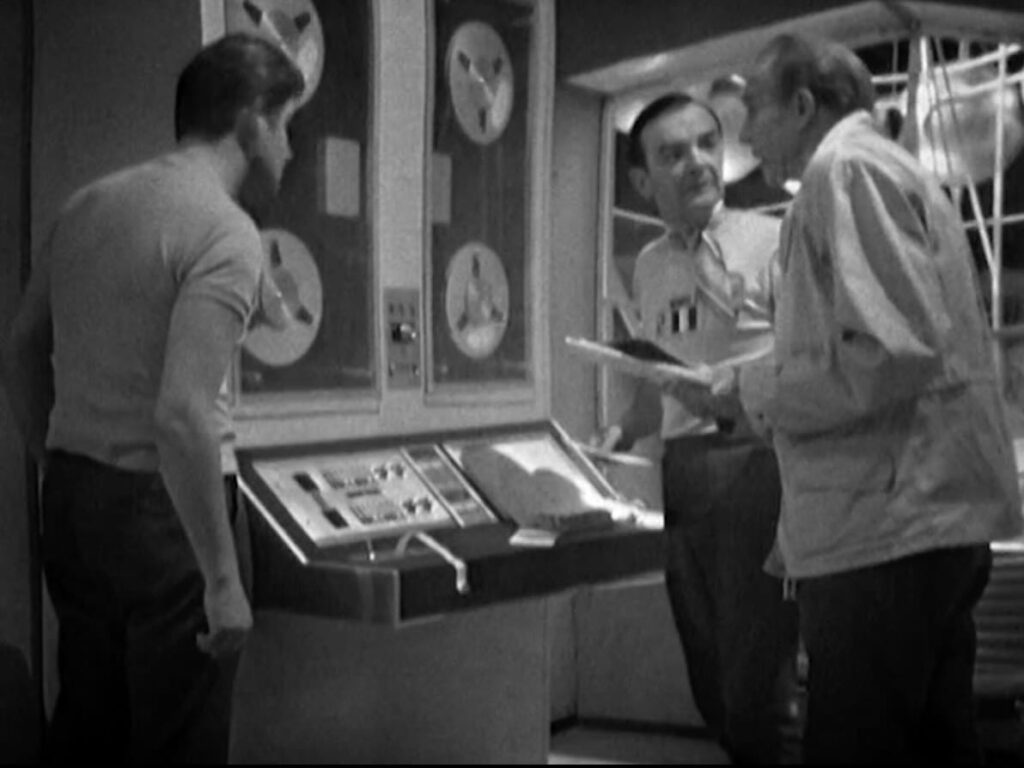
Patrick Troughton is possibly my favorite classic Doctor, but it’s been a while since I’ve watched one of his stories because of the fact that so many of them are incomplete. Nicely however, classy Doctor Who has returned to the Australian version of Britbox and it brought with it a couple of the Second Doctor stories that are only available thanks to animated reconstructions. One of them is The Moonbase, which was the second ever appearance of the Cybermen, for which you can only watch the first and third episode in animated form.

The Moonbase
Starring Patrick Troughton as the Second Doctor
Companions: Michael Craze as Ben Jackson, Anneke Wills as Polly and Frazer Hines as Jamie McCrimmon
Written by Kit Pedler. Directed by Morris Barry. Produced by Innes Lloyd. Script Edited by Gerry Davis. Animated recreations directed by Sean Zwan.
Format: 4 episodes, each about 25 minutes long
Originally Aired: February-March 1967 (Episodes 23-26 of Season 4)

Spoilers Ahead!
When The Moonbase hit the air, The Tenth Planet was only four months in the past. But obviously the Cybermen had been successful enough to warrant a quick return to the show (although some quick research suggests that this was way part of the plan). And once again, the being’s primary creator, Kit Pedler, was around to pen the story. But even with all of this consistency, the Cybermen themselves were pretty majorly redesigned.
They are still inhuman and metallic menaces that hulk over their victims, but gone are their individual names, their lilting voices , their fabric-based face masks and any particular emphasis on them being part biological. Instead, these Cybermen are more overtly robotic–indeed you’d be forgiven for thinking they are supposed to actually be robots. Nonetheless, this version of the Cybermen would be the template for pretty much all the Cybermen seen over the rest of the original series, even given the inevitable adjustments to their look over the subsequent 20+ years. In that way, they remind me of Patrick Troughton’s Doctor: not the original, but perhaps more influential on later iterations than what had come before.

A lot of the story of The Moonbase is suspiciously similar to The Tenth Planet. Again we’re in an isolated, science-focused base manned by an international crew. Again hapless crew members are caught by the Cybermen outside the base and clubbed into submission. Again the Cybermen breach the base and take charge, forcing the humans to obey them under threat of death (or worse). And again the humans resist, with the Doctor’s help of course, but with companion Ben Jackson doing a lot to help lead the fight back.
What’s novel about it all is of course the moon setting, and the concept of the Gravitron, a complex piece of machinery used to control the earth’s weather. All of that is interesting to a point, but not necessarily interesting enough to keep the story fully engaging all the way through. I enjoy the setting and the ideas, but the story itself lacks liveliness. Part of this is the lack of interesting characters. The Moonbase is a nifty concept but we only spend meaningful time with two of the scientists–mission commander Hobson and his second in command, Roger Benoit. And of them only Hobson has distinct personality, being a classic gruff and suspicious base commander.

He’s not as much of a mess as General Cutler from The Tenth Planet (or indeed Jarvis Bennet from a future Cyberman story, The Wheel in Space), but he doesn’t replace that with anything other than being generally level-headed. It’s nice to know that some base commanders in the Doctor Who universe are actually competent, but it doesn’t make him particularly memorable as a character.
The adventure is also hindered by a number of slap-dash parts of the plot, where things happen that require more suspension of disbelief than normal. The Cybermen weaken the crew with a disease, for instance, which they spread by sneaking it into the base’s sugar supply. Thus only the people who take sugar in their coffee get sick. But this disease has been spreading for the past two weeks, according to the dialogue. Have none of the sugar drinkers that we see had any coffee for the past two weeks? Or have the Cybermen only contaminated little bits of sugar at a time?
Later there is the realisation that people have been disappearing from the medical bay because a Cyberman has been hanging out in there, ready to grab the invalids. Again, people been sick for a couple of weeks, but this only seems to begin when the Doctor arrives. And then there is the “shocking revelation” that one of the patients in the room is actually a Cyberman!

How on earth has no one noticed this? There are only supposed to be nineteen crew members on the station, and the Cyberman’s boots are actually visible under the blanket.
Indeed, why are the Cybermen going to the bother of getting people sick and kidnapping them one by one? It seems like they could easily just walk into the station and club or zap everyone into unconsciousness, and then convert the people they need to operate the Gravitron. Their plan isn’t nearly as convoluted as we’ll get later with The Wheel in Space, but it’s still way more steps than necessary.
Finally, I thought the climax of the story was underwhelming. The Doctor is clever in his use the Gravitron against the Cybermen, and certainly that makes sense in light of the whole story, but it ultimately comes across as a pretty simple victory. The last minute obstacle of Hobson forgetting to remove a failsafe that would allow them to ue the machine in this particular way doesn’t really amount to anything, and so the defeat of the Cybermen and the Doctor’s departure is all somewhat abrupt. Rather than there being a sense of momentum building up to the conclusion, it feels like it comes when it does because we’re out of time.

Having said all that, there are still things about The Moonbase that I like. As I mentioned before, Ben Jackson is used very well here. He gets multiple important action scenes and Michael Craze gives him a lot of personality. I feel like Ben is nobody’s favorite companion, but based on this and The War Machines (the last story I watched him in), he’s quite the underrated character.
Perhaps less successful is Polly, who displays intelligence in figuring out that there may be ways to use the base’s chemicals to fight back against the Cybermen, but otherwise spends a lot of the story just being upset or screaming. I don’t mind people screaming (I think that’s a pretty legitimate reaction in a lot of cases). But it’s helpful if there is more to the character than that.

Of course Jamie’s in this story too–it’s interesting to go back to these early days of the Second Doctor when Jamie was not the main companion. Because I believe the story was developed before Jamie was part of the show, his part is a fairly reduced one (spending a lot of time being unconscious), but still Frazer Hines shows hints of charm that made him such an enduring figure in the show’s history.
And of course, the whole thing is anchored by Patrick Troughton as the Doctor. As usual, he’s great, even if it often feels like he’s playing second fiddle to Hobson in terms of screen time. I like when he confidently stands during one of the Cybermen’s attacks because he knows the Gravitron will protect them. And there is a really neat scene in the third episode where the Doctor is talking to himself, trying to figure out why the Cybermen are doing what they are doing. They dramatise this by having the Doctor essentially talking back and forth to himself with both audible thoughts and spoken words. It’s a very clever piece of storytelling.

Finally, The Moonbase is where we get one of Doctor Who’s signature early speeches. When given the chance to leave, the Doctor refuses. Ben questions him why they should not leave since Hobson obviously doesn’t want them around. The Doctor responds, “Because there is something evil here and we must stay.” Hobson replies, “Evil? Don’t be daft.”
To this the Doctor replies:
Evil is what I meant. There are some corners of the universe which h have bred the most terrible things. Things which act against everything that we believe in. They must be fought.
Genuinely awesome.

Other Thoughts
• I remember a piece of incidental music from this serial as being the same as The Tomb of the Cybermen (an ominous march used when the Cybermen are massing their forces in both stories). It got me wondering whether it was some sort of “Cyberman theme” that somebody had written. It turns out the music for The Moonbase is all stock music tracks, which is also the case for The Tomb of the Cybermen and many other early Doctor Who serials. The particular piece I’m thinking of is “Space Adventure – part 2” by Martin Slavin. It was also apparently used for the Cybermen in The Tenth Planet (something I didn’t remember) and also The Web of Fear, where of course it would have been associated with Yeti instead of the Cybermen.
• One of the scientists in this story is named Sam Becket, which is the same name, albeit with his name spelled differently, as the main character from Quantum Leap, Dr. Sam Beckett.

Weirdly, in the closing title card of the last episode of the original Quantum Leap, Sam’s name is misspelled in the same way: “Dr. Sam Becket never returned home.”
Ok, hear me out…maybe the Quantum Leap title card didn’t refer to Scott Bakula’s character, but to this guy. The last we see of him is him getting knocked out by the mind-controlled Dr. Evans. Maybe later Becket succumbed to his injuries. And so maybe we can rest assured that Quantum Leap’s Sam Beckett did make it home eventually.
Actually I once outlined a Doctor Who-Quantum Leap crossover that featured exactly that.
• Pursuant to the above, and even stranger, in the animated re-creations of the missing Episodes 1 & 3, Sam Becket’s name is actually spelled the same as the Quantum Leap character!

A mistake? An intentional easter egg? I do not know.
• John Rolfe, who plays Sam Becket, was also Ralph in The Green Death and a captain in The War Machines. Alan Rowe, who here plays Dr. Evans and the space control voice, also appeared in The Time Warrior (as Edward of Wessex), Horror of Fang Rock (as Skinsale) and Full Circle (as Garif). Barry Ashton (Schultz) was in The Time Monster (Proctor) and Frontier in Space (Kemp).
• Amongst the actors who played the Cybermen, Reg Whitehead had also played a couple in the first story, The Moonbase, and did so again in Tomb of the Cybermen. He also played a robotic Yeti in The Abominable Snowmen. And John Wills, aka John Maxim, had played the robotic Frankenstein’s Monster in The Chase.
• And Peter Hawkins, who did all the Cybermen voices here, played Dalek and Cybermen voices in pretty much all of their stories in the 1960s (except for The Invasion, apparently). He also played one of the mice in the original radio version of The Hitchhiker’s Guide to the Galaxy, and was depicted by Nicholas Briggs in the docudrama move An Adventure in Space and Time.
• Finally Victor Pemberton, who played scientist Jules Faure, was the very first person to every both write and act for televised Doctor Who, and is to date the only person to have served as an actor first. He wrote Fury from the Deep and also served as a script editor for several Second Doctor stories, although he was only credited for The Tomb of the Cybermen.
PakarPBN
A Private Blog Network (PBN) is a collection of websites that are controlled by a single individual or organization and used primarily to build backlinks to a “money site” in order to influence its ranking in search engines such as Google. The core idea behind a PBN is based on the importance of backlinks in Google’s ranking algorithm. Since Google views backlinks as signals of authority and trust, some website owners attempt to artificially create these signals through a controlled network of sites.
In a typical PBN setup, the owner acquires expired or aged domains that already have existing authority, backlinks, and history. These domains are rebuilt with new content and hosted separately, often using different IP addresses, hosting providers, themes, and ownership details to make them appear unrelated. Within the content published on these sites, links are strategically placed that point to the main website the owner wants to rank higher. By doing this, the owner attempts to pass link equity (also known as “link juice”) from the PBN sites to the target website.
The purpose of a PBN is to give the impression that the target website is naturally earning links from multiple independent sources. If done effectively, this can temporarily improve keyword rankings, increase organic visibility, and drive more traffic from search results.