Doctor Who has long been my favorite show, but it’s been a couple of years since I’ve actually watched anything but the newest episodes. Before that, I was making a respectable run at getting through the original series, most of which I haven’t seen for decades. For various reasons, lately it has felt like it’s time to get back into it.
The Ark
Starring William Hartnell as the First Doctor
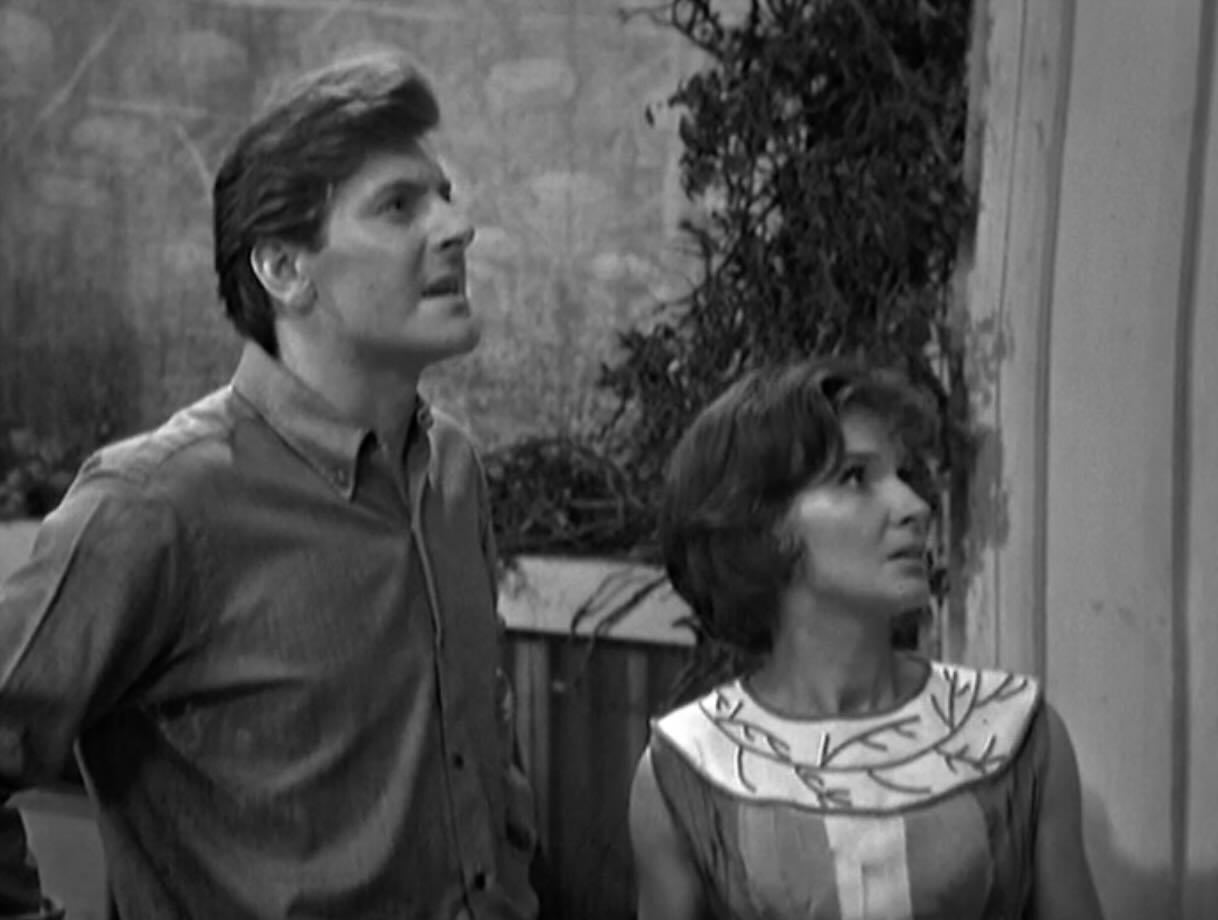
Companions: Peter Purves as Steven Taylor and Jackie Lane as Dodo Chaplet
Written by Paul Erickson and Lesley Scott. Directed by Michael Imison. Produced by John Wiles. Story Edited by Gerry Davis.
Format: 4 episodes, each about 25 minutes long
Originally Aired: March 1966 (Episodes 26-29 of Season 3). Individual episodes are known as The Steel Sky, The Plague, The Return and The Bomb

I have made several efforts to watch The Ark before, but I’ve never been able to get myself to fully pay attention all the way through. As a result the story had a reputation in my head for being kind of dull and uninteresting, which turns out to be somewhat true but not completely fair. Either way, it was sort of like I was coming into this serial for the first time, which is always fun.
Spoilers Ahead!
There are a bunch of notable things about The Ark, innovations that took place both in front of and behind the camera. Behind the camera the story was the first time the series made extensive, intentional use of the idea of taping things out of sequence. This was primarily in the last episode, The Bomb, especially to avoid unnecessary moving around of the large launcher prop. This of course is normal procedure in most productions over the decades, but for Doctor Who at the time it was a new approach. I’ve also read that it was the first time that forced perspective was employed to such a degree, presumably to create the illusion that the giant statue was as huge as it’s supposed to be.

All of this, I believe is to be credited to director Michael Imison. This is Imison’s only credit on Doctor Who and it was, from what I’ve read, not a project he enjoyed. But he does a good job with the serial–it certainly has its flaws but by-and-large the directing is not one of them. Overall there’s a smoothness to the visual presentation of everything–be it life on the Ark or on Refusis–that the show of this time period didn’t always deliver. The battle scenes are effectively edited, and I enjoyed the way the Ark’s internal visual communication screens were employed to tell the story.
The scripts for The Ark has also got something interesting going on, in terms of the structure. It’s not the first instance of time travel being used in the midst of the narrative, but it is the first time (and to my thinking, the only time) that it is used to form such a clear dividing line in the plot. The Ark is basically two stories linked only location and concept. The first two episodes tell the tale of the Doctor meeting the denizens of the Ark spaceship (as it comes to be known) in their centuries-long journey to their new home, and then saving them from a cold that is accidentally introduced to them via new companion Dodo Chaplet. At the end of the second part, the traveler’s say their farewells and leave, like was so often see them do…

…only to wind up back in the same place a moment later for them, but seven hundred years in the future! The revelation that the statue that was being built now depicts a Monoid makes for an effective cliffhanger. The story, however, is more typical humans vs. alien oppressors plot, as it turns out the Monoids, formerly servants of the humans, have risen up and taken over, and the whole ship is under the rule of the despotic Monoid leader known only as “One.”
In this structure there is a lot of potential for some interesting things, but unfortunately they are only somewhat taken advantage. The most obvious is the relationship between the Guardians (the humans) and the Monoids. There is a bit of work done in the first half with the idea that the Monoids were basically the Guardians’s slaves and that that helps to explaining their rebellion, but it is very lightly done. It’s really the story’s most compelling theme, but one could easily imagine the idea being totally missed by the audience until the Doctor actually talks about it in the last episode. Make no mistake, I was glad for its inclusion, but felt like it should have been a more significant part of the narrative.

If it had, it might have made the first half of the story more interesting. As it is, it’s mostly pre-occupied with world-building, which is interesting as far as it goes, but in terms of plot it’s a pretty slight effort. Maybe if there had been more of an exploration of the short-sightedness of the Guardians, it would have felt more meaningful? What little of that there is is more to do with the Guardian’s reaction to the TARDIS crew, rather than their treatment of the Monoids.
If all this had been better developed it could have made the story’s ending land more meaningfully, when the invisible and nigh-omnipotent and peace-loving Refusians (a very Star Trek-like alien race indeed) insist that the humans and the Monoids sort our their differences. It’s a cool idea but humanity’s share of the blame hasn’t been delved into as much as I would have liked.
Other interesting ideas that don’t go as far as they should include the idea that maybe the TARDIS crew have spread disease through time and space, as they inadvertently do here via Dodo’s cold. Also there’s the business with Maharis, the Guardian who eagerly returns to the Monoids even though he fully knows of their treachery, only to get immediately killed for his loyalty. That is genuinely interesting characterization there, but prior to his death it’s only something we hear about rather than see, and there is no effort to unpack any of the emotional or thematic implications of this little story beat.

I mean, this is early Doctor Who–there is barely time given to unpack anything–but the fact that there are hints to such mature ideas just makes me miss it all the more.
The Monoids themselves are kind of an “okay” alien race, as far as Doctor Who monsters go. Giving them them just one eye where the actor’s mouths were (the actors basically held the eye in their mouths), but as actual characters go they are pretty bland, and as villains they are not very bright, making all sorts of poor decisions that lead to their downfall. They talk in stilted dialogue, often announcing critical information unnecessarily, just for the benefit of the audience or the other characters who are listening in. “One” in particular is quite the over-the-top caricature of a bad guy, lacking any sort of subtlety or flair. You half expect him to start cackling madly–if he had a moustache he would certainly twirl it.

The most interesting Monoid to me, by far, is “Four”, the one turns against “One” and his mad plans. One of the most interesting but unexplored moments of the entire story is when “Four” drops his weapon after the Monoid civil war is over, effectively surrendering to the humans rather than continuing to fight. The story could really have stood to unpack him a bit more. I would have enjoyed seeing more of the their ideological differences, and so on.
Finally, some thoughts on the main cast.
This is Jackie Lane’s first full story as Dodo, after having debuted at the end of the last episode of the previous serial. She’s fine, I guess, but without anything going on to make her unique or memorable. She and Steven have got a bit of that brother-sister thing going on that I remember between Steven and Vicki in The Time Meddler (except now Steven is on the other side, as the experience traveler) but it’s nowhere near as dynamic or fun.

It’s hard of course to really judge these characters given how many of their episodes are missing, but it strikes me that Steven and Dodo might make for one of the least interesting companion ensembles in the show’s history. I mean, I’ve always liked Steven but he doesn’t have any particular character traits on display here, and nothing memorable going on with his relationship with either Dodo or the Doctor.
And this is a shame because it seems to me that there might not be another Doctor in the whole history of the show who really needs some interesting companions to play off as as much as William Hartnell’s original. You can see the effort to create cool moments of cleverness that we associate with the character in moments like his confrontation with the Monoids or his gentlemanly conversation with the Refusians, but there is a clunkiness to Hartnell’s delivery that undermines this.

All respect to William Hartnell–the guy will always be the original Doctor to me, no matter how many times he is recast or how many incarnations are squeezed earlier in the character’s timeline–but here I feel like you can see the show moving toward something that would really benefit from the kind of leading man confidence that almost every actor to take the part afterwards displayed in spades (and which Hartnell himself sometimes did as well, see The Rescue for instance.
Other Thoughts:
• Though Lesley Scott makes history here as the first woman to be credited as a writer on Doctor Who, she didn’t actually do any work on the scripts, the internet tells me. She was writer Paul Erickson’s wife at the time and her credit came out of personal circumstances that Erickson didn’t disclose.
• The end of The Plague (part two) has the earth being destroyed! It’s dies in a pretty dramatic fireball. Cool stuff.
• In episode four, there is a very brief moment between Steven Taylor and Vanussa which almost implies a bit of romance between them. It goes nowhere of course, but it might have been an interesting thing to include, just to give Steven a bit more character to play with.

• What is going on with Maharis? The collaborator Guardian becomes fully aware of the Monoids’ intentions to leave him behind and kill all the humans in part three, but when we next see him in part four he’s convinced that they’ll spare him and let him serve them on Refusis. If we’re going to take the character on that kind of arc, it would have been nice to try to make sense of it.
• The end of the story features a little lead-in teaser for the next story, The Celestial Toymaker, which starts with the Doctor suddenly turning invisible. Dodo wonders if it’s something to do with the Refusians. Of course it’s not, but that’s a little continuity detail that I think makes a lot of sense in these circumstances, and I appreciate it.
• There are also continuity references to the Daleks, Nero, and the Trojan Wars, which is nice. It seems the Daleks don’t much of a legacy when you get to the 57th segment of time.
• There’s an actual elephant in this story! Apparently her name was Monica.

Is this the only time the show featured a live elephant? [Does some quick searching]. Possibly there is an elephant in Terror of the Autons, in the circus scenes, I’m not sure (there is an uncredited character referred to as “Man with elephants”, and there is definitely one in Thin Ice and the teaser that leads into it at the end of Smile. My cursory internet search doesn’t reveal any of these other elephant’s names.
Agen234
Agen234
Agen234
Berita Terkini
Artikel Terbaru
Berita Terbaru
Penerbangan
Berita Politik
Berita Politik
Software
Software Download
Download Aplikasi
Berita Terkini
News
Jasa PBN
Jasa Artikel
Situs berita olahraga khusus sepak bola adalah platform digital yang fokus menyajikan informasi, berita, dan analisis terkait dunia sepak bola. Sering menyajikan liputan mendalam tentang liga-liga utama dunia seperti Liga Inggris, La Liga, Serie A, Bundesliga, dan kompetisi internasional seperti Liga Champions serta Piala Dunia. Anda juga bisa menemukan opini ahli, highlight video, hingga berita terkini mengenai perkembangan dalam sepak bola.