films to be watched over this year (and almost certainly beyond). You can read the rationale and ground rules here. In the meantime, we are advancing from 1935 to 1936 with this movie, #14 in this series.
As I’ve been proceeding along on this series, one of the years I’ve been looking forward to getting to has been 1936, so that I could get to this movie, a bit of a notable example of early science fiction filmmaking. Based on a novel by H.G. Wells, Things to Come‘s screenplay was actually actually written by Wells himself, although reports say it was challenging to turn it inro something with sufficient dramatic interest to actually work as a film.
Spoilers Ahead
Things To Come (1936)
Directed by William Cameron Menzies.
The Story: A cataclysmic global war and is subsequent devastating plague reduce the world to a primitive shell of its former self. Out of this, a new age of enlightenment rises up, focusing on scientific and social progress and doing away with nationalistic borders or ideologies. After this continues for several generations, a new conflict arises, over the wisdom of sending young people into space. People opposed feel that scientific progress needs to be curtailed, but in the end they are defeated and the ideals of continual advancement and growth for the human race prevails.

Starring: Raymond Massey as John Cabal, a pilot and survivor of the war, and later one of the founding architects of the eventual utopia that humanity develops into. Massey also plays Oswald Cabal, a descendent of John who continues to lead the newfound world order. Edward Chapman is Pippa Passworthy and his descendent Raymond Passworthy, both friends of the two Cabals. Ralph Richardson is Rudolf, aka “the Boss”, a warlord who rises up out of the ashes of the initial war. Margaretta Scott is the Boss’ consort Roxana. Maurice Braddell is Dr. Hardin, Cabal’s friend and a survivor of the war. Ann Todd is Harding’s daughter Ann, and Derrick De Marney is Ann’s husband Richard, who helps John Cabal defeat the Boss. Cedric Hardwick plays Theotocopulos, a member of the future society who opposes the continual pursuit of advancement and progress.
Comments: Things to Come begins with an extended montage of a country preparing for war, or perhaps more accurately, preparing its people for war. The innocent optimism of “Everytown”(basically, London) at Christmastime, is contrasted with newspaper headlines and other media outlets announcing war as an inevitability. Conversations between our initial set of characters highlight the different points of view people have about this. The blindly optimistic Passworthy feels it’s all a storm in a teacup–the war that is threatened is too terrible to actually happen. Meanwhile the more dour and world-weary John Cabal knows that it is coming, and that it’s basically the end of civilisation as they know it.

All of this feels very foreboding and prescient, especially when you remember that this movie came out a couple of years before the outbreak of World War II. Real countries like German and England are never mentioned, but it’s pretty clear that film is looking ahead to the conflict that was coming in real life. In the world of the film, the war starts in 1940, only a little later than it started in the real world.
The bigger difference is that the war in the movie goes on for a couple of decades. And when civilisation has basically descended into a kind of medieval feudalism, things get even worse due to an outbreak of a creepy “walking disease” (victims lose their minds and start walking around randomly before they die, which results in the disease spreading more aggressively). One pragmatic leader starts to just shoot the victims dead before they can do this, and only with these more heartless approach is the disease finally controlled. But a result, that leader rises to become a warlord in absolute control of his little area, enjoying the perks of power while pushing his people to continue to prepare for war, though now against some generic “hill people”.

This is the part of the movie I found the most engaging, and Ralph Richardson’s performance as the “Boss” was one of the movie’s most interesting. For a good chunk of the film, the film is about the efforts of the world-weary Dr. Harding, his daughter Ann, and her husband Richard, and their efforts to survive the Boss’s insistence that somehow their dilapidated airplanes be made air-worthy again, to ensure military victory against their enemies.
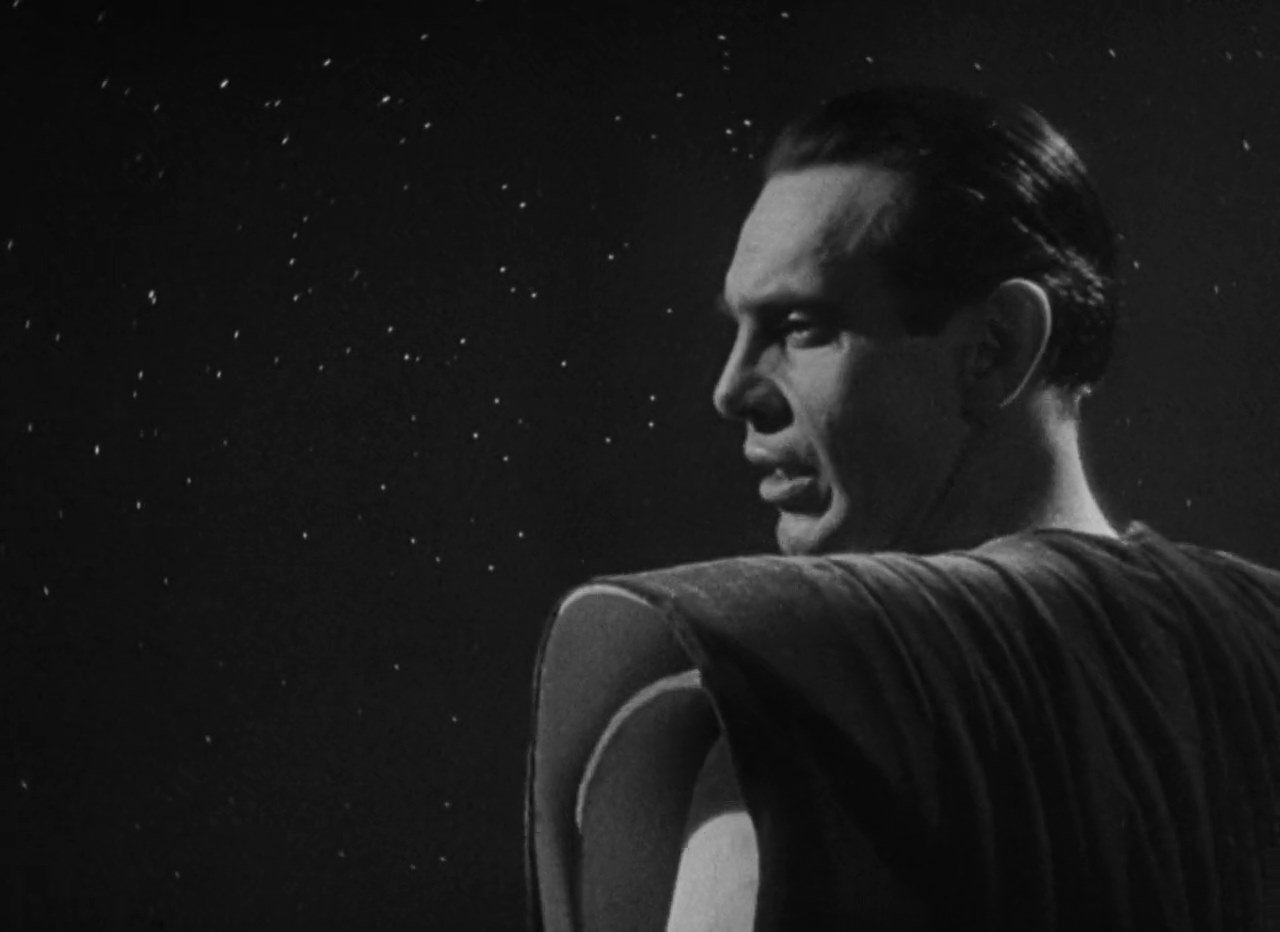
Into all this arrives an advanced airplane with a solitary passenger, looking very much like a cheesy science fiction alien, and largely undermining the gritty realism of the movie’s design up until that point.

But this guy isn’t an alien, it’s actually John Cabal, looking much older but with a message that a new world order has risen up, led by scientists and engineers who have had enough of war and nationalistic ideologies.
That doesn’t sit well with the Boss, unsurprisingly, so he arrests Cabal to use his scientific knowledge to get his planes in order. In the end, his efforts are for naught, as Richard and the others get to Cabal’s people and help them to come to their rescue, an act which involves dousing everyone with the “gas of peace”, a concoction which knocks most people unconscious, but has the unexpected side effect of killing the Boss (I’ve read it’s supposed to be an allergic reaction, but it’s not specified in the dialogue).

If all this sounds a little dystopian, I’d say it’s because it is. Cabal and his people have obviously good intentions, but they brook no dissent when it comes to establishing their political structure over every part of the planet. But the movie treats all this as basically completely positive, or at least the best alternative out there. The Boss is an immediate threat to them because he took Cabal prisoner, but there’s no sense that they were ever just willing to let him keep his little territory and do his own thing. I found the whole thing kind of creepy.
The novel that all this is based on, The Shape of Things to Come, is apparently even more overt and detailed about this. It describes how different major religious blocs–Islam, Judaism, Catholicism, etc–were all eventually wiped out by the new world government, a necessary step for the establishment of the new way of things.

Again, I found all of this pretty interesting, and I think I would have preferred it if this section had been expanded out until the end of the film. There are some interesting dynamics brought up in the conflict between the Boss and Cabal that aren’t developed as far as I would have liked. Particularly the Boss’ consort (or wife, or whatever, it’s not clear) Roxana, has got a bit of a thing for Cabal, or at least sees him as someone to hitch her wagon to. At the same time, the Boss is more than little lascivious in the way he talks to Ann…something she appears to be kind of into now and again.

But all of this is dropped at the same time that the gas of peace is deployed, which as I say I thought was a bit of pity.
Instead, the film saves its last third to take us a century into the future, to show us how it all works out. The focus of this part of the movie’s tension is whether or not reactionary voices who feel that progress has gone too far will stop the launch of two young people into orbit via a space gun. It all comes to a head when a huge mob charges the launch pad to destroy the gun, while a descendant of Cabal (again played by Raymond Massey) and the pilots (the Cabal’s daughter, and the son of his friend, a descendant of the original Passworthy) attempt to launch pre-emptively, before proper testing is completed. In the end, progress wins out and all the opposition are apparently killed in the backlash of the launch.


Then the final moments are devoted to a conversation between Cabal and Passworthy about whether what they’ve done is a good thing. Passworthy worries for the sake of the children, saying “Oh God, is there never to be any age of happiness? Is there never to be any rest?” To this Cabal gets to espouse the movie’s whole philosophy: “Rest enough for the individual man. Too much and too soon, and we call it death. But for Man, no rest and no ending. He must go on, conquest beyond conquest. First this little planet and its winds and ways. And then all the laws of mind and matter that restrain him. Then the planets bout him…and at last, our across immensity to the stars. And when he has conquered all the deeps of Space, and all the mysteries of Time, still he be beginning.”

It’s all very Star Trek, isn’t it? It almost sounds like something Patrick Stewart could have said in an episode of Next Generation. Of course, it all came long before, but like many of the old science fiction films I’ve seen, you can see the roots of some of stuff I grew up with.
At the same time, I didn’t really like it. As I said, the philosophy is not something I can bring myself to agree with. Basically you could sum it up by saying we have good ideas, and if you disagree we are going to overwhelm you either into compliance or out of existence (kind of like if the Federation of Star Trek was a lot more aggressive than it typically is). Cabal’s declaration that all that ultimately matters is the survival and advancement of human society certainly makes me uncomfortable. It’s kind of the same as saying the most important thing is the well-being of the State, right? Certainly, we’ve seem some pretty unpleasant applications of that idea in the decades since the film was made.

Whether you agree about that or not, the movie’s presentation of its point of view, especially when we get to the future is at best overwrought and heavy-handed, which makes it tiresome. But at the same time, at least the movie has a point of view, and it certainly takes us on a journey exploring that perspective. This means that even with its weaknesses, there is always interest in seeing how it’s going to unfold. And this is especially true when you remember how ambitious and innovative it is as an early work of cinematic science fiction.
Agen234
Agen234
Agen234
Berita Terkini
Artikel Terbaru
Berita Terbaru
Penerbangan
Berita Politik
Berita Politik
Software
Software Download
Download Aplikasi
Berita Terkini
News
Jasa PBN
Jasa Artikel
Situs berita olahraga khusus sepak bola adalah platform digital yang fokus menyajikan informasi, berita, dan analisis terkait dunia sepak bola. Sering menyajikan liputan mendalam tentang liga-liga utama dunia seperti Liga Inggris, La Liga, Serie A, Bundesliga, dan kompetisi internasional seperti Liga Champions serta Piala Dunia. Anda juga bisa menemukan opini ahli, highlight video, hingga berita terkini mengenai perkembangan dalam sepak bola.