Doctor Who has long been my favorite show, but it’s been a couple of years since I’ve actually watched anything but the newest episodes. Before that, I was making a respectable run at getting through the original series, most of which I haven’t seen for decades. For various reasons, lately it has felt like it’s time to get back into it.
The Seeds of Doom
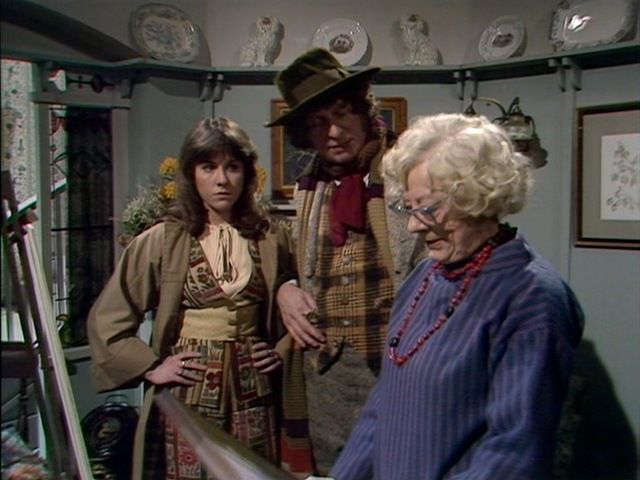
Starring Tom Baker as the Fourth Doctor.
Companion: Elisabeth Sladen as Sarah-Jane Smith
Written by Robert Banks Stewart. Directed by Douglas Canfield. Produced by Philip Hinchcliffe. Script Edited by Robert Holmes.
Format: 6 episodes, each about 25 minutes long
Originally Aired: January – March 1976 (Episodes 21-26 of Season 13)

I have a memory which I cannot find any reference for that a writer on Doctor Who was struggling with a serial’s six episode structure, and they received the advice to write a traditional four-parter, and then add another related two-parter to it. I don’t know if this is a true story, but if it is, The Seeds of Doom seems as likely a story for it to be about as any other. With the first two parts taking place at an Antarctic research station, and the remaining four leaving that location behind, it perhaps fits this bill better than any other serial in the show’s history (the other major contender is The Invasion of Time, which I haven’t rewatched yet).
Spoilers Ahead!
There is a lot about The Seeds of Doom which is absolutely top-notch. It’s an exciting adventure with strong performances and characterization. There is good production design and a lot about the story which is as legitimately horrifying as anything else the show has ever produced. But for all of that there is a way that the serial leaves me feeling strangely detached and cold.

I think my reaction stems from the story’s apparent flippancy with some of the character’s deaths, or indeed most of the characters’ deaths. I’m talking about people like Richard Dunbar (the World Ecology Bureau guy selling out information to Harrison Chase), Moberley (the first of the Antarctic researchers to get killed), or Sergeant Henderson (the UNIT soldier who accompanies the Doctor back to Chase’s estate)–they all have deaths that are purposeful, that show how threatening things are. And yet, they are all quickly forgotten about once those purposes are fulfilled. It’s even worse with Stevenson, the last surviving researcher–he seems to be killed off simply so the story doesn’t have to deal with him as it shifts its focus from the Antarctic to Harrison Chase’s house in England.

Scorby is another interesting case. He’s a character that could have been bland and one-dimensional–the main bad guy’s muscle and a secondary antagonist. But the story does a lot more with him and actor John Challis delivers an impressively detailed performance. He makes for an effective foil for Sarah Jane for much of the story, and ultimately dies when he loses his nerve and panics. And his death highlights how dangerous the Krynoid is with its ability to control all plant life, and its genuinely terrifying seeing him get dragged to his death by a bunch of living vines.
And yet, and yet, there is a way that it all feels kind of pointless. Like, why have him in the story for so long, why do all that work with him, if in the end we were just going to kill him off so pointlessly? I have no idea what I would have liked to have happened instead, but I can’t get away from the idea that there is wasted potential here.

I don’t know, maybe this isn’t any different than Doctor Who often is. It’s actually far better than you get in some stories–see Earthshock for instance, or Attack of the Cybermen–where characters die literally because the plot has run out of things for them to do. And I don’t feel this way about poor Arnold Keeler, the hapless scientist who turns into the second Krynoid, or about Harrison Chase himself, the insane plant-enthusiast who is ready to sacrifice all animal life for the glory of his beloved plants.
Maybe the issue is that the story itself can be stripped down to just a few components and still be made to work. All you really need is a scientist to find the pod, Keeler to go get the pod, and UNIT to ultimately blow up the pod, with Harrison Chase acting as the villain behind it all. Everything else, even the Doctor and Sarah, is just elaborate window dressing.

It is has been said, actually, that this is a story where the Doctor doesn’t really effect the plot at all, except for making things worse by finding the second pod in the first place. This is of course overstating things–it’s the Doctor who alerts UNIT to the problem and who gets them to move in with their air strike. But it is worth noting how little the Doctor ends up impacting things, which might go part of the way to explaining my feeling of the story’s emotional emptiness.
But with all this guarded negativity, I have to return to my initial statement that overall, The Seeds of Doom is an excellent production. In spite of the somewhat discardable nature of a lot of the plot, the individual scenes and episodes are tightly written. The normally dodgy CSO effect is used quite well to create the illusion of the gigantic Krynoid monster.

And in amongst all the generally good performances, one has to really appreciate Tony Beckley as the utterly insane Harrison Chase. Doctor Who has featured a lot of insane villains over the years, but Chase is on another level–even before he becomes infected with alien plants, he’s as unhinged as they come.
Elisabeth Sladen is as good as she typically is here as Sarah Jane, demonstrating the courage and characterization that makes her as one of the show’s most popular companions. Tom Baker is mostly good, just as usual. He’s got the confident swagger that always made him so endearing, but occasionally he lapses into that “loud and enraged” mode that he occasionally finds into that I never found as convincing. This story’s depiction of the Doctor is particularly action heavy–he leaps in, he punches people, and at one point he even looks like he breaks a guy’s neck (although it’s shown not to be lethal). The Doctor also wields more than one gun over the course of the story–there is definitely something odd about seeing that, although it helps that the script goes out of its way to point out he would never use them.

Incidentally, I read somewhere in a commentary on this episode it had an Avengers script rather than a Doctor Who script. With all of the spy-style action (ie the Doctor and Sarah Jane escaping from a murderous chauffeur) I can see the what they were getting at, but I also suppose that whoever said that was thinking of The Man-Eater of Surrey Green, an episode of The Avengers that Robert Banks Stewart also wrote, and which also featured a murderous plant.
Other Thoughts
• This was the last story in which UNIT played any significant role in the action until season 26’s Battlefield. It is the first UNIT story not to include any of the UNIT regulars story. Apparently this was considered, but dropped. It would have been cool to have seen Sergeant Benton take Sergeant Henderson’s place, providing the character didn’t end up dying the same way.
Agen234
Agen234
Agen234
Berita Terkini
Artikel Terbaru
Berita Terbaru
Penerbangan
Berita Politik
Berita Politik
Software
Software Download
Download Aplikasi
Berita Terkini
News
Jasa PBN
Jasa Artikel
Situs berita olahraga khusus sepak bola adalah platform digital yang fokus menyajikan informasi, berita, dan analisis terkait dunia sepak bola. Sering menyajikan liputan mendalam tentang liga-liga utama dunia seperti Liga Inggris, La Liga, Serie A, Bundesliga, dan kompetisi internasional seperti Liga Champions serta Piala Dunia. Anda juga bisa menemukan opini ahli, highlight video, hingga berita terkini mengenai perkembangan dalam sepak bola.