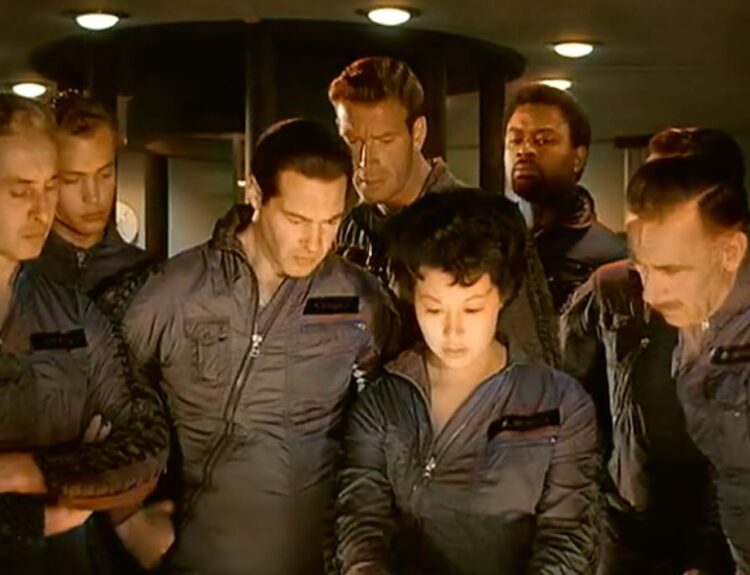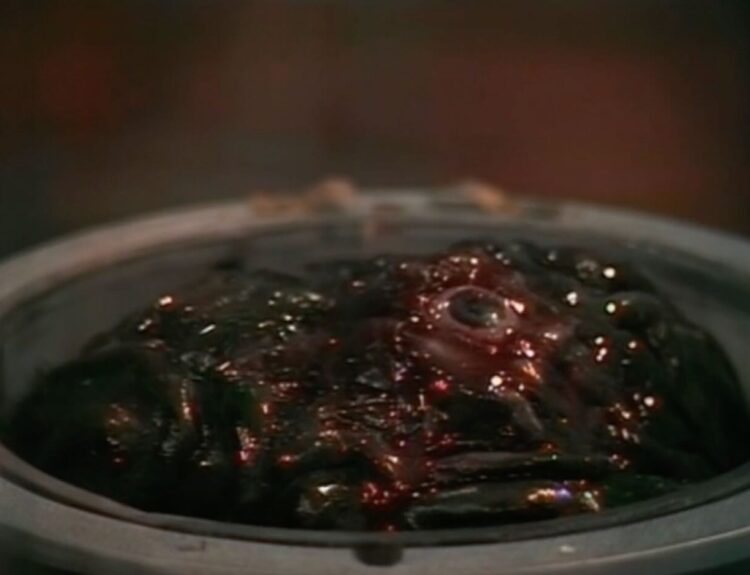
Doctor Who has long been my favorite show, but my actual viewing it over the years has been very on-again / off-again. Lately, it’s been all-on, as I’m actually closing in on finishing re-watching all of the classic episodes (at least the ones that are easily available for me to stream), whilst blogging about each serial.
Terror of the Zygons
Starring Tom Baker as the Fourth Doctor.
Companions: Elisabeth Sladen as Sarah Jane Smith and Ian Marter as Harry Sullivan.
Recurring Characters: Nicholas Courtney as Brigadier Lethbridge-Stewart and John Levene as RSM Benton.
Written by Robert Banks Stewart. Directed by Douglas Camfield. Produced by Philip Hinchcliffe. Script Edited by Robert Holmes
Format: 4 episodes, each about 25 minutes long
Originally Aired: August – September 1975 (Episodes 1-4 of Season 13)

Terror of the Zygons is one a story from the midst of perhaps the most celebrated time in classic Doctor Who history. With Tom Baker starring, Elisabeth Sladen co-starring (along with Ian Marter), Philip Hinchcliffe producing and Robert Holmes script editing, we had the creative line-up that for many years was kind of the automatic go-to mental image when people were thinking of this show. It also features monster that I thought for years was deserving of a comeback, which is something that finally occurred over 38 years later with The Day of the Doctor.
Spoilers Ahead!
I have read somewhere that Terror of the Zygons was originally written a six-part story that was to close out season 12. When shifting production schedules made it desirable to do so it was moved to open season 13, and was condensed down to its present form by Robert Homes without losing any significant storylines. I have no idea how that original script read but it’s hard to argue with the results–the Terror of the Zygons that we got is a great story–well paced and well directed that makes good use of all the regulars and semi-regulars. And with both the Brigadier and Benton along for the ride, there are a fair number of regulars or semi-regulars to make use of.

It’s funny seeing a UNIT story in which Jon Pertwee is not playing the Doctor (or that is not being produced by Barry Letts), because the Fourth Doctor’s relationship with these guys is so different than the Third. As portrayed by Tom Baker, the Doctor is still interested in saving lives and stopping the monster, but his attitude toward being summoned back by to earth, even for an emergency, is more to be annoyed than anything else. This Doctor is not coming back home when returns to earth, he’s coming in as an outsider, a superstar special guest who has been brought in to save the day. We’ll see the same vibe in the modern series, especially with Peter Capaldi.
And he’s not come alone. His companions, Sarah and Harry arrive with that same feeling of being specialist agents who are here to lend their skills in an emergency. It’s quite a different feeling to how it was with Jo or even Sarah back with the Third Doctor.

And it’s a dynamic that I really enjoy. It’s great to see both of them slip into their professional roles as soon as they are back on earth, with Sarah investigating and Harry doctoring–I really appreciate that the story remembers these bits of characterization, and I actually wish that we could have had more of it. I always liked the Fourth Doctor-Sarah Jane-Harry trio, but to have them doing their thing on earth, as a seasoned team–that’s something special.
And these guys feel like they really like each other. I like the gag at the start of with the Doctor wearing some traditional Scottish garb, while his companions don the iconic parts of his wardrobe that he’s otherwise left behind–Sarah is wearing his hat and Harry his scarf. It’s really fun, and also helpful to keep the Doctor likeable in the face of the much cooler relationship he has with the Brigadier than his predecessor did (both of his predecessors, actually).

I also enjoy seeing both the Brigadier and Benton, although the shift in tone that I’ve mentioned makes them both feel like returning guest stars than part of regular family.
None of this would make Terror of the Zygons a good serial if there wasn’t good plot and concept backing it all up, but fortunately as I’ve said, all of that works well. There is a good sense of dread provided by the mystery of whatever is destroying the oil refineries (in scenes that are very reminiscent to me of The Beast from 20,000 Fathoms) and I like how the script takes its time revealing new information about the Zygons themselves, particularly their ability to impersonate people. And I like how the Zygons are actually vulnerable to things like bullets.

They are definitely villains, and deeply threatening, but they aren’t unstoppable killing machines like the Daleks or the Cybermen tend to be. This has the side effect of making them a bit more sympathetic than many Doctor Who monsters, and so it’s not surprising that this angle has been played up a lot in their modern appearances.
The design work of the Zygons is also phenomenal. Visualised largely by James Acheson (who also put together the basic look for the Fourth Doctor), the Zygons are amongst the most effective looking creatures that I can ever remember seeing on Doctor Who. Of course they are humanoid, but the bizarre shape of their whole bodies combined with their sucker-covered skin and gurgling voices really sell the idea of alien like almost nothing else.

And the fact that their ship and technology all look like them is just a stroke of genius.

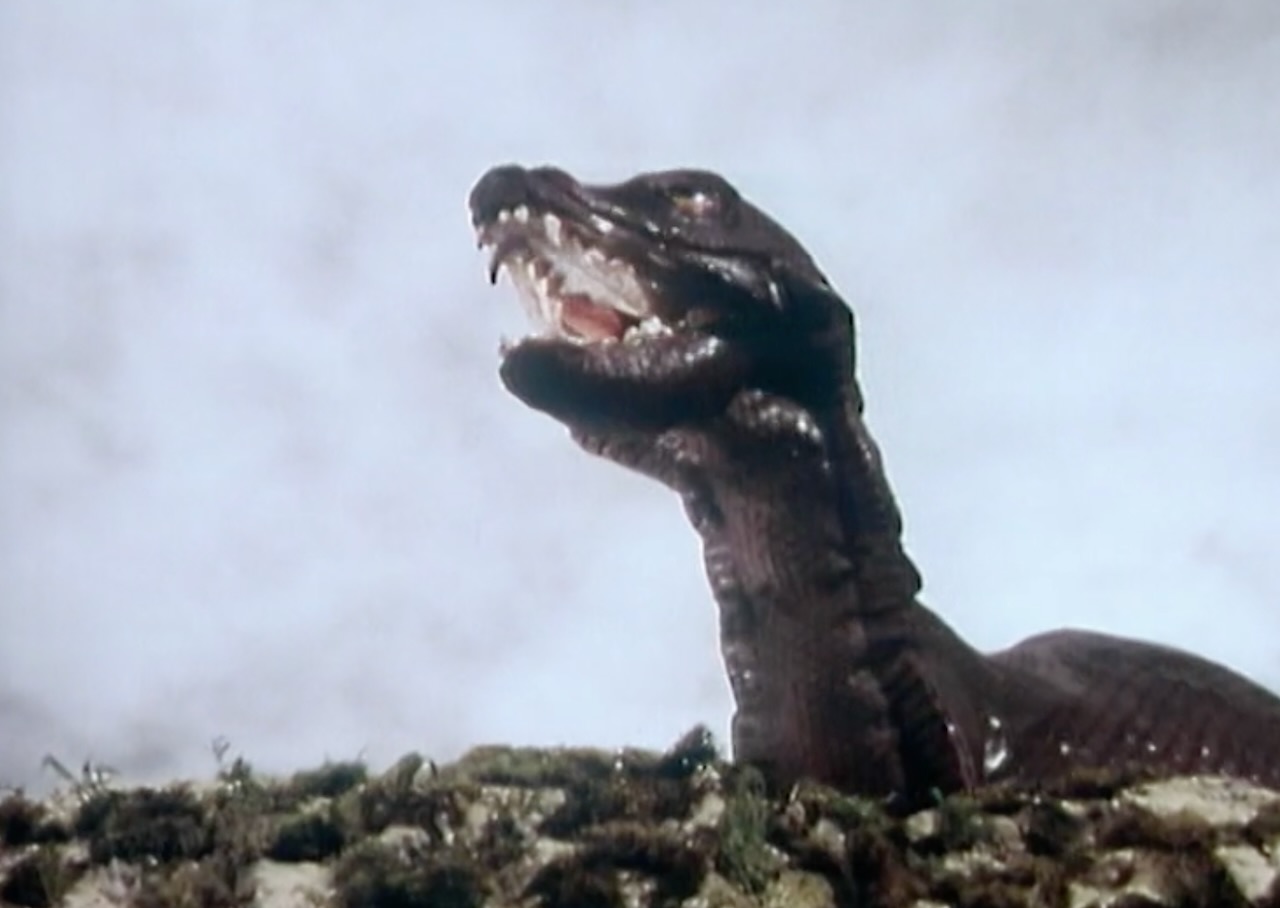
The Skarasen (aka the Loch Ness Monster) is less successful, and wisely the story keeps its on-screen appearances to a minimum.

This leads to one of the few disappointing aspects of the plot, as the Doctor’s solution for dealing with it (where he just feeds it the tracker its been following) makes for an underwhelming finale.
Also underwhelming is the departure of Harry Sullivan from the regular cast. He just matter-of-factly decides not to go with the Doctor and Sarah anymore, an event that is so flippant in its delivery that a casual viewer might not even know anything important was going on.

Harry will appear again in one more serial as basically a UNIT guest star (like the Brigadier and Benton are here), The Android Invasion. I haven’t rewatched that one yet but if memory serves there’s nothing there that adds to his departure here.
This is also the last story to feature Nicholas Courtney as the Brigadier for quite a few years, which is as much a sign as anything that the show was shifting its focus. He’s solid here as a character that he’s played for the ninth season in a row (I don’t think anyone else has matched that record, before or since) but there’s nothing special or celebratory about his part in the story. It’s nice that in his case we have later appearances in Mawdryn Undead and Battlefield to help make up for it.
This is also the second-to-last appearance in the show of John Levene as Benton.

I’ll see how The Android Invasion treats him, but even if there’s nothing notable there, he ends up having quite a good role through Terror of the Autons, getting to be in the heart of some of the military action and even getting to save the Doctor and Sarah at one point. In rewatching the show I’ve come to realize what a good job John Levene generally did with his limited scenes as the reliable everyman.
Anyway, in spite of a few weak spots, Terror of the Zygons is a strong outing for the series, and a clear demonstration of the kind of show of the thing the production team were going after now. It’s the beginning of an overall very strong season, which is notable to me in that it features zero returning monsters or villains, which is not the last time that this was the case, but almost. This was a time of great creativity for the Doctor Who, and Terror of the Zygons holds its head up high as worthy part of that.

Other Thoughts
• I didn’t mention this before but I have heard from time to time criticism of this story for being pretty stereotypical in its representation of Scottish characters. I don’t know enough to say whether that’s true, although I do note that the story begins with one character talking about haggis, and ends with another one equating being Scottish with being stingy.
• As a testament to how innovative this era of Doctor Who was, it’s worth remembering that two of its contributions to the series (Zygons and Sutekh) have been part of major events in the revival era, and that another story, The Brain of Morbius, has been mined pretty extensively for story elements (the Sisterhood of Karn and the all of the supposed pre-Hartnell incarnations of the Doctor) that have played a role in other modern day stories.
• John Woodnutt, who is this story’s main guest star as both Broton and the Duke of Forgill, has a long history with Doctor Who. He was George Hibbert in Spearhead from Space, the Draconian emperor in Frontier in Space, and Seron in The Keeper of Kraken.
• Angus Lennie (Angus MacRanald) also appeared as Storr in The Ice Warriors. He also played Ives, the “Mole”, in The Great Escape, one of my favorite movies.

• As a bit of trivia, I’ve recently written commentaries on Time-Flight and the movie The Beast from 20,000 Fathoms. Both of these also featured actors who appeared in The Great Escape (Nigel Stock and Lawrence Montaigne). What’s next? Maybe it’ll end up being The Web Planet, which is my only remaining First Doctor story easily available to stream…that has William Russell in it, who is in The Great Escape too.
EDITED TO ADD:
• I just spun some random numbers to find out what story I’m going to watch next, and it indeed came up with The Web Planet! So yes, another connection to The Great Escape!
PakarPBN
A Private Blog Network (PBN) is a collection of websites that are controlled by a single individual or organization and used primarily to build backlinks to a “money site” in order to influence its ranking in search engines such as Google. The core idea behind a PBN is based on the importance of backlinks in Google’s ranking algorithm. Since Google views backlinks as signals of authority and trust, some website owners attempt to artificially create these signals through a controlled network of sites.
In a typical PBN setup, the owner acquires expired or aged domains that already have existing authority, backlinks, and history. These domains are rebuilt with new content and hosted separately, often using different IP addresses, hosting providers, themes, and ownership details to make them appear unrelated. Within the content published on these sites, links are strategically placed that point to the main website the owner wants to rank higher. By doing this, the owner attempts to pass link equity (also known as “link juice”) from the PBN sites to the target website.
The purpose of a PBN is to give the impression that the target website is naturally earning links from multiple independent sources. If done effectively, this can temporarily improve keyword rankings, increase organic visibility, and drive more traffic from search results.