As mentioned previously, in “Impossible Voyages” I’m watching and writing about a run of new (to me) science fiction films to be watched over last year, which has extended to this year (2026). You can read the rationale and ground rules here. In the meantime, we are advancing from 1952 to 1953 with this movie, #31 in this series.
Picking up in quality after the emptiness of our 1952 choice, The Beast from 20,000 Fathoms sounds like something that might be riffed about on Mystery Science Theatre 3000, but it’s actually an intelligent and thoughtful monster-thriller. It’s not the first movie to ever feature a giant creature (King Kong, for instance, came out almost 20 years earlier) but it did kickstart a new wave of atomic-powered monster films, that no doubt we’ll end up revisiting as I proceed through the years.

Spoilers Ahead
The Beast from 20,000 Fathoms (1953)
Directed by Eugène Lourié
The Story: In the wake of an atomic experiment in the Arctic Circle, Professor Tom Nesbitt witnesses a prehistoric dinosaur that has newly emerged from the ice. At first, nobody believes him, but soon the fearsome predator (a “Rhedosaurus”) is causing chaos along a path that leads it to New York City. Nesbitt investigates the Rhedosaurus’ movement with the help of the noted palaeontologist Professor Thurgood Elson and Elson’s assistant Lee Hunter, but Elson is in an attempt to find out more information about it. The battle against the dinosaur is complicated by the fact that the creature’s blood carries an ancient disease that kills humans it come in contact with. To destroy it, a radioactive isotope is fired into the creature through a wound, which burns it up from the inside.

Starring: Paul Christian as Tom Nesbitt, Paula Raymond as Lee Hunter (who becomes Tom’s love interest), and Cecil Kellaway as Thurgood Elson. Kenneth Tobey and Donald Woods play two military commanders (army Colonel Jack Evans and coast guard Captain Phil Jackson) who help lead the response against the Rhedosaurus. Lee Van Cleef plays Corporal Stone, the sharpshooter who actually takes the shot that eventually kills the monster.
Technical effects (ie stop-motion animation) is by the legendary Ray Harryhausen. The script is co-written by Fred Freiberger, the oft-maligned producer of the third season of the original Star Trek. The whole thing is based on a short story by Ray Bradbury.

Comments: My “Impossible Voyages” series has brought me to more than a few monster movies, but none have been on such a scale as The Beast from 20,000 Fathoms. The only contender would be The Lost World from 1925, but Beast exceeds that at creating an immersive experience even if just for the fact that now it includes sound. But there’s more than that worth talking about with our current outing, and a lot of that is to be credited to the special effects wizardry of Ray Harryhausen, who here takes hi first leading role in the stop-motion animation for a major movie. There is so much impressive detail that goes into the Rhedosaurus (a completely fictional dinosaur), especially when it’s roaming down the streets of New York City.

Actually, part of what makes the movie work is the fact that our views of the dinosaur are a bit limited prior to the New York attack in the latter this of the story. The movie threatens to be a little slow during the build-up, but I like the fact that it doesn’t give us long-scenes showcasing the creature before this. We see it, of course, roaming around in the snow, attacking a lighthouse and about to kill one of the supporting characters (who seems weirdly oblivious to how much danger he is in), but it’s not until it crawls out of the water and start walking up the streets of Manhattan that it’s fully shown off, and we get to see it actually eat someone.
That someone is a particularly over-confident police officer who decides to hold his ground, shooting his little pistol at the leviathan that is laying waste to the city and sending its inhabitants fleeing in a panic.

He does not last long, and his death is particularly gruesome, for the time anyway. There’s no blood of course, but that’s definitely half of his body sticking out of the dinosaur’s mouth.

Harryhausen delivers impressive detail to the Rhedosaurus and its rampage, which gives the whole back half of the film a harrowing feel that makes it worth the wait.
As far as the rest of the story is concerned, it’s fine for what it is. Lead actors Paul Christian and Paula Raymond are not the most engaging personalities I’ve seen on film, but I believe them as intelligent people trying to overcome the skepticism around them. The process of their investigation makes sense and the way that they end up falling in love is also plausible.

The fact that movie is willing to kill off the likeable Professor Elsen mid-way through things shows us that the movie means business with its story as well.

Story-wise I enjoy how this movie is different from what we saw in The Lost World (or in King Kong, for that matter)–it’s not about finding a monster in its natural (and savage) habitat and then foolishly transplanting it to human society only for it to escape. Instead, this is a film about a monster that is making its way to the world of man and there is precious little anyone can do to stop it. In this way, The Beast from 20,000 Fathoms less anticipates something like Jurassic Park as it does Godzilla–the monster is out there, we woke it up and now there is hell to pay.

There is a plot development in the last act in which it’s revealed that the Rhedosaurus’ blood carries a disease that is deadly to humans. This ups the tension for sure, but at the same time it’s such a huge idea that I feel gets glossed over pretty quickly. We never deal with whether it’s contagious beyond those who are initially exposed, what it exactly does to them, do they all die, or anything like that. So in the end it really just an excuse for why the military can’t just blow the dinosaur to kingdom come.

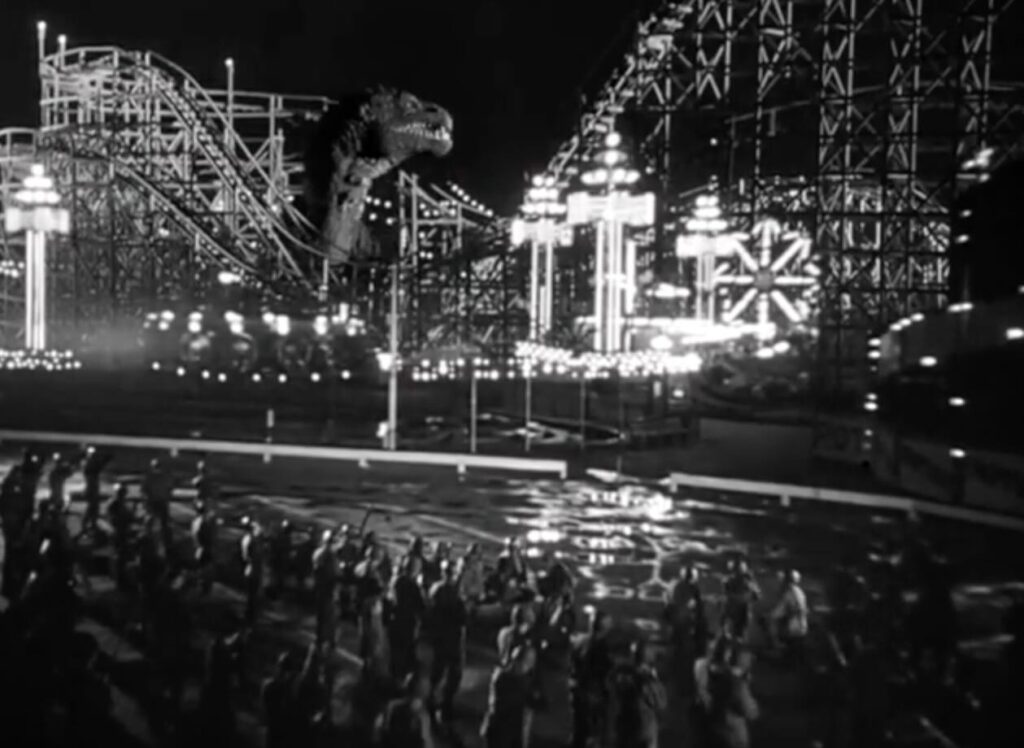
This brings me to one of the coolest things in the film, which the presence of the character Corporal Stone, played by the legendary Lee Van Cleef (best known to me from For a Few Dollars More and The Good, the Bad and the Ugly). Stone is the sharpshooter who has to deliver the shot that will kill the dinosaur, and thus he’s there alongside of Nesbitt during the climax, having to perch on top of a rollercoaster at Coney Island and then to escape before the whole thing is enveloped in flames.
It’s a great set piece that could have been directed with a bit more urgency, but is elevated by how impressive the visuals are of the Rhedosaurus raging amongst the attraction at night (particularly when its on fire) but also by how much personality Lee Van Cleef brings to his role.

Corporal Stone is not in the movie a lot, and only has a handful of lines of dialogue, but this guy carries himself with such impressive bearing that I only wish he had been in it more and that the climax had been drawn out a little more.

I can’t quite bring myself to call The Beast from 20,000 Fathoms a great movie. The characterisations and performances are mostly routine, and there are parts of the story that drag and some of the pacing seems a little off (there is a lot of gravitas around the initial atomic experiment, for instance, and though that is what apparently wakes up the monster, it doesn’t really have as much to do with the story as it seems like it’s going to). But there is a lot here to appreciate, and in general the whole film is a worthy pioneer in its genre.
Other Thoughts
• Amongst the uncredited minor cast of this movie is Lawrence Montaigne as a soldier–he was Haynes (“Diversions”) in The Great Escape, and played both a Romulan (in Balance of Terror) and a Vulcan (in Amok Time) in the original Star Trek.
• Also James Best plays Charlie, a radar operator, right at the start. He was Sheriff Rosco P. Coltrane in The Dukes of Hazzard.
PakarPBN
A Private Blog Network (PBN) is a collection of websites that are controlled by a single individual or organization and used primarily to build backlinks to a “money site” in order to influence its ranking in search engines such as Google. The core idea behind a PBN is based on the importance of backlinks in Google’s ranking algorithm. Since Google views backlinks as signals of authority and trust, some website owners attempt to artificially create these signals through a controlled network of sites.
In a typical PBN setup, the owner acquires expired or aged domains that already have existing authority, backlinks, and history. These domains are rebuilt with new content and hosted separately, often using different IP addresses, hosting providers, themes, and ownership details to make them appear unrelated. Within the content published on these sites, links are strategically placed that point to the main website the owner wants to rank higher. By doing this, the owner attempts to pass link equity (also known as “link juice”) from the PBN sites to the target website.
The purpose of a PBN is to give the impression that the target website is naturally earning links from multiple independent sources. If done effectively, this can temporarily improve keyword rankings, increase organic visibility, and drive more traffic from search results.