This is the first ever live action (mostly) adaption of Superman, long one of my favorite characters–a 15 chapter serial (serialized films that were released in cinema matinée screenings over successive weeks) from Columbia pictures in 1948. It starred Kirk Alyn, Noel Neill, Tommy Bond, and Carol Forman. I’m going through it (and its sequel) chapter by chapter. Read here for where it all starts.
Man of Steel (Chapter 4)
Directed by Spencer Bennett and Thomas Carr
Runtime: 18 minutes (I realize that in the version of this that I watched, after Chapter 1 they didn’t include the opening title sequence, so this might be slightly off.

Spoilers!
Super-feats: Superman, to prove his identity, uses his x-ray vision to identify the contents of Professor Leeds’ safe, and to then lift the safe off the ground. He then flies away. He does not, it must said, change clothes at super-speed. Maybe Clark uses his hearing to eavesdrop on Lois and Jimmy’s conversation, but it’s not clear.
Super-Lore introduced (in the context of these serials, I’m not warranting this is true for the character overall): Lead prevents Superman’s X-ray vision from working.
Clark gets out of an awkward conversation with Perry by pretending he has a headache. It’s not so he can get away to change into Superman, but it’s still reminiscent of something you see a lot in the comics over the years.
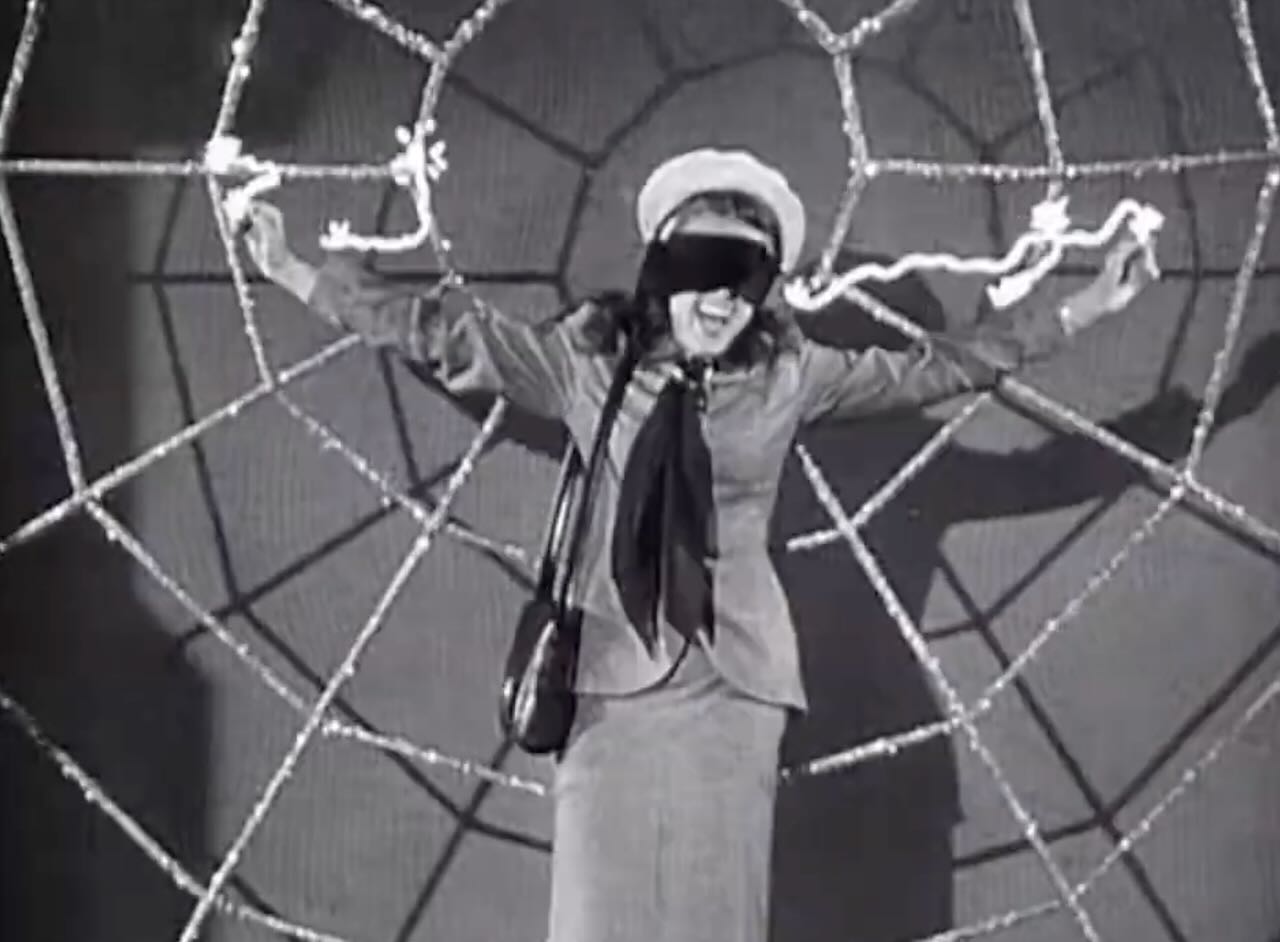
Comments: The Spider Lady is back! And now we get our first real sight of just how cold-blooded she is. If she doesn’t like what you have to say, watch out, because she’ll turned her web-themed wall-art into some sort of electromagnet that will pin you to it and then pump electricity through you until you are a corpse. The victim? Morgan, the hapless schmoe who is desperate for money, felt overlooked by his boss, found out about Superman’s susceptibility to kryptonite and hoped to score a quick buck by selling this information to queen of the underworld.

He doesn’t like the Spider Lady’s terms, which to be fair are a bit brutal—she pays him just $1 with the promise of more later on. It’s like it’s some sort of loyalty test which Morgan fails spectacularly when he threatens to expose her. And that is the end of poor Morgan.
This serial isn’t playing games when it comes to death. So far, in addition to the El’s and the Kent’s, the Spider Lady’s New Mexico division got wiped out by the Reducer Ray, and now Morgan gets electro-zapped to death. Who is next?
The episode ups the Spider Lady’s sense of menace, which is welcome, but it doesn’t actually tell us anything about her. I’d like to know who this woman is, and why she opts to do her criminal acts while dressed in an evening gown. Hopefully the movie will give us some clue about these things—we will see over the next eleven chapters!
As for Superman, he doesn’t actually do all that much in this chapter, except for not die from kryptonite. This is thanks to Professor Leeds just closing the box, so that Clark quickly recovers from his death-like coma. Or alternatively, maybe he was actually dead. After all, Leeds said he wasn’t breathing and didn’t have a pulse. Maybe, in the absence of kryptonite, Superman will just come back to life. Is the guy immortal?

To get Leeds on his side (ie to prevent kryptonite from being available to harm him), Clark does something which in the comics would be a bit unthinkable—reveal his secret identity! Amusingly he has Leeds turn off the lights as he changes clothes, which I guess is the guy’s modesty kicking in. To prove he’s really Superman (and not just a guy in a costume) he has to use his X-ray vision and super-strength, which are almost the only super-powers he displays in this chapter.
Interestingly, Superman talks here about how he has always suspected he might come from the planet Krypton, with the incident with the meteor serving as definitive proof. So in this world, the existence and destruction of Krypton are pretty common knowledge; people just don’t know it was inhabited or that its last son was rocketed to earth from it prior to its destruction.
Anyway, Superman wants Leeds to destroy the meteorite that is so dangerous to him, but not just for selfish purposes—it’s to ensure that the Reducer Ray stays safe. Unfortunately, the ill-fated Morgan overhears all this, which is what leads him to seek out the Spider Lady and eventually find both her and his high voltage doom. So now the Spider Lady knows about kryptonite and is determined to use it to stop Superman from interfering with her plans. Sounds like we have some exciting stuff coming up in the next few episodes.
On the whole I enjoyed this episode. It’s not nearly as packed with plot as the previous chapter, but as a result it has more time to breathe with its different major story points. In addition to Clark’s self-outing and the Spider Lady’s cold-heartedness, we also get to see some more of that Lois-Perry-Clark-Jimmy dynamic that really defines the franchise for the next decade or so, and even to see Lois do some ace reporting.

Specifically, we see Lois meet with a stool-pigeon named Hawkins (who hopefully is important in the story going forward, or he’s a bit of a waste of time) who puts her onto what Morgan is up to. This results in Jimmy getting knocked unconscious and Lois getting herself captured by the Spider Lady, which then leads us to what is certainly the best cliffhanger of this serial so far (see below).
I have only seen a few movie serials in their entirety—The Phantom Empire, Batman, Batman and Robin, and The Vanishing Shadow were all watched in my relatively recent adulthood, and I saw The Adventures of Captain Marvel when I was teenager or in my early 20s. So far, by far, Superman is my favorite, thanks to the strong characterization of the leads and the deft storytelling, which includes a breezy pace in which the events taking place still feel meaningful.
Cliffhanger ending: Lois Lane finds herself a prisoner of the Spider Lady—she’s pinned to the deadly web, and it’s activated. She screams as her body is wracked with the deadly electricity…
Is Clark Kent utterly unaware of Lois’ fate? Can even Superman arrive in time to save her? Don’t miss “A Job for Superman!” the fifth smashing chapter of Superman!
It’s an awesome cliffhanger. I have no idea how she’s going to survive. Clark doesn’t even know where Lois is or even that she’s in any danger at all!

Other Thoughts:
• The chapter’s title seems generic and sort of meaningless. There’s no reason this chapter evokes the idea of Superman as the Man of Steel more than any other.
• Superman pronounces “Krypton” kind of like Jor-El does in the 1978 film: “Krip-tin”, where other characters say it in the more traditional way (“Krip-ton”–you know, how it’s spelled).
• Professor Leeds finds out Superman’s secret identity! Will he survive the serial? Does this come up again as plot relevant?
• Clark is assigned by Perry to help someone at the Planet with her lovelorn column. I wonder if he’s any good at that?
Berita Terkini
Berita Terbaru
Daftar Terbaru
News
Berita Terbaru
Flash News
RuangJP
Pemilu
Berita Terkini
Prediksi Bola
Technology
Otomotif
Berita Terbaru
Teknologi
Berita terkini
Berita Pemilu
Berita Teknologi
Hiburan
master Slote
Berita Terkini
Pendidikan
Resep
Jasa Backlink
Slot gacor terpercaya
Anime Batch