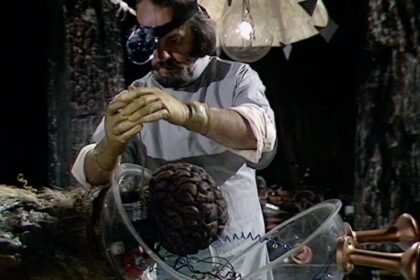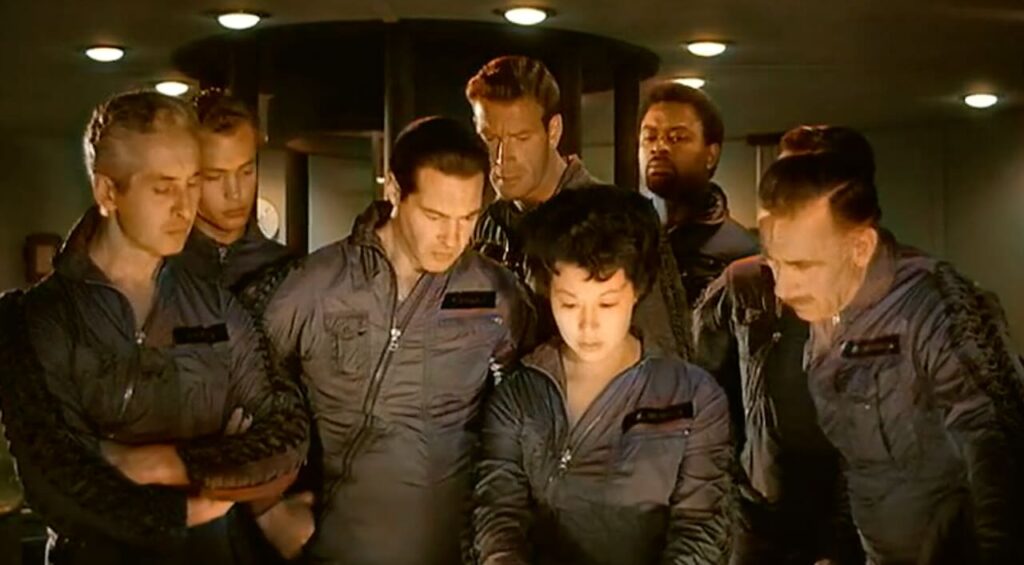
As mentioned previously, in “Impossible Voyages” I’m watching and writing about a run of new (to me) science fiction films to be watched over last year, which has extended to this year (2026). You can read the rationale and ground rules here. In the meantime, we are advancing from 1959 to 1960 with this movie, #38 in this series.
Some of the movies that I’ve looked at for this series have been kind of bland. Others have been majorly unhinged. 12 to the Moon might be the first movie that I’ve watched that is both.
Spoilers Ahead
12 to the Moon (1960)
Directed by David Bradley
The Story: An international mission of 12 scientists (10 men, 2 women) make mankind’s undertake mankind’s first mission to the moon. There they encounter of a mysterious, advanced civilisation of disembodied but telepathic beings. After becoming suspicious of the human explorers, these beings attack the earth with giant freezing cloud. When two of the astronauts sacrifice themselves to undo this damage, the aliens realize that humanity are not all evil and aggressive, and let the remaining scientists know that the people of earth are welcome to return to the moon as friends.

(Incidentally, this movie is originally in black & white, but I ended up watching a colorised version, hence all these color images).
Starring: The titular 12 are played by:
Ken Clark – John Anderson, the mission commander – USA
John Wengraf – Dr. Erich Heinrich, the ship’s designer- Germany
Richard Weber – Dr. David Ruskin, mission log recorder – Polish-born Israeli
Tom Conway – Dr Feodor Orloff, geologist and mapmaker – Russia
Robert Montgomery Jr – Dr. Rod Murdock, mathematician – USA (this is not said in dialogue, but it is discernible in other ways)
Anthony Dexter – Dr. Luis Varga, pilot and communications – Brazil
Michi Kobi – Dr. Hideko Murata, astro-photographer and pharmacist – Japan
Roger Til – Dr. Etienne Martel, engineer and technician – France
Cory Devlin – Dr. Asmara Markonen, navigator – Nigeria
Anna-Lisa – Dr. Sigrid Bomark, physician and physicist – Sweden
Philip Baird – Dr. William Rochester, geophysicist – Britain
Tema Bay – Dr. Selim Hamid, space medicine – Turkey
The only other character is the Secretary General of the International Space Order (the organization that launches the mission), played by Francis X. Bushman (who is listed as a guest star).

Comments: There are ways that 12 to the Moon seems to be anticipating Star Trek, a show that was still about six years away but which many of the same vibes. There’s a nationally and ethnically diverse crew of a space ship on a mission of peaceful exploration. There’s an ambitious to foster global unity and cooperation. There’s also a mysterious alien force that defies any easy definition. And there is a story climax that’s more about establishing communication than it is defeating an enemy.
Unfortunately, it’s also pretty flat in its pacing and design.

I don’t mind the cheapness of the film’s look too much, and I think they do at least a decent job with what they were working with. The whole movie is confined to just a few locations, but the interior of the ship (interestingly called the Lunar Eagle 1, a name very similar to the vessel that actually made mankind’s first touchdown onto the moon’s surface nearly a decade after this movie came out) works just fine. It’s not remotely accurate of course, but it feels like a reasonable set up for how someone might imagine such a ship would look if they’re not going to worry about pesky things like the lack of gravity in space.
The various sound stages representing the moon’s surface (the only other real location) have got a kind of earnest charm to them. It’s all about ten years too late to be considered actually impressive, but it’s enough of a skeleton to hang an interesting story featuring a diverse and colourful array of characters.

Unfortunately, the characters are not all that colourful and diverse. They come from different countries but most of them lack anything akin to a distinct personality or even any particular traits, beyond whatever the actors are able to imbue.
Obviously there was never going to be a dozen well-developed characters, but by the end of this movie there’s not much that one can say about any of the crew. Mission commander John Anderson is obviously the star of the show, but actor Ken Clark doesn’t get to play much except for stalwart.
The only characters with something like an arc are David Ruskin, a Jewish scientist who is hurt and embittered by the suffering of his people at the hands of Nazi Germany, and the German Erich Heinrich, who is deeply ashamed about his father’s role in Nazi atrocities.

But that arc is limited to the audience finding out about these backstories, Ruskin finding out about Heinrich’s father’s history but immediately accepting him as a friend anyway, and then the two men dying to save everyone else at the end. That’s barely enough to qualify as a story, it’s more like just an idea.
Aside from that you’ve just got the Russian guy, Orloff, who walks around annoying everyone by claiming that every notable scientific development is of Russian origin (Chekov did this a bit on Star Trek as well; is this some sort of Russian stereotype that I wasn’t aware of?), but then comes through by catching the treacherous Martel in an act of sabotage. There is another trace of a story here with this political intrigue, but again it’s over as soon as it begins.
So yeah, there are a lot of ways the movie is dull and fails to maintain interest–but that’s only part of the story. It must also be said that 12 to the Moon is low-key bonkers–bonkers because of some of the story beats, and low-key because of how flippantly those beats happens.

The first evidence of this is after the group is on the moon and medical scientists Dr. Selim Hamid and Dr. Sigrid Bomark are sent off to find out of there is any air anywhere.

They find some in a cave, remove their helmets, and immediately begin making out passionately.

They discard their helmets and walk off deeper into a cave, making goo-goo eyes at each other. Apparently they are in love and it’s been all they could do to keep their hands off each other, and are so desperate for each other that they take the first chance they can to be together, even if it’s in a mysterious cave with an uncertain air supply. The journey to the moon, incidentally, has taken less than a day, so it’s not like they’ve been having to maintain self control for all that long.
It would have helped a little if there had been any sort of build up to this, but only a little.
And what makes this even crazier is that this is the last time we see these characters. After the entrance to the cavern that they wander down fills with ice, and later we find out that mysterious disembodied aliens that live on the moon are keeping them captive to observe them so that they can understand this human emotion called love.

How do the humans know any of this? Well the Moon beings communicate through a series of strange hieroglyphs that vaguely resemble “Oriental picture writing,” something akin to Chinese. How can the humans understand this? Well, they put the Japanese Dr. Hideko in front of them and somehow she can just translate it all. She seems somewhat bewildered that she can comprehend the messages, which is never stated to be an actual earth language, but this oddity is never explored or explained, or even acknowledged. She just can.
There’s an also a scene where the crew are trying blow a hole in a moon mountain and a some liquid begins to bubble out of the rock. And then Orloff, who is a geologist, just goes up to it…and sticks his hand in the liquid and gets horrendously burned for his troubles. Why would anyone do that, let alone some sort of trained scientist?! There’s not too much time to think about that because then poor Rochester ends up dying in some moon-quicksand, but at least you don’t feel like what happens to him was because he was being idiotic.
Anyway, later, the Moon beings, suspicious of humanity, send a big freeze cloud over all of North America.

But don’t worry, nobody dies because they were all put into suspended animation first. Then because Ruskin and Heinrich sacrifice their lives to set off a volcano which somehow undoes this, and because of the ongoing evidence provided by Hamid and Bomark that humans are capable of emotions other than aggression, the aliens just un-suspend everyone and say that they’re all good now, they just want to be friends. I can’t help but wonder if when humans do go back if they’ll find Bomark and Hamid still there. Maybe they’ll have children by then? Hopefully they are happy together.
Anyway, I have saved the nuttiest thing in the movie for last. In addition to the 12 crew members, the mission also involves animals–they have at least two cats, two monkeys and a dog.


One of the characters says to the cats that they are there to test whether they can procreate on the moon (really). The dog even gets to see the day at one point when its barking alerts everyone to a potential fire.

But the weirdest part is thing is to do with the cats. The moon beings, via the pictographs, ask the humans to give them the cats. They are instructed to leave them behind because they are very interested in them, and don’t have any such creatures of their own.

I mean fair enough, I like cats too.
And the moon beings have proved their power clearly enough that the astronauts don’t waste any time. The cats are left in the cave, and the last we see of them is a creepy shadow passing over them followed by a terrified meow, before they are both just gone.
What does it mean? Did the moon beings eat them? Are they playing with them? Are they watching them procreate like they seem to be with those two scientists? Nobody knows. It’s never mentioned again.

So that’s what I mean–12 to the Moon has just got all this nutty stuff going on, that is all just dropped on screen in a very casual, off-the-cuff manner. And all of that happens in the second half of the story, after the first half was just a slow & steady procedural. It makes for a really strange mix that never comes together as anything meaningful, but does result in an bizarre oddity that I got a bit kick out of watching.
Other Thoughts
• This movie’s spacesuits don’t have any face plates over them, but they say they have instead some sort of invisible energy shield that prevents them from dying of exposure or suffocating. This is silly of course, but a pretty nifty idea (as well as a cost saving one, probably) since having all the characters unrecognisable in their space helmets would make it even harder than it already to to distinguish one character from another.
PakarPBN
A Private Blog Network (PBN) is a collection of websites that are controlled by a single individual or organization and used primarily to build backlinks to a “money site” in order to influence its ranking in search engines such as Google. The core idea behind a PBN is based on the importance of backlinks in Google’s ranking algorithm. Since Google views backlinks as signals of authority and trust, some website owners attempt to artificially create these signals through a controlled network of sites.
In a typical PBN setup, the owner acquires expired or aged domains that already have existing authority, backlinks, and history. These domains are rebuilt with new content and hosted separately, often using different IP addresses, hosting providers, themes, and ownership details to make them appear unrelated. Within the content published on these sites, links are strategically placed that point to the main website the owner wants to rank higher. By doing this, the owner attempts to pass link equity (also known as “link juice”) from the PBN sites to the target website.
The purpose of a PBN is to give the impression that the target website is naturally earning links from multiple independent sources. If done effectively, this can temporarily improve keyword rankings, increase organic visibility, and drive more traffic from search results.