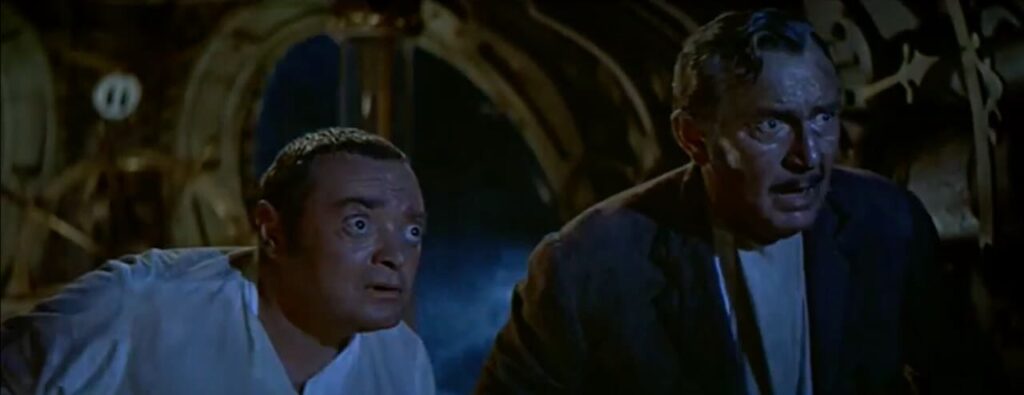
As mentioned previously, in “Impossible Voyages” I’m watching and writing about a run of new (to me) science fiction films to be watched over last year, which has extended to this year (2026). You can read the rationale and ground rules here. In the meantime, we are advancing from 1953 to 1954 with this movie, #32 in this series.
I strongly considered whether I was going to watch the original Godzilla for this entry in this series, but in the end I went for the movie listed below, partly because it was easily available on Disney+, but also because of the funny coincidence of watching two movies in a row with the number “20,000” in the title–see The Beast from 20,000 Fathoms here).
By way of comparison, a “fathom” is six feet. A “league” is a less precise term, meaning different things in different countries–as short as 1.5 miles but more frequently from 3-4 miles. So “20,000 leagues” is significantly further than “20,000 fathoms.” Apparently, in the novel it’s clear that “20,000 leagues” refers to how far the story’s submarine travels–as in “they traveled 20,000 leagues while under the sea”–not how deep (since clearly saying you went 20,000 leagues down under the sea would be patent nonsense (the internet says that the deepest part of the ocean is a bit less than 7 miles, or maybe around 2 leagues).

Spoilers Ahead
20,000 Leagues Under the Sea (1954)
Directed by Richard Fleischer
The Story: In 1968, Professor Aronnax, his assistant Conseil, and master harpoons Ned Land are thrown overboard during a doomed expedition to hunt down a supposed sea beast. They are picked up by their quarry, which turns out to be really be a highly advanced submarine called the Nautilus, under the command of the embittered Captain Nemo. Nemo and his crew live more or less permanently on the ocean, engaging occasionally in violent activities against what Nemo sees as the fruit of man’s corruption on the surface world. Aronnax is intrigued by Nemo’s technology and the potential boon to mankind that it could represent, but Conseil and Land are just determined to escape. The Nautilus experiences many perils including an attack by a giant squid, which nearly kills Nemo before Land is able to save him. In the end, warships surround the Nautilus. Nemo is mortally wounded and along with his crew, opts to take their own lives and destroy his secret island base and all his technology, but Land, Aronnax and Conseil are able to escape.

Starring: Kirk Douglas as Ned Land, James Mason as Captain Nemo, Paul Lukas as Professor Aronnax, and Peter Lorre as Conseil. Robert J. Wilke appears as the Nautilus’ First Mate, and Ted de Corsia is the captain of the expedition that Land and the others are originally part of.
Comments: Like some of the other films that I’ve watched for this series, Walt Disney’s 20,000 Leagues Under the Sea has got some thoughtful ideas that it is exploring, and threatens for a while to get lost in the scientific exposition behind its premise, but ultimately remembers that it is telling a rousing adventure story with strong production values. So the end result is a movie that feels endlessly watchable without also making you feel like you are shedding brain cells by letting it get into your head. It doesn’t necessarily make it my favorite movie from this series, but it might be the best all-round at creating a purely enjoyable experience. Kind of like the Project Hail Mary of its day.

Based on Jules Verne’s novel of the same name, the movie centres around four characters who are almost the only four people in the movie to have names. The big leading man movie star of the lot is obviously Kirk Douglas as Ned Land, who barrels through the whole production on the basis of his physicality and charisma. If that’s what you’re after, you can scarcely do better than Kirk Douglas, but it doesn’t make for a nuanced role.
Much more fascinating is James Mason as Captain Nemo.

Nemo is a complex guy and Mason manages to give the impression that there is a lot going under his stiff and reserved exterior–he is an interesting mix of philosophical, courageous and vengeful. Also, he provides his own dramatic music via the organ he on board his submarine.

He doesn’t show up until a fair bit into the movie but once he is there he is definitely the character you want to get to know. He is mostly a villain, but a complicated one, and the story avoids ever making the goal just to defeat him.

Getting lost in all this a bit is Paul Lukas’ Professor Aronnax. Aronnax seems like he should be a critical figure to the movie’s themes, as he is the guy who sees the real value in Nemo’s technological accomplishments and works to reconcile him to the rest of humanity. But that argument doesn’t ever have the weight that it could have, and the conflict between Aronnax and his colleagues about how to deal with their situation ends up not amounting to much.
This is just one of the ways that movie doesn’t go as deeply as it could, or rather that it just leaves some of its ideas off the table. Maybe this is most noticeable in just the way that all the other characters are basically just human props. There is a pretty big moment, for instance, in which the Nautilus crew all decide to sacrifice their own lives after Nemo is mortally wounded, but we just have to accept this kind of loyalty on faith rather than be something we see or experience.
But what the movie lacks in exploring every corner of its premise it makes up for in its giant squid!

Now, make no mistake, this squid is a bit ludicrous–it chases after a giant metal thing that is multiple times its size, and persists even when it takes a massive electrical shock for its troubles. It’s like this thing knows there is food inside this giant tin can and it’s not going to let anything stop it.
But when you are watching the sequence it doesn’t matter, because the giant squid attack is harrowing as anything.


It’s definitely a highlight of the movie and genuinely thrilling. It’s all the more impressive when you remember that the squid itself is a giant practical effect, created a good 20 years before Jaws, for instance. That one bit is almost worth the price of admission.
I also have to give a shout-out to the Nautilus itself, which is pretty cool and as memorable as any of the science fiction spaceships we’ve seen in this series so far.

Apparently, the literary Nautilus lacked any design frills–practical and cigar-shaped. The cinematic Nautilus is fancier and full of dramatic flair, and the film is more memorable for that creative choice.
Overall I enjoyed 20,000 Leagues Under the Sea, in spite of the elements that felt lacking. It’s a great example of the sort of rousing family adventure that Disney was capable of producing in live action, which I feel I also saw in their Treasure Island from a few year earlier.

Other Thoughts
• The only two women in the movie are the two girls that are on Ned Land’s arms in his opening scene (Minnie and Daisy, according to what Ned yells out to them). Apparently that scene was only added because Kirk Douglas insisted that for his image, he should be seen to be ladies’ man who got into a tough-guy brawl. It just goes to show, I think, that concern over public image isn’t any more of a thing today as it was then; it’s just that then the tools to control that image on such a broad scale were only available to a select few, unlike now where loads of people could spend their lives on this if they wished to.
• My daughter pointed out, in jest, that there should have been a scene before this one in which Minnie and Daisy talk together about something other than Ned so the movie could have passed the Bechdel Test.

• I didn’t mention Peter Lorre anywhere in my main notes, above, but he is (unsurprisingly) quite good in this movie as Conseil. I mostly know him in villainous roles (M and The Maltese Falcon) so to see him here as probably the most sensible character is a nice change of pace.
• 20,000 Leagues was directed by Richard Fleischer, who was the son of Max Fleischer, an animation pioneer and ostensible competitor with Walt Disney. From what I’ve read, in spite of these connections, everyone on all sides of the issue was happy with Fleischer’s appointment to direct this movie. Fleischer’s other directorial credits include Fantastic Voyage, Soylent Green and Conan the Destroyer.
PakarPBN
A Private Blog Network (PBN) is a collection of websites that are controlled by a single individual or organization and used primarily to build backlinks to a “money site” in order to influence its ranking in search engines such as Google. The core idea behind a PBN is based on the importance of backlinks in Google’s ranking algorithm. Since Google views backlinks as signals of authority and trust, some website owners attempt to artificially create these signals through a controlled network of sites.
In a typical PBN setup, the owner acquires expired or aged domains that already have existing authority, backlinks, and history. These domains are rebuilt with new content and hosted separately, often using different IP addresses, hosting providers, themes, and ownership details to make them appear unrelated. Within the content published on these sites, links are strategically placed that point to the main website the owner wants to rank higher. By doing this, the owner attempts to pass link equity (also known as “link juice”) from the PBN sites to the target website.
The purpose of a PBN is to give the impression that the target website is naturally earning links from multiple independent sources. If done effectively, this can temporarily improve keyword rankings, increase organic visibility, and drive more traffic from search results.