Doctor Who has long been my favorite show, and after a long time of not really watching it very actively, lately I’ve been deliberately working at rewatching all the available episodes of the classic series, and writing up my thoughts on each adventure. But there are a lot of episodes! So it’s taking a while. For extra fun I’m mostly watching them completely out of order.
The Power of Kroll
Starring Tom Baker as the Fourth Doctor
Companion: Mary Tamm as Romana
Written by Robert Holmes. Directed by Norman Stewart. Produced by Graham Williams. Script edited by Anthony Read.
Format: 4 episodes, each about 25 minutes long
Originally Aired: December 1978 – January 1979 (Episodes 17-20 of Season 16)
Except for, I think, the last episode, I’ve never seen The Power of Kroll before, somehow missing it on my main run-through of Tom Baker stories back when I was watching the show on PBS. I know it doesn’t have the best reputation, but given that it was written by the stalwart Robert Holmes and featured Mary Tamm as Romana (a companion I enjoy) I was sort of hoping this would turn out be something of a hidden gem of a story. Unfortunately, this is not an easy case to make.

Spoilers Ahead!
The Power of Kroll is notable for featuring Doctor Who‘s largest ever monster, at least in the classic era. But when things got bigger in the revived series, with the likes of 42 and The Rings of Akhaten, the threats became more abstract–giant sentient things in space. Kroll in The Power of Kroll is, as far as I can think at the moment, the franchise’s most legitimate kaiju–something akin to Godzilla in terms of power and scope. It’s an impossibly gigantic monster (a squid-type creature in this case) that just wants to eat people. One assume that the main reason the show had never gone this way before was for production budget limitations–truly the attempt to bring it to life represents such a mad act of audacity for the series that I really have to appreciate it.
And indeed, Kroll doesn’t look anywhere near as bad as I expected. Most of the time it’s realized on screen via a split-screen effect where the creature take up the whole top half of the screen, as if it’s risen above the water and is just dominating the horizon. The first time it appears, the effect is quite good. I don’t mean the special effect is goodl–it turns out those production limitations were a real thing–but the narrative impact of suddenly seeing something so huge is memorable. This also happens as early as the second episode, which means you don’t have to wait until the end of the story for the big “money-shot” (if you can call it that), which is something I appreciated.

Unfortunately what this means is that every time Kroll appears after this (with one exception), the thing is just suddenly there. There was no way to convincingly show it rising out of the sea or anything like that, and so there are definitely diminishing returns on the use of the creature.
(Toward the end we do see it rising out of the water, with an obvious model of the monster attacking an obvious model of the refinery, so they do show that eventually, but the effect is very different).
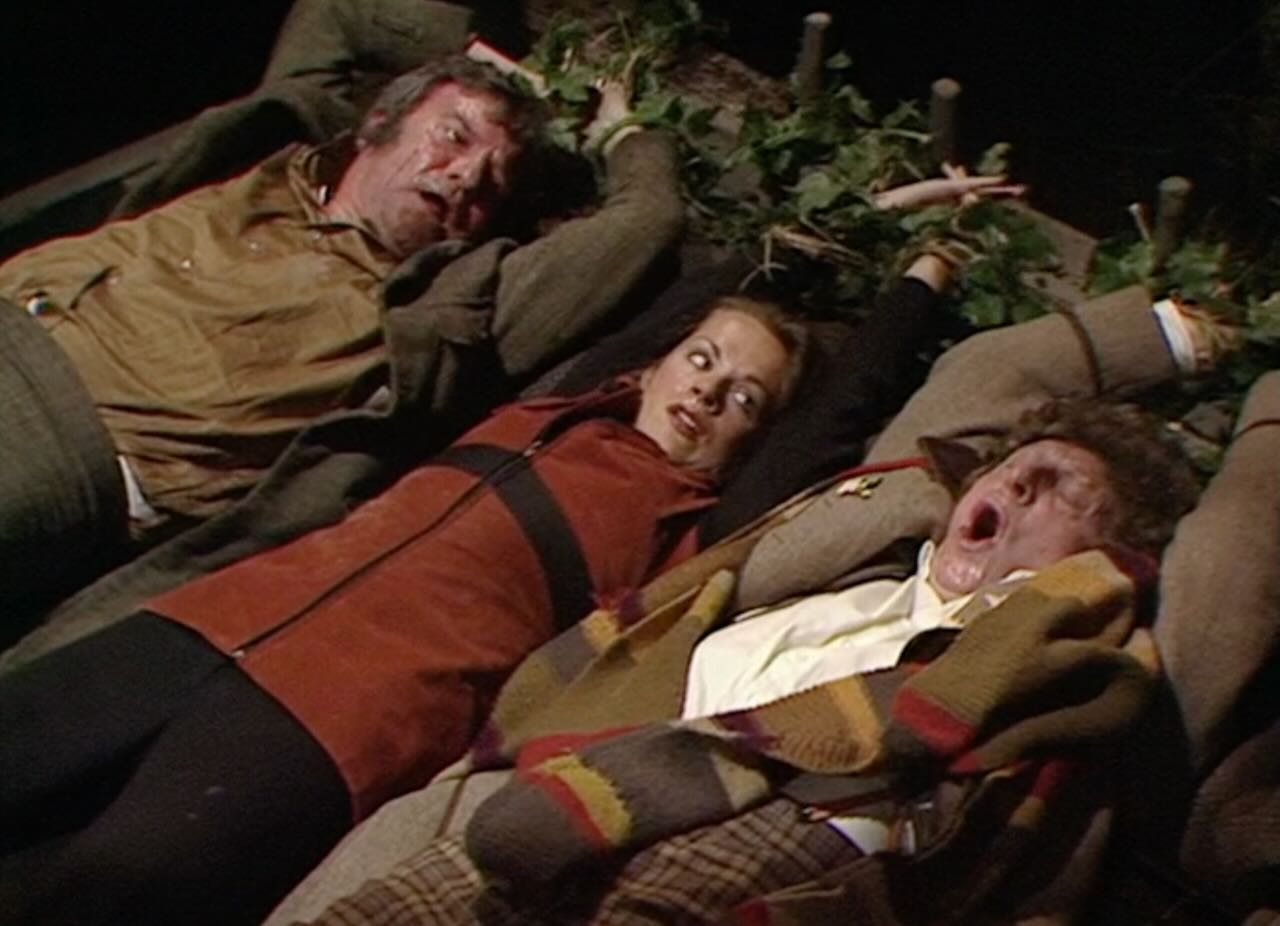
Kroll is also represented via its tentacles, which likes to pull people into refinery pipes or to drag them down to the swampy depths.

The tentacles also look better than I expected them to, with the various deaths being pretty horrific. They do perhaps seem a little small compared to the rest of the creature, but maybe Kroll has a bunch of little sub-tentacles that aren’t so clear in the wide shots.
The big problem with The Power of Kroll is that in spite of how fun the idea of such a goofy gigantic creature should be, the rest of the story is unaccountably dull. There is the effort to make it all mean something, with a story of corporate exploitation of the resources of a native people, but just because there’s a theme to things doesn’t make it a good story. And The Power of Kroll is not a good story. The plot is dull and the characters shallow, and rarely get the chance to actually do anything to make us care about them (the refinery workers especially spend almost all their time sitting around looking at screens and pressing buttons). And while the setting has the benefit of being novel (we haven’t had that many swamps in the show), it gets a little tired after a while.

And it’s a shame because the ideas for things which might have helped to flesh out the characters and the world they live in are present in the story, they just go undeveloped. Rohm-Dutt has got his whole thing where he selling weapons to the Swampies, but only so Thawn has an excuse to go to war against them. Dugeen doesn’t believe in what Thawn is doing and stands up to him. And Ranquin the Swampie leader is blinded by his completely unfounded faith in Kroll as a benevolent god, twisting every event into an interpretation that allows him justify his belief. Maybe for me the idea with the most potential is the parallel between the Swampie leader Ranquin and the head of the refinery Thawn. Both are the leaders of their respective sides of the story’s conflict, and both are too stubborn to recognise how their actions are going to lead to their doom.
So there is the makings for good drama here, but it all gets flattened out by a script that never really engages with its material and direction that doesn’t make room for things to be interesting. As a result the most engaging moments by far are whenever Kroll shows and drags someone to their doom–and that’s just not enough to build a whole adventure around.

The guest cast is full of Doctor Who stalwarts (see below) and for the most part I think people are trying their best. Neil McCarthy’s Thawn is a bit cartoonish, but there are some decent performances otherwise. I thought Glyn Owen’s Rohm-Dutt had good screen presence and thought he was going to turn out to be the story’s most interesting character–but he runs out of steam after a bit and is killed off pretty unceremoniously. John Leeson (the voice of K9 himself) is decent as the idealistic Dugeen and has got a couple of good moments before he gets killed off–it might have been nice if that had been a bigger part of the story.
As for the leads, Tom Baker keeps things as lively as he can, but think Mary Tamm has got her least interesting part in the series so far. She’s fine, but mostly just functional, which is especially a shame given that this is a Robert Holmes script. Holmes not only was classically one of the most interesting writers for Doctor Who, he also wrote Romana’s debut story; all in all I’d have hoped for more from something he put together. Although on the positive side, he did find a clever way to incorporate the quest for the fifth segment of the Key to Time (remembering that this story was part of that season-long arc) into the plot, with it turning out that the segment was a relic that Kroll had swallowed, which was responsible for giving the titular “Power of Kroll.”

So yeah, I liked the idea of Kroll the monster, and the use of it in the drama is pretty fun, but the story itself never successfully does the work of being meaningful on its own terms. So, mostly a disappointment.
Other Thoughts:

• One of the familiar Doctor Who actors in the cast include Philip Madoc (Fenner)–he was in The Krotons, The War Games (as the War Lord), and The Brain of Morbius. He also showed up as a guy who gets exterminated in the second Peter Cushing Dalek movie, Daleks’ Invasion Earth 2150 A.D.
• Also, Neil McCarthy (Thawn) was in The Mind of Evil as George Patrick Barnham, the guy the Master runs over at the end of that serial.
• And John Abineri (Ranquin) was also in Fury from the Deep, The Ambassadors of Death and Death to the Daleks. He was also Herne the Hunter in the Robin of Sherwood series, a shamanistic figure not unlike Ranquin in some respects. I once met him at a convention, in an experience I detail here.

• Also Frank Jarvis (Skart) had small roles in The War Machines and Underworld. And Terry Walsh (Mensch–the Swampie who gets killed by Kroll the first time it appears) was in loads of Doctor Who stories as an actor, credited and uncredited, and also as a fight arranger and stuntman. His involvement in the show dates as far back as the end of the First Doctor’s era with The Smugglers, all the way to a season past this one with The Creature from the Pit.
• The Swampies chant “Kroll Kroll Kroll etc” during one of their rituals in an oddly sing-songy, and thus unconvincing, manner.
• Romana gets terrified by a Swampie in a Kroll suit. She’s embarrassed to really that it was fake–“Well, he probably looked more convincing from the front,” says the Doctor, comfortingly. Of course, because the special effects on this series were so limited, it’s impossible for us in the audience to know if we’re watching a character who is supposed to be wearing a costume, or an actor who is wearing a costume but is supposed to be a monster. Something similar happens back in The Rescue, all the way back in Season 2.
• For the most part, I wasn’t that taken with this story’s dialogue, but there is this funny bit where Ranquin announces to the Doctor, Romana and Rohm-Dutt that “The Great One condemns the prisoners to die by the seventh holy ritual of the Great Book.” The Doctor finds out that this is the most painful of all the seven rituals. The more sympathetic Varlik tells the Doctor that he tried to persuade Ranquin to just the first ritual on the Doctor and Romana. “That’s very easy,” he says. “They just throw you down the pit and drop rocks on you.”

• The Doctor demonstrates in this story the bizarre ability to sing high enough to break a window! Strange, strange little detail. I wonder if there are other circumstances that we’ve seen that that would have come in handy for?
Berita Terkini
Berita Terbaru
Daftar Terbaru
News
Berita Terbaru
Flash News
RuangJP
Pemilu
Berita Terkini
Prediksi Bola
Technology
Otomotif
Berita Terbaru
Teknologi
Berita terkini
Berita Pemilu
Berita Teknologi
Hiburan
master Slote
Berita Terkini
Pendidikan
Resep
Jasa Backlink
Slot gacor terpercaya
Anime Batch