Doctor Who has long been my favorite show, but it’s been a couple of years since I’ve actually watched anything but the newest episodes. Before that, I was making a respectable run at getting through the original series, most of which I haven’t seen for decades. For various reasons, lately it has felt like it’s time to get back into it.
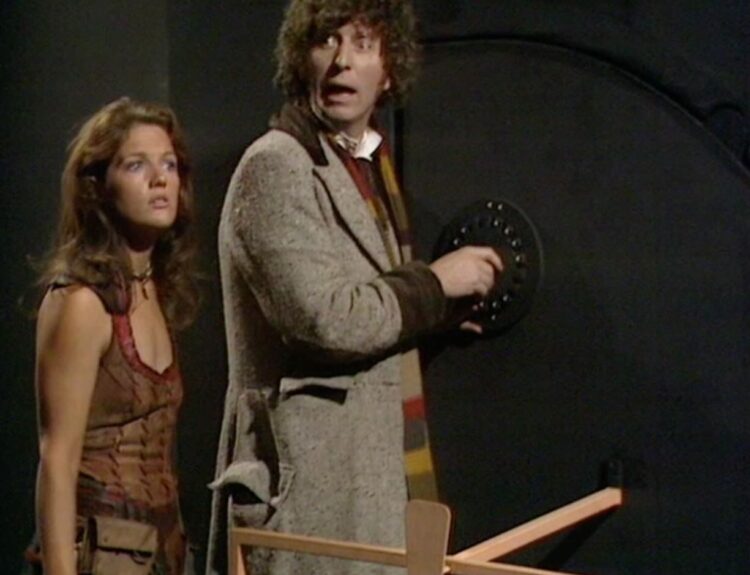
The Chase
Starring William Hartnell as the First Doctor.
Companions: William Russell as Ian Chester, Jacqueline Hill as Barbara Wright and Maureen O’Brien as Vicki. Introducing, in the last episode, Peter Purves as Steven Taylor.
Written by Terry Nation. Directed by Richard Martin. Produced by Verity Lambert. Script Edited by Dennis Spooner.
Format: 6 episodes, each about 25 minutes long (individually named The Executioners, The Death of Time, Flight Through Eternity, Journey Into Terror, The Death of Doctor Who, and The Planet of Decision)
Originally Aired: May – June 1965 (Episodes 30-35 of Season 2)

For reasons I can’t fully account for, I have a real sense of nostalgia when I look back at the earliest days of Doctor Who. I was not around in 1963 when the show began, or in 1965 when this story aired. When I was born, it was Jon Pertwee’s era. By the time I discovered the series, Colin Baker was ramping up. But even though the days of William Hartnell with Ian, Barbara and Susan or Vicki was not part of my childhood, emotionally it feels a bit like it was. It’s an experience that might go back to my first discovery of the series’ history when I was glancing through an old programme guide that I had picked up at the bookstore, and saw how it all began with these original characters, and how it went on the cast changed over.
Anyway, because of all that, The Chase in particular is a meaningful story to me, as it’s where Ian and Barbara leave the show. These are the original companion characters, the original audience viewpoint characters, and in many ways, the original protagonists for the whole series.

There will be other events after which “the series would never be the same again”, and many in much more dramatic ways (ie the first regeneration, the show moving into color, the kick-off of the revival era), it’s after The Chase that this is really true for the first time. Even though we’d already farewelled (and replaced) Susan some time earlier, it’s the departures of two modern day school teachers that signifies the first major turning point between what the show was, and what it was going to become.
So all that to say, I want to just give the warning that I go into my comments on The Chase with the full knowledge that I have a somewhat peculiar affection for this era of the show, and particularly for Ian and Barbara. I understand that objectively, they are probably not as great as I’d like to think, but that doesn’t matter, I just love them (I have a similar thing going on for the first Tron, and actor Michael Durrell from V, and probably a few other things here and there). And so there final story hits me a bit harder than it would otherwise.

Spoilers Ahead! Also, warning: this is a long article, so buckle up.
The Chase, as we generally call it, was the third ever Dalek story that the show produced (aside from their cameo in The Space Museum), and so it’s still early days for the little exterminators. This is the first time we see them using time travel, and even more iconically, it’s the first time that we hear them using “Exterminate!” as a battle cry.

And exterminate they do, though perhaps not as much as you might expect. Notably, no human beings face their direct wrath, not even when it would seem like an obvious thing for the Daleks to do. Instead, extermination is reserved for robots and lizard men, which is not to say it’s not ruthless. There is a particularly cruel scene in the second episode where the Daleks are holding a couple of Aridians prisoner, forcing them to dig the TARDIS out of the sand, and when they have completed their task, they just cold-bloodedly zap the hapless beings to death.
But most of the time in The Chase, the Daleks don’t actually come off all that impressive. One falls into a pit trap that Ian creates, and possibly get eaten by a Mire Beast for his troubles (at least, that’s what the Doctor and Ian think), one of them just wanders off the Mary Celeste into the ocean to its doom, and another one is ripped to pieces by a fun house monster. The story also takes the time to include moments with one of the Daleks struggling to convert things into earth time units (“Er, er, in earth time, er, four minutes” and so on), and another couple of bits where Daleks are seen nodding their eye stalks like humans would nod their heads, which is, frankly, hilarious.


None of this doesn’t mean they aren’t menacing, of course. The idea of Daleks that can now come deliberately after the Doctor through space and time definitely heightens their threat-quotient. By the end of the story, the Daleks’ one and only time machine is destroyed, but their quest to master time travel will come up again, repeatedly, in the years to come.
Like all the other Dalek stories up until this point, The Chase is written by Terry Nation, who also contributed the non-Dalek adventure The Keys of Marinus. That story has a lot in common with this one, in that the action in both is spread out over multiple settings, and features a wide range of creative concepts. But like Marinus, The Chase suffers from the fact that few of those concepts feel satisfactorily developed, if they are developed at all. And the plot that ties it all together is equally thin.
But before we get to any of it, there’s a full half episode taken up with just showing life on the TARDIS, with Vicki bored as the Doctor tinkers with a new device, Ian tries to read a book and Barbara sews a dress. Then everyone starts watching the History Channel for a while on the Doctor’s new Time-Space Visualizer.

This incredibly unhurried opening is a big indicator of how meandering the whole story is. And yet this is also part of the significance of The Chase, as I was talking about above. I can’t remember another story–certainly not the classic era–that spent so much time just letting the characters be. This was a feature of the show in its very original form–it wasn’t just about the Doctor and his companions fighting monsters. It was about this particular collection of characters, traveling together in their peculiar circumstances (and yeah, fighting monsters). We would often spent time with them just wandering around some new environment and just looking around, especially at the start of the story. They weren’t written in the deepest way, but there was a lingering and “hanging out” with them that we rarely got later on.
To be clear, I don’t mind that the show changed–it often made for more exciting and dramatic stories. It was part of the show’s maturing. But as a result it makes this particular era unique for me, and so considering that this is the last time we’ll see Ian and Barbara in the TARDIS, I don’t mind that so much of the first episode is “wasted” like this.

Eventually though the crew land on the desert planet of Aridius, where we spend an episode and a half in what is probably the least interesting part of the serial. We meet some Aridians and we learn a little bit of their history with the Mire Beasts…but really it’s all over before you know it. Mainly this is here just to establish the Dalek threat.
After that we take half an episode each for a series of mostly goofy set pieces–the observation deck of the Empire State Building, the Mary Celeste just before its crew goes missing, and a haunted house which just might or might not “exist in the dark recesses of the human minds.”
The Empire State Building is notable for me because I’m originally from New York, not far from New York City.

Indeed I used to work in the Empire State Building. This is the first time Doctor Who went to America, which means that, as far as I know, the first American characters on the show were played by Arne Gordon as the tour guide, and Peter Purves as a tourist from Alabama named Morton Dill.
Or at least that’s what the credits tell us–his name is not mentioned in the script anywhere.

This is notable of course–Purves will return to Doctor Who in only three episodes, at the end of this very serial, to play Steven Taylor, who will basically replace Ian as the show’s male companion. There are some other companions-actors who appeared as other characters in the show first (Ian Marter, Lalla Ward, Freema Agyeman, Karen Gillan and Varada Sethu all come to mind. Also, depending on how you count them, Nicholas Courtney, Jean Marsh and John Levine), but none of them had done so earlier in that same story. Presumably, Purves had been cast as Morton, the producers liked him and so they brought him back to play Steven? I don’t know for sure.
(Oh wait! As I was writing this I realized that the tour guide and Morton are not the first American characters to appear on Doctor Who. In The Chase’s first episode we spent a few minutes with Robert Marsden as Abraham Lincoln, reading the famous Gettysburg Address (and doing a reasonable job of it, I thought). I guess he’s the first ever American character on Doctor Who? Feel free to correct me if I’m wrong, internet!)
Anyway, Morton is such a ridiculous and over-the-top character that it’s impossible to take the New York City scene seriously. This is followed by the show taking us to the famed mysteriously abandoned ship, the Mary Celeste.

But even though the sequence is tragic with everyone jumping into the ocean to their deaths (including apparently the first child we see die on Doctor Who, as a woman is seen carrying a baby), it’s still presented kind of tongue-in-cheek: Vicki accidentally bonks Ian on the head, the Daleks are ironically trying to prevent everyone from dying because they want information, and one hapless Dalek just trundles its way off the side of the ship into the ocean.


Then we get the story’s third little mini-adventure as the TARDIS lands in a haunted house populated by the likes of Frankenstein’s monster (just credited as “Frankenstein”), Dracula and the so-called Grey Lady (a ghost, apparently).

This is by far the weirdest sequence of the serial. The Doctor speculates that they are in some sort of shared nightmare created by the subconscious fears of humanity (apparently Terry Nation’s original idea for this part of the story) but the punchline is that they are in a shut down attraction at the Festival of Ghana in the futuristic time period of 1996, populated by (one assumes) animatronic robots.
That’s quite the haunted house attraction! Who knows, maybe the attraction was shut down because the robots were already out of control?

Personal Fan Headcanon: the attraction was shut down because the robots were potentially dangerous. When the Frankenstein one was shot by the Daleks, it fully malfunctioned or some sort of dangerous self-preservation mechanism was activated, leading to its attack.
Anyway, storywise the result of all this is that Vicki gets herself stuck in the Dalek’s time machine. This doesn’t amount to much (though it does provide an excuse for the characters to talk about the use of this other time travel device, which will be important later on), as she just rejoins her friends at the very next landing spot. That spot is the planet Mechanus where the Daleks set about using a robot duplicate of the Doctor to “infiltrate and kill” the TARDIS crew.

The strain that I imagine this story having on the series’ budget is most apparent here–the jungle floor of Mechanus is particularly unconvincing, and the native “Fungoid” life forms makes for the second creature this serial has introduced (after the Mire Beasts) which looks most like a big blobby decorated pillow that ambles around. But I found the way the show went about creating the Robot Doctor to be extremely interesting.
Now, if you don’t know, these early episodes of Doctor Who were, mostly, recorded in the studio “as if live”–in other words, they were performed before multiple cameras in real time, with live switching going on between the cameras to capture the story to tape.

This means what would be simple techniques nowadays of just getting William Hartnell to record his scenes as the Doctor and then his scenes as the Robot Doctor, and then edit them together, was basically not feasible. So to accomplish the effect, actor Edward Warwick was hired to play “Robot Dr. Who”. (Warwick had also played the back of the Doctor in an episode of The Dalek Invasion of Earth when Hartnell took ill. By all accounts, Warwick didn’t really look all that much like William Hartnell, but with the right make-up and costuming, you can certainly tell that he’s supposed to look like the Doctor.
Hartnell, however, also played the Robot whenever he had extended close ups, at least whenever possible–in the scene where he is deceiving Barbara, for instance. But this also meant, because of the filming realities I mentioned above, that sometimes Warwick appears to be playing the actual Doctor, presumably because there was no way for Hartnell to suddenly materialise in a new location. In these instances, the camera attempts to avoid lingering on the Doctor for too long, focusing instead on Ian.

In general, whichever character Warwick was playing, they attempted to maintain the illusion by using William Hartnell’s voice and having Warwick mime the lines–I’d guess the lines were pre-recorded and then played back live, as they sound different.
The effect of all this is bizarre. Whenever Edmund Warwick is on screen, it’s transparently not William Hartnell.

The recordings of Hartnell’s voice sound strange (and there’s one line of “No,” which I think is Warwick himself speaking). And seeing them attempt to cut to Hartnell as the robot whenever possible is jarring. But there’s obviously a great effort going into this, to tell the first ever story of the Doctor coming face to face with a doppelgänger of himself.
And with this, there is one particular sequence which I’m really amazed by, which is the confrontation between the Doctor and the robot just before they fight it out. For this bit, they cut back and forth between William Hartnell as both characters, spouting off a quick succession of argumentative dialogue at each other. As best as I can figure, they would have been filming this with two cameras, both trained on Hartnell at different angles (they each have generic jungle backgrounds), cutting back and forth between them as he performs both characters.


I could be wrong, but if I am it would mean they employed a whole bunch of edits that were not characteristic of the show at this time. It’s an amazingly effective bit of work, particularly when you consider the limitations of the time.
Anyway, after all this is settled, we have the Doctor and friends hiding out in a cave, with the Daleks closing in, and we get one of the serial’s greatest moments, and certainly its best cliffhanger–the sudden reveal of the Mechanoids.

A door slides open suddenly and the thing is just there, speaking in a truly unsettling way (which is at once both mechanical and guttural), courtesy of Dalek voice artist David Graham: “Eight hundred thirty Mechanic. English input. Enter.”
And this takes us into the serial’s last episode, which is by far the best. The Doctor and friends are taken up into a fascinating looking elevated city, where they meet space pilot Steven Taylor, who has been a prisoner of the Mechanoids for the last two years. Steven is played, as I mentioned, by Peter Purves, who makes an immediately positive impression as this new regular character, even though it’s not clear at the story’s end that he is around to continue traveling with the Doctor.

Anyway, meeting Steven helps the others realize that they are prisoners as well, and their focus becomes on escaping, which they have to do by climbing down 1500 feet of cable. They are aided by an incendiary device that the Doctor has been working on for a while, and by the fact that the Mechanoids do not take too kindly to being attacked. This leads to the frankly awesome battle scene between Daleks and Mechanoids, a cacophony of weapons fire, explosions and mechanised screaming.


It ends with both sides, and the city, destroyed. The Daleks would return the following season for their biggest epic ever, and the Mechanoids would return…well, never (apparently because the costumes were too difficult to operate), except for in spin-off media.
And this of course takes us to the sequence that makes this story as meaningful as it is–the departure sequence of Ian and Barbara. It’s a bit abrupt–there’s no talk throughout the serial of their desire to return home or anything like that–but it works because its consistent with who the characters have been from the beginning.

And as I mentioned, it is set up slightly by the earlier conversation about how they could perhaps use the Dalek time machine to return to the haunted house to rescue Vicki. But there are other ways that I think The Chase fits as a farewell story for the characters.
Notably in the penultimate episode of the serial (The Death of Dr. Who, the one with the Robot Doctor), there are moments in which both characters get to show, to us in the audience at least, how much the other one means to them. The Robot Doctor lies to Barbara and tells her that Ian is dead. Her reaction is subdued only because she can’t believe it. Or perhaps a better way to look at it is that she can’t accept it. When she hears his voice, her relief is obvious and joyful.

Similarly, when Ian learns about the robot duplicate and realises the danger Barbara is in, his look of horror is overwhelming.

This is not just one of his friends–this is someone he has shared life with, like nobody else.
Doctor Who the TV series, back in 1965, never overtly talked about the idea of Ian and Barbara being in love. But every piece of spin-off media that I have ever come across that featured or mentioned the characters included the idea that after they left the Doctor, they got married. It’s one of the most obvious, least arguable “character ships” that I can imagine, even though as I said it’s never once directly acknowledged on screen. And so the scene in the last episode of The Chase where they are arguing with the Doctor that they want to go home, that they understand the risks and are prepared to face them–it almost reads like characters saying their wedding vows.

I know I’m being a bit over-the-top with it all. That’s what I talked about way at the beginning of this post, my admittedly extreme affection for these characters. But even if you don’t add this layer to it, it’s a good scene. Barbara and the Doctor (arguably the show’s central relationship to this point) both refer to the events of An Unearthly Child, and so there is a real sense of a story that had gone on for nearly two seasons and 77 episodes was coming to an end.
The little coda where we see Ian and Barbara arrive back on earth…

…and then frolic around London (including freaking out when they see an actual police box), before having their final scene while riding a bus and figuring out that they are a couple of years out, is just an extra treat, and a great way to farewell the characters.
And then fittingly, it all ends with the Doctor and Vicki watching them on the Time-Space Visualizer (remember that thing? It had been important five episodes earlier, and then like the Mechanoids, never appeared again), and William Hartnell musing that “I shall miss them. Yes, I shall miss them, silly old fusspots.”

Me too, Doctor. Me too.
Oh, The Chase. Yeah, it’s obviously not a great story. I haven’t watched most of The Daleks’ Masterplan, but I’m thinking The Chase is definitely the weakest Dalek story of the 1960s. Besides the last episode, and some of the character work scattered throughout, there’s not a lot to recommend about it. Like any story designed this way, there are some ideas that could have worked well if they’d been given more development (the original idea for the haunted house segment, with the TARDIS traveling into some sort of shared gestalt nightmare of humanity, would have been way more interesting than what we got), but they weren’t developed and so they don’t work. Even the stuff with the Mechanoids could have used another episode to flesh out the idea.
But The Chase does work well as a farewell to two of the original cast members of the show, and also as an introduction to a new regular character. And because of that, and also because of just the Daleks being involved at all, it will always be a significant story, even if it’s not a particularly good one.

Other Thoughts
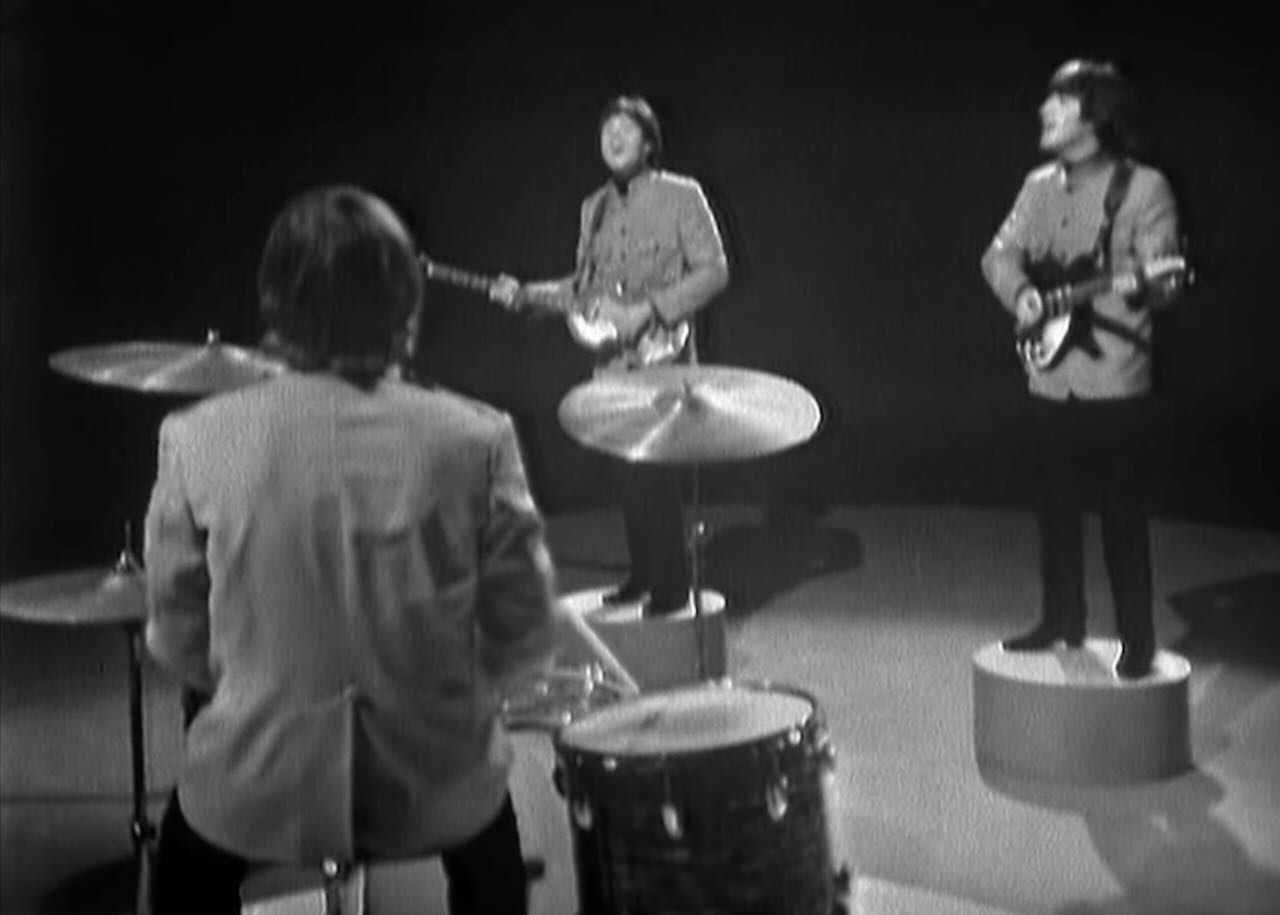
• So during the first episode, Vicki sets the Time-Space Visualizer to watch the Beatles performing Ticket to Ride on Top of the Pops. Interestingly, this episode of Top of the Pops is now wiped, just like too many Doctor Who episodes, and this clip of the Beatles is now only known to exist thank to being in this episode. Because of rights issues, this scene is deleted from a lot of versions of the episode, including the one that I watched on streaming. Fortunately, I happen to own a DVD of the story (I think from Australia, where I live) that includes it, so I fired that baby up for this rewatch. George Harrison is barely visible (and only in negative), and Ringo Starr only slightly more so. You do get some solid shots of Paul McCartney and especially John Lennon (who is singing lead).

• Ticket to Ride was released in 1965, the year this story was aired, so presumably Ian and Barbara have never heard it before. That doesn’t stop Ian from singing along to it, though. It’s certainly catchy enough to pick up the chorus on a first-time listen.
• Speaking of Ian singing along to the Beatles…well, Ian has never been a hip guy, but this bit is particularly cringey. So too is a bit later when Barbara takes a light they’ve found on Mechanus and plays with it like it’s a machine gun.
• The Time-Space Visualizer sequence also includes appearances by William Shakespeare and Queen Elizabeth I and , both of whom would appear in the series again in modern times (in The Shakespeare Code and The Day of the Doctor). That makes both of them recurring Doctor Who characters.
• Also, hilariously, at the start of the second episode when they are being attacked by monsters, Ian yells at Vicki: “Don’t just stand there and scream, you little fool, run!” A moment later she returns the favor with “Oh, don’t just stand there gaping, you nit! Come on, back!”

• Aridius was apparently covered with ocean, but then all the seas dried up. Guess they shouldn’t have called it Aridius! Similarly, Mechanus is a world full of jungle, but it’s also got the Mechanoids living there in their big city. Talk about some prophetic planet naming!
• In a minor coup of continuity, when Ian asks Barbara for her cardigan to use it in a trap for the Daleks, she replies, “Oh, not again,” referring to the fate of her similar garment in the previous story.
• And then in a major coup of continuity, Barbara figures out which Doctor is the Robot when the duplicate refers to Vicki as “Susan” (the Daleks not being aware that Susan has been replaced by a suspiciously similar replacement). I think that’s a great touch.
• The haunted house exhibit at the Festival of Ghana has a sign on it that says it’s “Cancelled by Peking.”

What happened here? Did Peking, the whole city, cancel a haunted house exhibit at the Festival of Ghana? How do they even have the authority to do that? Just how much influence does China have in that part of the world? Is the Festival of Ghana actually in Ghana? I assume so, but maybe I’m wrong. Either way, maybe Peking’s issue with the attraction was that the monster robots were liable to go berserk.
• At the end when the TARDIS crew confirms that the Daleks are gone, the Doctor says to Ian, “My dear boy, I could kiss you!” Barbara says, “Don’t waste it on him, kiss me instead!” The Doctor replies, “Oh, I’d be delighted!” I double checked to see if the Doctor actually kisses Barbara at that point (he obviously doesn’t kiss Ian) but he doesn’t, they just have a hug. I thought maybe this might be the first time the Doctor shares a kiss with a companion, but it’s not.
• Richard Martin was the director for this serial, but the last bit with Ian and Barbara back in England was filmed as part of the following production block, which means it was directed by an uncredited Douglas Camfield.

• Expanded media has all sorts of strange things to say about this serial. The novelisation version of The Chase explains that Morton Dill went on to be permanently institutionalised after his experiences on the Empire State Building, and indeed the reason that the Daleks didn’t kill him was because they reasoned that this would be a worse fate for him than death, and that it would worse for humanity than his death as well. Also, according to the novel Interference – Book One, the fun house monster robots were built by Microsoft, who got into trouble for making them so dangerous. And finally, according to the novel Dalek Survival Guide, the Time-Space Visualizer was actually a hoax created by a group of criminal Daleks (the ones seen in this story) as some sort of elaborate attempt to ensure their own future freedom. In this version of things, the historical figures that the Doctor’s companions view are actually recordings made by human prisoners of Daleks! I have never read this book, but it sounds pretty wacky.
• Amongst the familiar guest cast for this story is Dennis Chinnery (the first mate on the Mary Celeste), who was also Gharman in Genesis of the Daleks and the twins’ father Sylvest in The Twin Dilemma. Roger Hammond (Francis Bacon) was also Dr. Runciman in Mawdryn Undead. Hugh Walters (Shakespeare) was Runcible in The Deadly Assassin and Vogel in Revelation of the Daleks. And David Blake Kelly (the Mary Celeste‘s captain) also appeared in The Smugglers, the last penultimate First Doctor story.
PakarPBN
A Private Blog Network (PBN) is a collection of websites that are controlled by a single individual or organization and used primarily to build backlinks to a “money site” in order to influence its ranking in search engines such as Google. The core idea behind a PBN is based on the importance of backlinks in Google’s ranking algorithm. Since Google views backlinks as signals of authority and trust, some website owners attempt to artificially create these signals through a controlled network of sites.
In a typical PBN setup, the owner acquires expired or aged domains that already have existing authority, backlinks, and history. These domains are rebuilt with new content and hosted separately, often using different IP addresses, hosting providers, themes, and ownership details to make them appear unrelated. Within the content published on these sites, links are strategically placed that point to the main website the owner wants to rank higher. By doing this, the owner attempts to pass link equity (also known as “link juice”) from the PBN sites to the target website.
The purpose of a PBN is to give the impression that the target website is naturally earning links from multiple independent sources. If done effectively, this can temporarily improve keyword rankings, increase organic visibility, and drive more traffic from search results.