Doctor Who has long been my favorite show, but my actual viewing it over the years has been very on-again / off-again. Lately, it’s been all-on, as I’m actually closing in on finishing re-watching all of the classic episodes (at least the ones that are easily available for me to stream), whilst blogging about each serial.
Arc of Infinity kicked off Doctor Who‘s 20th season, and kicked off the year’s trend of having every story feature some returning threat or story element from the show’s history. This was back when this was still kind of a novel thing (indeed, from here on in it became a lot more common). That returning threat this time around was quite a special one, a threat who had first (and last) appeared in the show’s first ever anniversary episode, The Three Doctors.
Hmm, remember when Omega showing up on TV was a special thing? Sigh.

Arc of Infinity
Starring Peter Davison as the Fifth Doctor.
Companions: Sarah Sutton as Nyssa and Janet Fielding as Tegan Jovanka
Written by Johnny Byrne. Directed by Ron Jones. Produced by John Nathan-Turner. Script Edited by Eric Saward.
Format: 4 episodes, each about 25 minutes long
Originally Aired: January 1983 (Episodes 1-4 of Season 20)
Spoilers Ahead!
Arc of Infinity does have a very good reputation, and for the most part that is deserved. It’s not an egregiously bad story, but it’s flat and uninspired. The story is poorly paced, plodding along at a tepid rate that stubbornly refuses to build any meaningful tension or momentum.

At times the story aspires, it seems, to be something of a political thriller, with intrigue taking place amongst the Gallifreyan elite in one fashion or another. But the way this portion of the story unfolds is so incredibly clunky that it’s hard to care. Some Time Lord technician gets killed near the start and it’s simply ages before anybody even mentions this. It’s obvious that a member of the High Council is behind whatever is going on, but the blindly believes the Doctor is guilty, even though he is the one under imminent threat. There is a traitor amongst a small pool of characters, but none of them have more than the slightest hint of a personality, so it doesn’t really feel like it matters who is guilty.
The exception to this lack of a distinct personality is of course Commander Maxil, played by future Doctor Colin Baker.

Much amusement has been had because actually finishes his first episode by shooting his predecessor Peter Davison’s Doctor. This doesn’t amount to anything from a plot point of view but Baker is by far the guest player with the most screen presence.

It’s a bit over-the-top but the serial probably would have been more fun if there was more of this sort of thing going on. Paul Jerricho’s Castellan also has potential and I would have enjoyed the Gallifrey stuff a lot more if these two characters hadn’t been written to be so bull-headed and obtuse. I was briefly hoping that they had shared the information about the president’s supposed treachery as a trap to lure out the real traitor, but alas there was nothing so interesting going on.
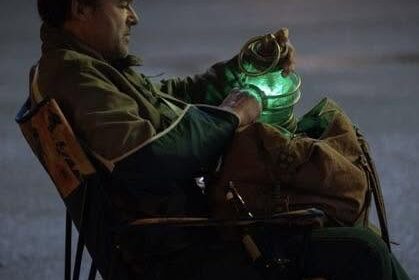
The other notable guest star is of course Michael Gough, who plays Hedin.

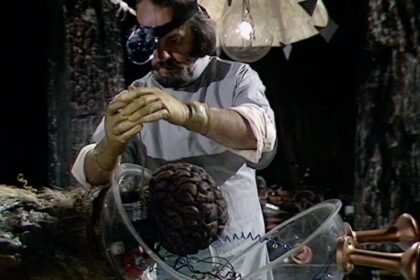
He was the original Toymaker back in the 60s and also is well known for playing Alfred in all four of the Batman movies in the 80s and 90s. He clearly knows how to act, and there is a seed of an idea with his character’s veneration for Omega as a sort of historical deity, but there is no time or energy given to actually exploring this. We just find out he’s guilty, and then Hedin is abruptly killed before the story can do anything interesting with him.
The other main setting for the story is of course Amsterdam. It’s sort of neat seeing Amsterdam simply because it’s different than what the show usually gives us, but besides this novelty nothing about being out of the UK actually adds to the story in any meaningful way.

Really, I think out of all of classic Doctor Who‘s forays into international location shooting, only City of Death made it feel like it really mattered.
Amsterdam is also where we get Andrew Boxer’s scenes as Robin Stuart, where he spends much of the story running around with Tegan. He is easily my least favorite performer in the serial.

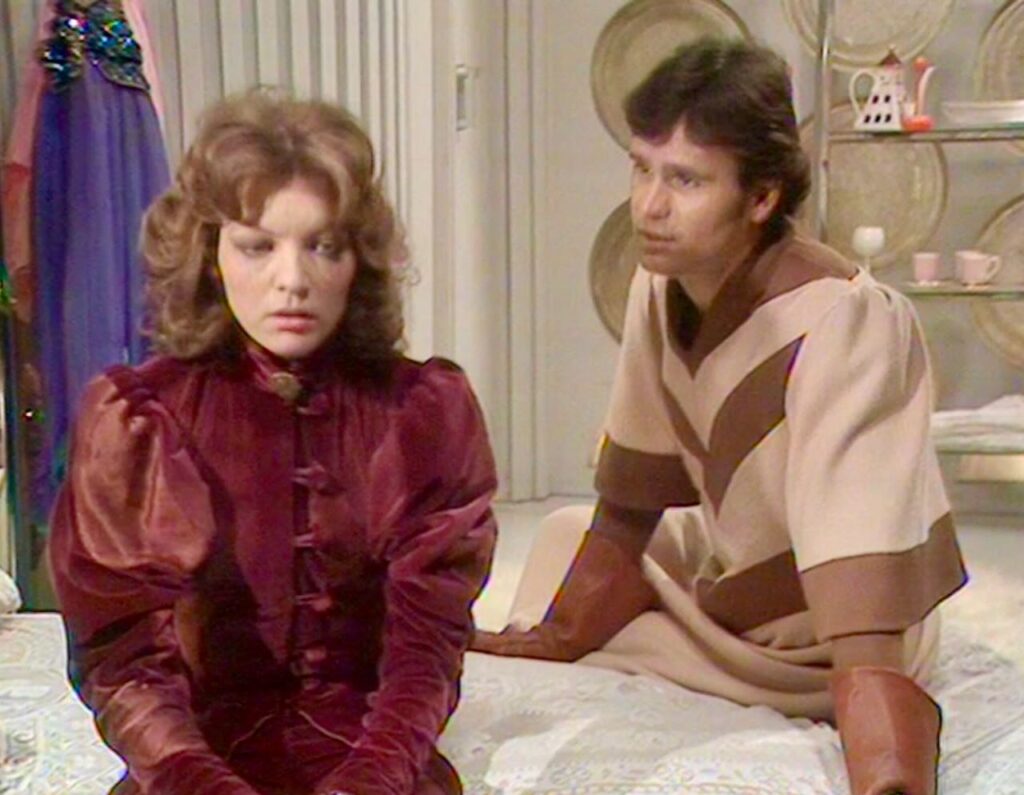
Speaking of Tegan, I do enjoy the way she is brought back into the plot. The fact that she disappeared from the TARDIS to return after missing only one episode does make it feel like kind of a pointless exercise, but it’s just something a little different than what we usually see, and allows a chance for Janet Fielding to totally revamp the character’s style.
And I like the way that Tegan’s partial absence gives Nyssa a chance to shine. This is probably the only story where we see her really operating as the Doctor’s main companion. I like the way she loyally sticks with the Doctor on Gallifrey, and it’s interesting to see her get so violent.


Seriously, she gets to a do a lot of gun-brandishing in this story.
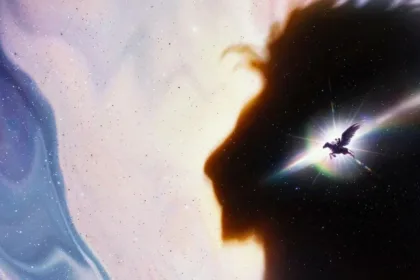
Omega is of course a major figure from the Doctor Who history, and thus his appearance has some interest built into it, but taken on his own merits in this story he doesn’t really come cross all that well (of course, this was all before The Reality War reared its head at us and ewe learned what a poor use of Omega really looked like). For most of the story he is just a face on a screen. Eventually it seems he is just hanging out in a crypt in Amsterdam with his bizarre unexplained upright pterodactyl-creature servant.

The Doctor briefly explains that this thing, an “Ergon”, is something Omega created with his mental powers to serve him in the positive matter universe. This is a little confusing though because in spite of all this talk about how he needs the Doctor’s body to be able to properly enter the positive matter universe, Omega seems to be right there, next to the Ergon, hanging out with it. I guess the idea is that Omega is inside his TARDIS and that is what allows him to lurk around like this, but it undercuts the dramatic impact of the character’s goal to see him just hanging out like this. Is the idea that Omega’s TARDIS is not part of the positive matter universe? How can the Doctor even go in there then?
In the last episode of Arc of Infinity, Omega is played by Peter Davison himself as he takes not he Doctor’s form and starts wandering around Amsterdam.

Some interesting things are done here with Omega’s child-like interest in a local puppet show, followed by his horror at seeing his body rapidly decaying. Davison does really well in the double role, and the serial’s direction pulls off the illusion that there are two characters well without getting into any really complicated special effects. I wouldn’t call this material especially good, but it’s probably the most engaging stuff in the entire serial.
At the end of the day, I’d call Arc of Infinity weak but watchable, a serial with various potentially interesting ideas, but none of which are actually presented in a way that really demonstrates that interest.

Other Thoughts
• Leonard Sachs becomes the third actor to play Borusa. He also appeared in The Massacre way back with the First Doctor. When Borusa appeared again in The Five Doctors, he was once again recast.

Sachs’ Borusa is the only one who appears to have a moustache.
• Paul Jerricho, who plays the Castellan, returned to the role in The Five Doctors.
• Ian Collier, who plays Omega for most of this serial, was also Stuart Hyde in The Time Monster, one of only two Third Doctor serials I have not rewatched yet.
• John D. Collins, who played the doomed Time Lord Talor, was better known as one of the two British airmen who were being kept hidden in the sitcom ‘Allo ‘Allo!

• The character Colin Frazer is Tegan Jovanka’s cousin. This makes him the second of three relatives of Tegan’s to appear during her time on the show (after her Aunt Vanessa and before her grandfather Andrew Verney). I think this makes her the classic-era companion with the most different relatives appearing in the most stories. Let’s see, other companions with on-screen relatives include Susan (the Doctor himself), Sara Kingdom (her brother, whom she kills!), Victoria (her father, who dies), Adric (his brother, who dies), Nyssa (her father and step-mother, who both die), Turlough (his brother), Peri (her step-father) and Ace (her mother & grandmother). And Sarah Jane also has an aunt who appears in K9 and Company. So yeah, by my count, Tegan has the most, and is the only one to have multiple stories which introduce different relatives.
PakarPBN
A Private Blog Network (PBN) is a collection of websites that are controlled by a single individual or organization and used primarily to build backlinks to a “money site” in order to influence its ranking in search engines such as Google. The core idea behind a PBN is based on the importance of backlinks in Google’s ranking algorithm. Since Google views backlinks as signals of authority and trust, some website owners attempt to artificially create these signals through a controlled network of sites.
In a typical PBN setup, the owner acquires expired or aged domains that already have existing authority, backlinks, and history. These domains are rebuilt with new content and hosted separately, often using different IP addresses, hosting providers, themes, and ownership details to make them appear unrelated. Within the content published on these sites, links are strategically placed that point to the main website the owner wants to rank higher. By doing this, the owner attempts to pass link equity (also known as “link juice”) from the PBN sites to the target website.
The purpose of a PBN is to give the impression that the target website is naturally earning links from multiple independent sources. If done effectively, this can temporarily improve keyword rankings, increase organic visibility, and drive more traffic from search results.