Doctor Who has long been my favorite show, and after a long time of not really watching it very actively, lately I’ve been deliberately working at rewatching all the available episodes of the classic series, and writing up my thoughts on each adventure. But there are a lot of episodes! So it’s taking a while. For extra fun I’m mostly watching them completely out of order.
Four to Doomsday
Starring Peter Davison as the Fifth Doctor.
Companions: Janet Fielding as Tegan Jovanka, Matthew Waterhouse as Adric and Sarah Sutton as Nyssa
Written by Terence Dudley. Directed by John Black. Produced by John Nathan-Turner. Script Edited by Anthony Root.
Format: 4 episodes, each about 25 minutes long
Originally Aired: January 1982 (Episodes 5-8 of Season 19)

It seems like a lot of the episodes of Doctor Who that I’ve been watching lately are ones that I don’t have a high regard for. My recent viewings have included The Space Museum, Underworld and The Creature from the Pit. Revisiting these stories has generally resulted in me realizing that amidst whatever problems these stories have, there were some positive aspects of each that have faded from my memory. Four to Doomsday is in the same category. Will watching it have the same result?
Spoilers Ahead!
Four to Doomsday was the first full story that Peter Davison filmed as the Doctor. And even though this apparently had to do with nothing but just the general complexities of production schedules, I think it shows.

Specifically, you can see it in Davison’s performance, particularly in the earliest part of the story (even though I have no idea if those sections were filmed earlier than rest). It’s not that he’s bad, it’s just that in those early TARDIS scenes Davison’s Doctor seems more manic than usual, more prone to outbursts of squeaky energy. The performance is less grounded than what I’m used to and it’s a while into the tale before we the more thoughtful take on the Fifth Doctor that I’m used to (eventually we do get there though).
Of course, maybe the issue is that he’s just busy being surrounded by too many companions. Not that it’s too many characters for the story–the script handles them all quite well–but it may be that the Doctor himself is just frustrated being surrounded by so many people that are so incredibly difficult to deal with.

First, there’s Tegan, who is still actively trying to get back to Heathrow airport and her job as an airline stewardess. She’s in a grumpy mood for much of the story, but I guess you can understand where she’s coming from, trapped away from her life against her will as she is. What is less understandable are some of the choices she makes in this story, particularly her attempts to fly the TARDIS back to earth to warn them of this adventure’s forthcoming invasion.
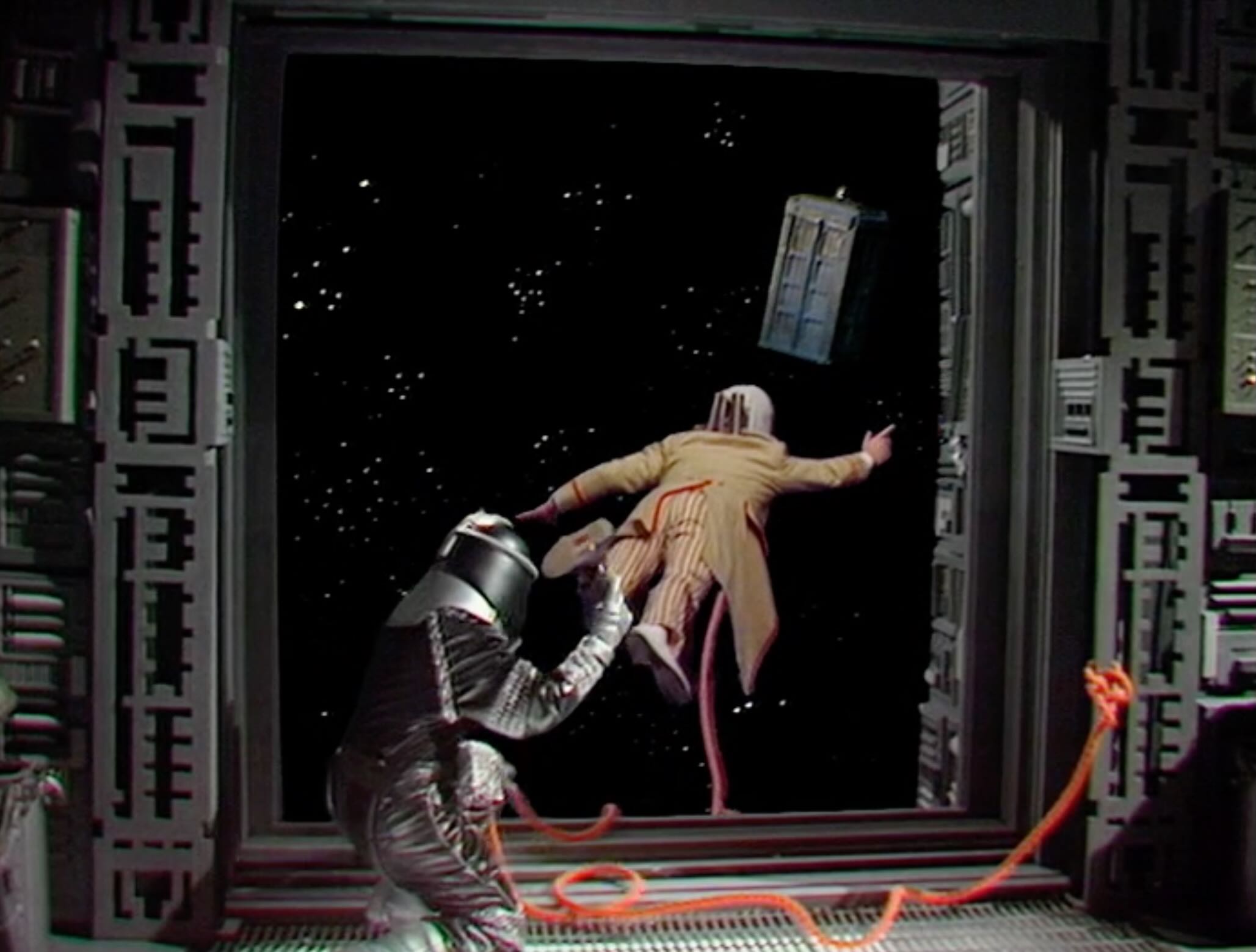
It’s ludicrous to think that she thinks she can do this, and isn’t almost certainly about to get herself completely lost in the universe forever. Not to mention the likelihood that she is almost certainly about to abandon her traveling companions in the process. From a story and character perspective, it’s absurd, and doesn’t really serve any purpose but to get the TARDIS away from the ship so the Doctor has to do his dramatic “space walk” stunt.

And then there’s Adric, who shows astounding naivete and falls completely in to the snake oil that Monarch, the story’s main bad guy, is selling. Adric has a bit of a reputation for siding with the villains in his stories, but usually this is an effort on his part to trick them (see for instance State of Decay, Castrovalva and Kinda). But here he actually goes and does it. Not that he turns fully evil or anything, but from the Doctor’s point of view, dealing with Adric must be pretty irritating. And from a story point of view it’s an interesting idea, but doesn’t play as well on screen as it should. The scripting could definitely have been sharper. And Matthew Waterhouse’s performance is okay and gives the idea of what we’re after, but isn’t exactly believable, per se. Apparently Waterhouse was pretty frustrated with the development, which is I can understand given that it’s kind of out of nowhere.
So out of the companions here only Nyssa comes across as someone the Doctor would actually want to have around. And you can see that in the interactions that they have, especially as they geek out over the advanced equipment they find all over the Urbankan ship. It’s like with Nyssa, the Doctor has got someone to talk to, not just someone he has to deal with.

(Or to save his life when he’s about to be executed–that was a pretty cool Nyssa moment in a story where she didn’t get that much to do).
Aside from all that, the overall story and production of Four to Doomsday has got a lot of promising aspects to it, even if they don’t quite come together as one would wish. I enjoy the whole dynamic of the Doctor and his friends exploring the ship and speaking to their off-screen observers via the flying spy-eyes. I think this would have worked even better if the episode didn’t spend so much time with those observers and hearing what they were saying. Even though they were kept visually off-camera for while, I think the intrigue of the set-up would have worked better if we had just kept with the TARDIS crew exclusively, or close to it, and the reveal would have therefore been more interesting.

Similarly, the little dance concerts from the various cultures was a novel thing to include, and did allow for some moments like the Doctor having hushed conversations with various characters that couldn’t be overheard. But there are too many of them, and they go on for too long for it to not just start to feel like padding.

Kind of like they were thinking, we have all these people on set to do this dancing, I guess we really want to see them, don’t we? Sure yeah, we do, a bit. But mostly I want to see us get on with the story.
Speaking of the Doctor’s hushed conversation, a lot of Four to Doomsday concerns itself with the Doctor, Bigon and the others skulking around the ship trying to circumvent the surveillance, but you have to wonder why Monarch and his cronies allow him so much leave to do what he wants to at all. They’ve got all those androids at their beck and call, the fact that they use them so sparingly definitely comes across as plot contrivance.
And it’s not the only plot contrivance–Bigon’s friends are definitely on Monarch’s side until they just aren’t anymore, Tegan happens to be able to speak an Aboriginal language so that someone from 35,000 years ago will understand, and for some weird reason Monarch flies his ship back and forth between the earth and his planet over tens of thousands of years just to assess it’s suitability. The story ends with the somewhat convenient reveal that Monarch is still organic, something which contradicts everything he has talked about up until that point. It’s fine for a character to be hypocritical, which is presumably the point, but this is never unpacked. Instead it seems to be just a random throw-in to make him vulnerable to the shrinking poison that takes him down in the end.

Something I really enjoy about the story, on the other hand, are the performances of the guest characters. Stratford Johns in particular is good as Monarch. He’s an obviously deranged madman but some dubious strategic choices aside he comes across as a real person. His self-inflated ego, his attempts to manipulate, and the amusement he finds in so many things around him are all brought to life really well. It’s a good performance and it’s always interesting to watch.

Also good are the other guest characters, including Paul Shelley and Annie Lambert as Persuasion and Enlightenment. The nature of their abilities (and thus the threat they pose) isn’t really clear but the actors do a fine job. So too does Philip Locke as the dignified and ultimately heroic Bigon. All of these people help to prop up a story and keep it watchable, in spite of the ways it occasionally drags or lacks cohesion.
And that’s probably a good way to sum of Four to Doomsday. The pacing is off, the companions are a little all over the place, and there are a couple of standout hokey special effects, such as the way they transition between Bigon’s human face and the circuitry underneath, and of course the Doctor’s heroic leap through space (and chucking a cricket ball) to get to the TARDIS.

But it’s still enjoyable and fun to watch. It’s one of the weaker entries into the season, but not a disaster.
Other Thoughts:
• That’s the legendary Burt Kwouk as Lin Futu.

He’s best known, of course, for playing Cato (Inspector Clouseau’s manservant) in, I think, seven Pink Panther films.
• I’m born in the United States but have been living in Australia for pushing close to thirty years, so I think I am pretty reliable when I say that the idea that 20+ year old Tegan knows a random Aboriginal language (of which there are hundreds) well enough to have the conversation that we hear her having is absolutely ludicrously improbable. Nevermind that the language is tens of thousands of years old.
• Having said that, Tegan and Kirkutji are apparently actually speaking a real Aboriginal language (Tiwi), which came about because Janet Fielding objected to the dialogue being just gibberish, which is what was scripted.
• Adding to Adric’s lack of charm in this episode is a bunch of chauvinistic stuff he gets to blurt out: “That’s the trouble with women: mindless, impatient and bossy.” He goes on to say that Nyssa is not a woman, just a girl (it would have been a lot more plausible if Adric had been shown to have a crush on Nyssa or something). I’m not sure how old Nyssa is supposed to be but the actress, Sarah Sutton, is only a year younger than Tegan is supposed to be (although in reality Janet Fielding was a fair bit older).
• At the end of the story, Nyssa abruptly faints.

This was to given an excuse for Sarah Sutton to not appear for most of the following story, Kinda. No clear reason is given either here or there except that she’s experiencing mild mental disorientation. Given that this story provides a perfect rationale for this (Nyssa gets put in a trance a couple of times), it might have been nice if the scenes leading up to her fainting showed any indication of her disorientation, but they did not.
Agen234
Agen234
Agen234
Berita Terkini
Artikel Terbaru
Berita Terbaru
Penerbangan
Berita Politik
Berita Politik
Software
Software Download
Download Aplikasi
Berita Terkini
News
Jasa PBN
Jasa Artikel
Situs berita olahraga khusus sepak bola adalah platform digital yang fokus menyajikan informasi, berita, dan analisis terkait dunia sepak bola. Sering menyajikan liputan mendalam tentang liga-liga utama dunia seperti Liga Inggris, La Liga, Serie A, Bundesliga, dan kompetisi internasional seperti Liga Champions serta Piala Dunia. Anda juga bisa menemukan opini ahli, highlight video, hingga berita terkini mengenai perkembangan dalam sepak bola.