Doctor Who has long been my favorite show, and after a long time of not really watching it very actively, lately I’ve been deliberately working at rewatching all the available episodes of the classic series, and writing up my thoughts on each adventure. But there are a lot of episodes! So it’s taking a while. For extra fun I’m mostly watching them completely out of order.
The Invasion of Time
Starring Tom Baker as the Fourth Doctor
Companions: Louise Jameson as Leela and John Leeson as the voice of K9
Written by David Agnew. Directed by Gerald Blake. Produced by Graham Williams. Script edited by Anthony Read.
Format: 6 episodes, each about 25 minutes long
Originally Aired: February – March 1978 (Episodes 20 – 26 of Season 15)

So The Invasion of Time has had a funny history for me, when it comes to my impression with how good it is. As a kid, first discovering Doctor Who, it was kind of an automatic classic, given that it featured Gallifrey and the Sontarans and a more extensive exploration of the TARDIS interior than ever before. As I got a little bit older and became more familiar with the story’s reputation amongst fans and my overall opinions of Doctor Who under Graham Williams’ producer-ship, I was pretty dismissive of it as weak and trite and too hampered by silliness, punctuated by one of the worst companion-departures ever. But with all of that, my actual memories of the story have been pretty fragmented. So it was cool to have an excuse to actually go back and watch it.
Spoilers Ahead!
So it turns out that the truth about The Invasion of Time, as with many things, is found in balance and understanding the details. The story is far from some kind of absolute classic–just because a story visits Gallifrey or explores the TARDIS interior or has Sontarans or any other element external to the actual quality of production, it’s not necessarily any good. But similarly, just because it’s got some unnecessary silliness and a bad companion departure, that doesn’t make it a disaster. Indeed, it’s a lot further from a disaster than I might have guessed.

The Invasion of Time starts off as an odd sort of mystery, in which it appears that the Doctor himself is working with alien invaders. He refuses to confide in Leela about what’s doing, and acts in uncharacteristically threatening way as he demands the presidency of the Time Lords (something to do with something that happened in The Deadly Assassin, a season earlier). Watching him stomping around, demanding things from everybody like a spoiled child and screaming out orderst really seems like he’s just lost his mind.
It’s an unusual way for the story to begin, all the more-so because it continues, more-or-less until the third episode. It’s only because we know the show and know the Doctor that we assume there is something more going on. The scenes in the TARDIS where it is only the Doctor and K9, where the script could have conceivably let us in on the secret, are still kept ambiguous, so we can’t really be sure. During this time where the Doctor is not functioning as much of a protagonist as he normally does, our attention is divided between a bunch of other characters.

There’s Leela, of course, who is struggling to figure out what is going on and how to reconcile her unwavering faith in the Doctor and everything she is seeing happen. But there’s also three other key guest characters, who all share some of the spotlight. Borusa is the Doctor’s old teacher, who we have seen before but played by another actor, so he may as well be a totally new character. There’s also commander of the guard Andred, who seems a straightforward and fairly heroic figure. And there’s Castellan Kelner, who kind of just sits backs and observes everything with cunning sort of suspicion. Each of these personalities spend their time trying to adapt to the situation in way that’s still in keeping with their sense of duty as Time Lords, and in these first couple of episodes we can’t quite tell what direction their characters will go in.
Then episode three comes along and introduces the Vardans, represented at this point by what looks like shimmering pieces of cellophane.

They are generally made out to be very threatening but the reasons why are not completely clear. But it’s in this episode where the Doctor is finally able to isolate himself from their telepathic probing (via the nice idea of him shielding his room by demanding it be decorated in a peculiar way) and we get what amounts to an outstanding sequence between him and Borusa.
The exact reasons why the Doctor has gone to such extreme lengths to defeat the Vardans could have been made more explicit, but the fact that all he’s done has been to trick them into exposing themselves is very clear, and provides a very nice payoff for everything we’ve seen so for. Suddenly things like banishing Leela and some of the other Time Lords become meaningful. The roles that Andred, Kelner and Borusa have in the story become more specific as well, as does that of Rodan, the other major guest character that we are introduced to. In general, the story gains a lot of momentum as it pushes forward to its climax (a false one, as it turns out).
Unfortunately that climax turns out to be underwhelming.

The Vardans fully materialise and turn out to be the singly least interesting alien invaders that Doctor Who has ever shown us–a couple of mousy-looking guys in uniforms. Now, you could be a mousy-looking guy in a uniform and still be very dangerous, but like I mentioned the show has done almost nothing to establish why these guys are such a threat, and why the Doctor felt he had to go to such lengths to scam them. Leela and the band of outsiders that she has met attack the Citadel, which is exciting but doesn’t really amount to much, and the Doctor pushes a few buttons and the problem is solved.
Of course, that’s where the end of Act 2 twist comes in and the Doctor suddenly finds himself facing Sontarans.

It’s a pretty effective reversal of fortune, but it would have been more effective if the victory the Doctor had just come off of had felt more hard-won.
At this point, Castellan Kelner, who had already thrown in his lot with the Vardans and used the opportunity to impose his own petty rule over the Time Lords, proves himself to be the ultimate collaborator’s collaborator, siding with the Sontarans and working very hard to out-manoeuvre the Doctor until he’s finally arrested at the end. Rewatching the early episodes, of course I knew where Kelner was going as a character but I couldn’t help but to notice that he was written in a way that he could have ended up as the hero of the story, watching the Doctor as he was with quiet suspicion, trying to figure out what he was up to. But no, he ends up being cowardly, opportunistic, and thoroughly unlikeable.
The last two episodes of the story, which deal with the whole Sontaran threat, are a little bit of a rinse and repeat of the previous two, but with just more exciting enemies.

And at first they work pretty well–there is even a second outstanding scene between the Doctor and Borusa, where the Doctor is able to get his hands on the “Great Key” of Rassilon, something it seems that all Time Lord presidents are tasked with seeking, but are not expected to find as it is it already being kept hidden by the Time Lord Chancellor (what does this mean when a Chancellor becomes the President, as Borusa will eventually do?).
But unfortunately, just as the conclusion of the Vardan threat was the least interesting part of the first section of the story, it’s in the last half of the Sontaran plot (and the last episode of the whole serial) where things really break down. A lot of Part 6 is spent with the characters chasing each other around the inside of the TARDIS. Apart from the questionable decision of having the TARDIS interior represented by a bunch of industrial looking staircases and store rooms, it is also boringly repetitive, relying on something that is supposed to be funny but isn’t, and which just ends up helping the episode run down the clock. Worse than that, when the Doctor does get the Great Key and the fearsome and illegal “De-mat Gun”, all the does with it is shoot and disintegrate two Sontarans.

We’d already seen some Sontarans killed by Leela and another outsider, so all the De-mat gun did was take the place of a couple of extra daggers and some good aim.
I’ve heard it said that the idea is that the De-mat Gun erases its victim from time itself, which is a very cool idea, but this is not evident from anything in the episode. Even if we accept the idea that having the gun made it far easier to defeat the Sontarans than would have been otherwise, nothing we see on screen justifies the build-up of having to put Roman under hypnosis to build it, having to force Borusa to give up the Great Key or even the denouement where the De-mat gun seems to destroy itself and erase the whole experience from the Doctor’s mind. It’s like the writers got to the end of the story, thought of something that seemed cool and consequential, and spent minimal time creating something the audience could experience.

So as I’ve said, The Invasion of Time is neither an unmitigated success or an unmitigated disaster. There are some very clear weaknesses, most of which I’ve already mentioned. But let me add a couple more lesser ones:
The bit where the Doctor hypnotises Rodan is terrible–it’s badly written, directed and performed. He simply tells her to look at him, and then announces she is in a state of deep hypnosis. The comment is so flippant, and Rodan’s behavior is so unchanged, that I used to wonder if it was supposed to be a joke, like if the Doctor was just trying to give Rodan an excuse to do something forbidden. But the rest of the story implies that yes, she is in deed hypnotised. If the Doctor can hypnotise people with almost no effort like that, that puts him light-years ahead of the Master. Maybe he can only do it to Time Lords? Maybe he’s too moral to do it most of the time? Whatever, it’s just a bad piece of storytelling.
Most of Tom Baker’s performance in this story I think is fine, but I think his early “bratty” behavior when he first arrives on Gallifrey is hard to believe. Instead of being intense or unsettling, he too frequently just turns to shouting. I know the Doctor is supposed to be acting strangely, he’s doing something on purpose, but for big chunks of these episodes I just don’t believe the performance.

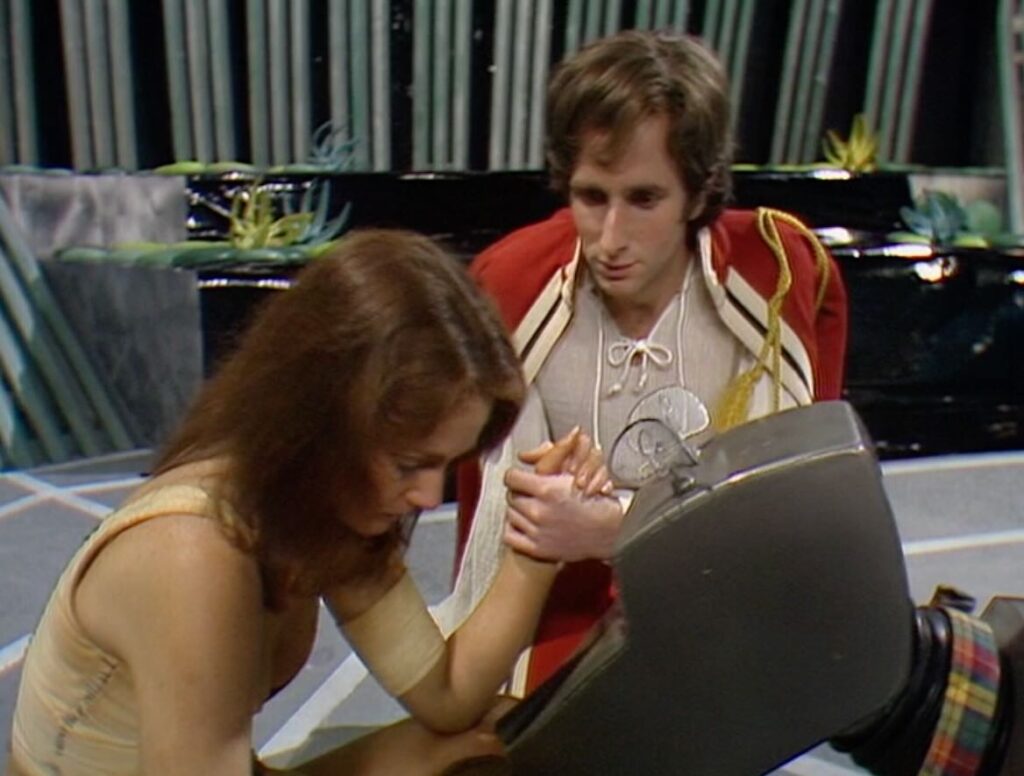
And of course, we have to mention Leela’s departure, which is amongst the series’ least interesting (although it’s not the worst, in my opinion–for that you can see this old post–I still hold to this opinion even though other companions have left the show since I wrote it). It’s not badly acted, it’s just perfunctory and not set up at all. Leela and Andred do interact through the adventure, and they even fought alongside each other, but there’s nothing to indicate that she’s chosen this guy to be her mate. I’ve ready that Louise Jameson and Christopher Tranchell (who played Andred) tried to add some moments between their characters to support this idea once they knew what was happening, and while I appreciate that effort, it’s just not enough. Blame for this most surely fall to Graham Williams, who not only co-wrote the story with script editor Anthony Read under the pen-name David Agnew when another story fell through, but also apparently didn’t believe Louise Jameson when she told them she was leaving the show.
But aside from the story’s various weaknesses, there is also some stuff I think works really well.
As I already implied, the two big scenes between the Doctor and Borusa, after the Doctor has let down his façade, are both excellent.

John Arnatt is the second of four actors to play Borusa, and I think he’s by far the best (I believe most would agree). He and Tom Baker have got excellent chemistry, and the characters in their hands come across as uncertain allies who share a common goal, even if their approaches are radically different.
And even though her departure from the show is weak, this is actually a really good Leela story. Leela gets what amounts to her own adventure through much of the serial, separated from the Doctor as she is, then teaming up with and escaping the Citadel with Rodan, meeting with the Outsiders and galvanising them to action, and finally leading the attack back into the Citadel.

In addition to some cool action stuff (as I said, she gets to kill a Sontaran, for instance) the script goes out of its way to show Leela’s loyalty to the Doctor, and his back to her. Some of the best moments are in Leela’s conversations with Rodan.
When Rodan argues that “Reason dictates the Doctor is a traitor,” Leela replies, “Then reason is a liar!” And there’s also my favorite line, which sums up Leela’s perspective over it all: “You keep your Lord President, I’ll keep my Doctor. He has a plan.”

So as imperfect as it is, there is a lot I enjoyed about The Invasion of Time. And given that Leela is one of my favorite companions (a real contender for my very favorite in the classic era), it’s nice that even though the set-up for her departure is not very good, the story itself does a good job celebrating what makes her unique, and the heart of her relationship with the Doctor.
Other Thoughts:
• As I’ve been going through my classic Doctor Who semi-randomly, season 15 turned out to be the last one where I had not yet rewatched more than half of the available episodes. I’m glad this has happened with The Invasion of Time rather than The Sunmakers because it means that my last story with Leela in one of her “savage” outfits will be with the original brown one, which I like a lot more than the yellow one she wears here. (In The Horror of Fang Rock, which is the other story from this season I haven’t gotten yet, she wears just ordinary clothes).
• This story is, as far as I know, the origin of the idea of the TARDIS having a swimming pool.
• Rodan, as played by Hilary Ryan, is very much a proto-Romana type character.

She’s a Time Lady (the first female Gallifreyan seen since Susan!) who is excessively “book smart” but lacks practical experience. I would not have wanted to trade Mary Tamm for anyone, but if The Ribos Operation had started with the White Guardian bringing Rodan to help the Doctor find the Key to Time, it would have worked perfectly fine.
• Speaking of Rodan, what is up with the decor of her workplace? The area right outside her station, where they are meant to be keeping an eye all of Gallifreyan planetary security, looks a lot like it’s the waiting room for some kind of childcare centre with its bright plastic furniture.

• The Doctor has to figure out a secret lock that Borusa has in his office that is voice-activated. The key is just saying, “There’s nothing more useless than a lock with a voiceprint.” Well, later in The Five Doctors, there’s also a scene of the Doctor trying to figure out a sound-operated lock of Borusa’s, which is very similar–only in this case the key is a piece of music. That Borusa loved his sound-operated locks!
• When Leela is meeting the Outsiders outside of the Citadel, she is introduced to a young guy named Ablif, who looks at her like he’s thinking, “Man, if this girl needs some guy to abruptly hook up with so that the writers have an excuse to abruptly write her out of the show, I would be happy to volunteer!”

Of course, too bad for him, he ends up getting killed by the Sontarans before he has his chance.
• Amongst the many silly things in this story, the image of K9 wearing the Matrix circlet and the Sash of Rassilon, is for sure one of the most ridiculous.
• While walking around the TARDIS, Borusa at one point says, “I wish you’d stabilise your pedestrian infrastructure, President,” hinting at an idea that becomes more common as things go on, which is that the TARDIS isn’t just enormous (and possibly infinite) but it’s also variable–changing according to various circumstances.
• As the Sontarans are wandering around inside the TARDIS, one of them walks in front of the most conspicuous-looking man-eating plant I have ever seen, and gets himself chomped down on for his troubles (although not fatally, it turns out).

• Along with Leela, K9 also stays on Gallifrey, but we don’t think about it very much because as hinted at at the end of the serial, the Doctor already has plans to build a “Mark II” K9. This will amount to the last time we see the original K9 on TV, unless one counts the brief appearance of classic K9 that is scene in the Australian-produced spinoff, K9, in which the original K9 Mark I (apparently this same one) is forced to self-destruct before being rebuilt into a new and more advanced CGI incarnation.

• Amongst the guest cast for this story is Milton Johns (Kelner) who also played Benik in The Enemy of the World and a character called Crayford in The Android Invasion, a story I have not rewatched yet. Christopher Tranchell, who plays Andred, had previous appeared in The Massacre and The Faceless Ones. Stuart Fell is the other main Sontaran aside from Stor–he was a frequent Doctor Who stuntman, actor, and occasional fight arranger. He was the acrobatic performer in The Masque of Mandragora and was the body of Alpha Centauri in both The Curse of Peladon and its sequel, The Monster of Peladon.)
PakarPBN
A Private Blog Network (PBN) is a collection of websites that are controlled by a single individual or organization and used primarily to build backlinks to a “money site” in order to influence its ranking in search engines such as Google. The core idea behind a PBN is based on the importance of backlinks in Google’s ranking algorithm. Since Google views backlinks as signals of authority and trust, some website owners attempt to artificially create these signals through a controlled network of sites.
In a typical PBN setup, the owner acquires expired or aged domains that already have existing authority, backlinks, and history. These domains are rebuilt with new content and hosted separately, often using different IP addresses, hosting providers, themes, and ownership details to make them appear unrelated. Within the content published on these sites, links are strategically placed that point to the main website the owner wants to rank higher. By doing this, the owner attempts to pass link equity (also known as “link juice”) from the PBN sites to the target website.
The purpose of a PBN is to give the impression that the target website is naturally earning links from multiple independent sources. If done effectively, this can temporarily improve keyword rankings, increase organic visibility, and drive more traffic from search results.