Doctor Who has long been my favorite show, and after a long time of not really watching it very actively, lately I’ve been deliberately working at rewatching all the available episodes of the classic series, and writing up my thoughts on each adventure. But there are a lot of episodes! So it’s taking a while. For extra fun I’m mostly watching them completely out of order.
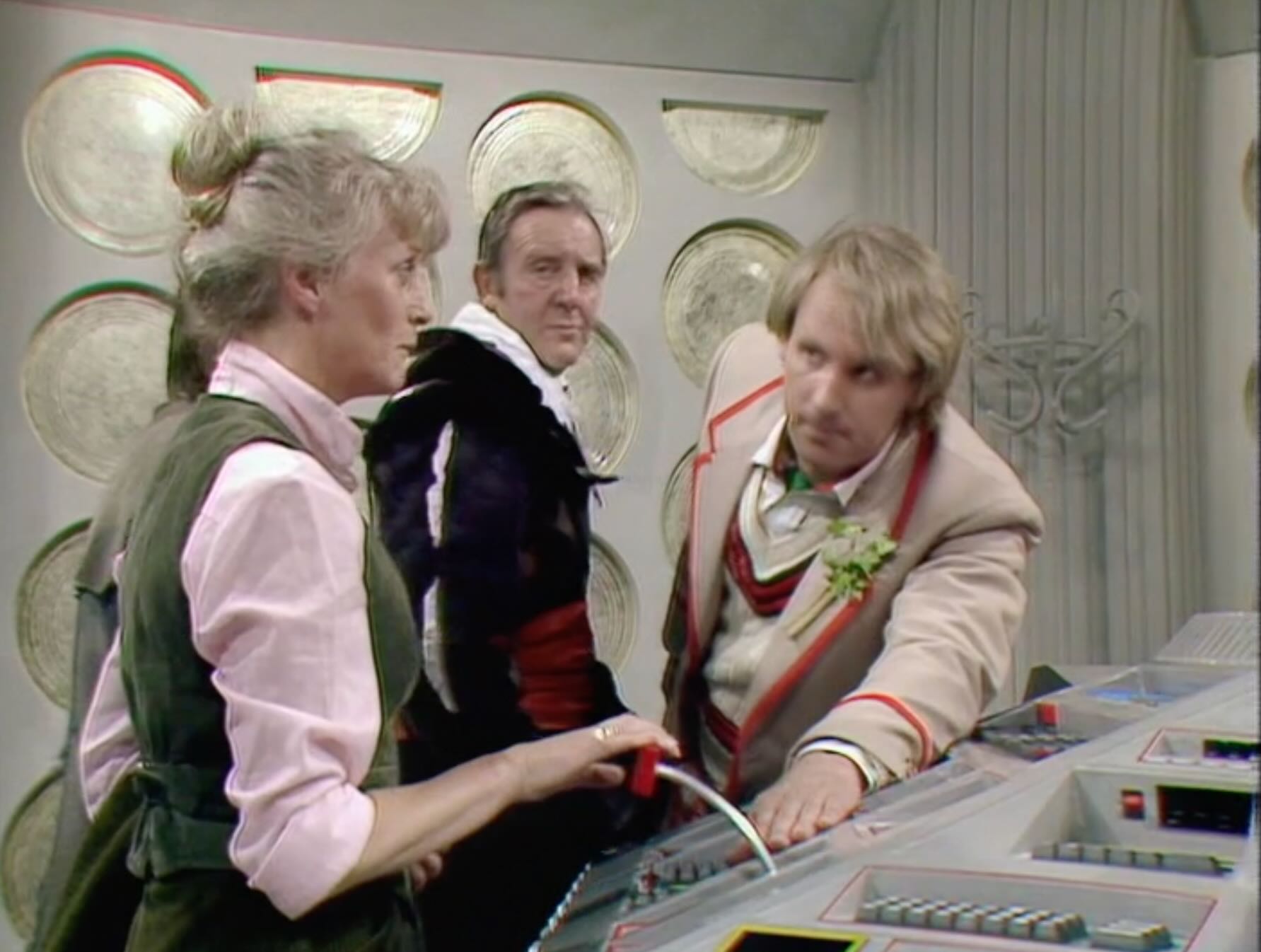
The Awakening
Starring Peter Davison as the Fifth Doctor.
Companions: Janet Fielding as Tegan and Mark Strickson as Turlough.
Written by Eric Pringle. Directed by Michael Owen Morris. Produced by John Nathan-Turner. Script edited by Eric Saward
Format: 2 episodes, each about 25 minutes long
Originally Aired: January 1984 (Episodes 5-6 of Season 21)

The Awakening is not the last two-parter in classic Doctor Who, but it is pretty much the last one of the “classic” two-part length–in other words, episodes that are only 25 minutes long (unless of course you count the last bit of Trial of a Time Lord). It’s a bit of a rare format for the classic series, and out of all of them I’d say The Awakening makes a good case for being the most ambitious and successful.
Spoilers Ahead!
In many ways, The Awakening would be very at home as an adventure from the revived era of Doctor Who. This is in part because of the runtime (with most modern stories being the equivalent of about two classic episodes), but there are other things as well. The adventure takes place on modern day earth with a companion looking to hang out with her family. The drama drops us right into the middle of the action with a very tight set-up and barely any time for explanations except for what we can get as we run around through the set pieces. And the nature of the Malus as a sort of existential eldritch nightmare (even with its science fiction backstory) would be very at home in the latter years of the show.

All of this feels like an episode of the show under Russell T. Davies or Steven Moffat, especially connecting the story with a companion’s family or home life. And this was the first time this had ever happened on the series–prior to this relatives were pretty much doomed to die in a new companion’s debut story (Victoria’s father, Adric’s brother, Nyssa’s father, Tegan’s aunt).
Now suddenly there’s the idea that Tegan could just go and visit her family, and it doesn’t mean she has to leave the Doctor or anything. There’s even a sequence at the end everyone argues that the Doctor should stay and hang out a bit, which feels exactly like something we’ve seen with David Tennant or Matt Smith.

I like all of it, it feels like neat developments, even if this sort of thing became overly commonplace under Russell T. Davies. But back in these earlier, more innocent times, the idea of revisiting someone like Andrew Verney, and his neighbors, actually, now and again would have been kind of nice (if Tegan had ended up being around for even longer).
The tightness of The Awakening‘s plot works very much to its favour. It hits the ground running and manages to squeeze quite a lot into less than an hour. The guest cast immediately instil their characters with distinctive voices and personalities, so that even as we meet them all in quick succession their relationships and positions in the story are clear.

Amongst the distinguished presences of the likes of Dennis Lill, Glyn Houston, Polly James and Frederick Hall, the most notable guest performance is from Keith Jayne as young Will Chandler, the boy from the 1600s. He gives Will tremendous personality and makes him a fun part of the whole landscape of the story.
The character is such a lively part of the story that he was apparently considered for “regular companion” status. It’s an idea that sounds interesting at first, and it briefly feels like the story is actually going in that direction toward the end. But it’s hard to imagine how Will would really have on the show in an ongoing fashion, especially given all the major changes that were coming.

The Malus is an interesting idea, if a little confusing. Not exactly a living thing, not exactly a machine, but an entity of enormous psychic energy and destructive intent which manifests as a big stone face with glowy eyes. I love the fact that it never speaks, but only operates through the poor deranged Sir George and his desire for power.
The Malus also shows up as bizarre stone-lizard type creature that appears on the wall inside the TARDIS, which is a very creepy idea, particularly when it starts leaking all sorts of gross green goo as the Doctor cuts it off from its power source.


The realisation of the Malus from a production standpoint of course comes with all the limitations of the day. The design is interesting and used fairly well, but is never exactly convincing. Still, it’s better than the other psychic apparitions that come long, which often just look like pixellated dots blinking awkwardly in the sky.
Overall the whole village design of the story works quite well (even if the historical costumes are a bit next-level if they were originally just for a village festival), but the science fiction effects are what they always are on this show, which is a product of the budget and the time period.

Also, it must be noted that in spite of The Awakening’s lean length, there still is some room for some semi-pointless running around, getting caught, escaping, etc. At point the Doctor just seems to walk right up to all the villagers just so he can almost get captured. The drama is overall pretty eventful but even at only two episodes there is padding.
It is pretty minimal though, and mostly the story is breezy fun, punctuated by good dialogue. Maybe the most classic line is the Doctor’s response to being told that speaks treason–“Fluently.” But I also enjoy the funny little conversation between Turlough Will and the Doctor that closes out the story. On the news that they are staying for a while, Turlough says, “Good. I quite miss that brown liquid they drink here.” “Ale,” Will offers, but Turlough corrects him–he’s talking about tea. Will asks “What be tea?” and the Doctor explains, “Oh, a noxious infusion of oriental leaves containing a high percentage of toxic acid.” Will says it “Sounds an evil brew, don’t it,” and the Doctor replies, “True. Personally, I rather like it.”

Other Thoughts:
• The script makes references to the Terileptils, and related concepts like the mineral tinclavic and the planet Raaga, all from The Visitation. Apparently, these were added by script editor Eric Saward, who had written The Visitation.
• There is some fun direction and largely non-verbal characterization that comes through with the character of Jane Hampden related to the lever that controls the TARDIS door.

You see her notice Tegan using it, and then later she surprises the Doctor by showing that she understands its use. Finally, at the end he asks to close the door for him, which she does.
• This story is designed by Barry Newbery. He had been a designer on the show since almost the very beginning, with the second take of the first episode of An Unearthly Child (apparently, the original designer was ill when it was time to film it for the second time, and Newbery had it all remade according to the original designs). The Awakening is the last contribution he made to the series. Newbery died in 2015.
Agen234
Agen234
Agen234
Berita Terkini
Artikel Terbaru
Berita Terbaru
Penerbangan
Berita Politik
Berita Politik
Software
Software Download
Download Aplikasi
Berita Terkini
News
Jasa PBN
Jasa Artikel
Situs berita olahraga khusus sepak bola adalah platform digital yang fokus menyajikan informasi, berita, dan analisis terkait dunia sepak bola. Sering menyajikan liputan mendalam tentang liga-liga utama dunia seperti Liga Inggris, La Liga, Serie A, Bundesliga, dan kompetisi internasional seperti Liga Champions serta Piala Dunia. Anda juga bisa menemukan opini ahli, highlight video, hingga berita terkini mengenai perkembangan dalam sepak bola.