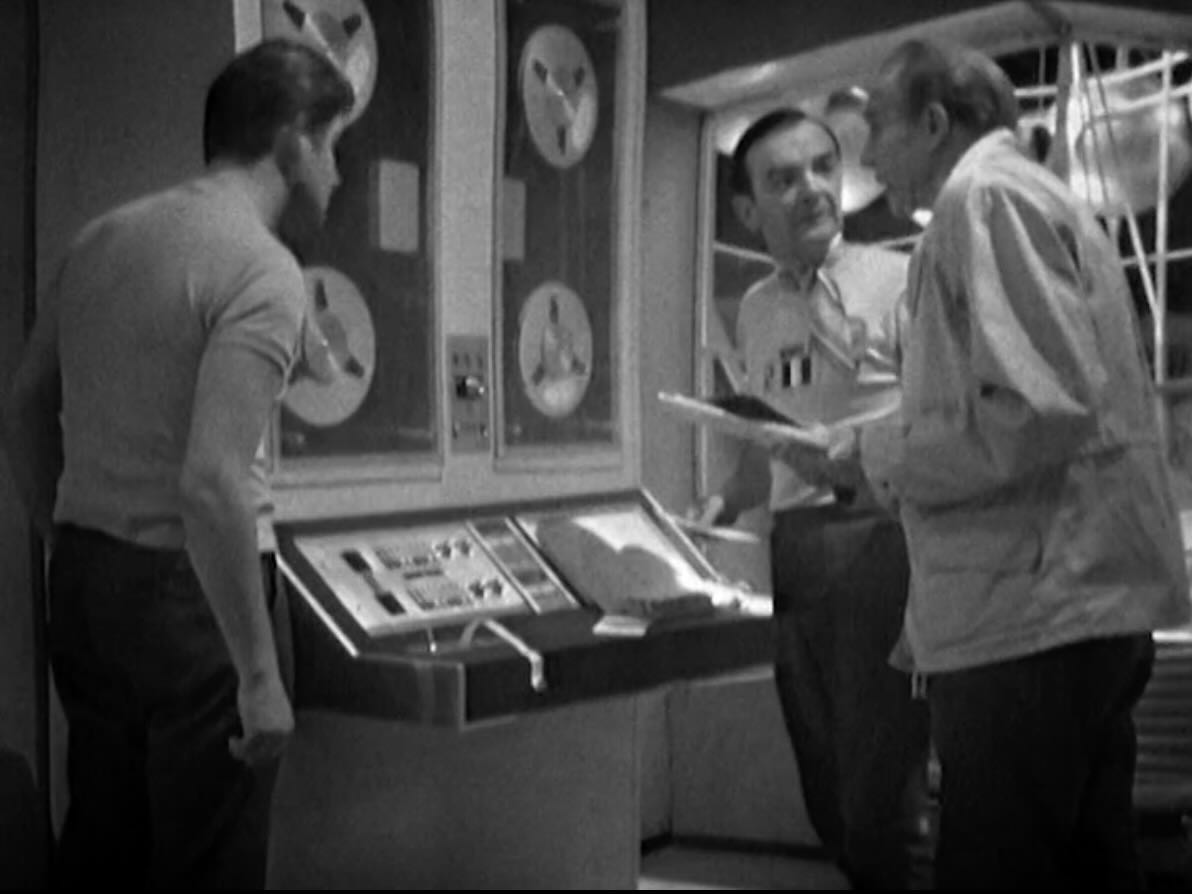
As mentioned previously, in “Impossible Voyages” I’m watching and writing about a run of new (to me) science fiction films to be watched over last year, which has extended to this year (2026). You can read the rationale and ground rules here. In the meantime, we are advancing from 1960 to 1961 with this movie, #39 in this series.
Sometimes picking films for this series is a bit tricky. I want to read a bit about the film’s concept or style so I can decide if it’s something that I want to watch, but I don’t want to read too much about it so I don’t spoil anything about the experience of seeing it for the first time. As a result, all I knew about The Flight That Disappeared was something about scientists being taken from a plane by beings from the future for the crime of developing a weapon that would one day destroy the future. Sounds like an intriguing premise, right? Unfortunately, “an intriguing concept” does not equal “a good movie.”
Spoilers Ahead
The Flight That Disappeared (1961)
Directed by Reginald LeBorg

The Story: A flight to Washington DC suddenly begins to experience malfunctions, whereby they are unable to stop ascending. Eventually everyone passes out due to lack of oxygen. Three scientists who are on board wake up and find themselves in a sort of timeless limbo, put on trial by a jury of potential people from the future for the crime of contributing to the invention of a super-weapon that may someday destroy all life on earth (and thus prevent these beings from ever existing). The scientists are found guilty and sentenced to remain in limbo for eternity, but one of the future beings argues that people of the present cannot be judged by beings such as them. The scientists are returned to the plane, the events of the flight are undone and everyone’s memories of the events are erased. Only the scientists recall what happened, but they argue whether was some sort of shared dream. However, when the plane lands, they find that they have lost 24 hours of time. This convinces the scientists and the main one who developed the weapon chooses to destroy his notes to save the future.
Starring: Craig Hill, Paula Raymond, and Dayton Lummis as the three scientists: Tom Endicott (the engineer who developed the rocket system that can deliver the weapon with precision), Marcia Paxton (a mathematician whose work assisted in creating the weapon) and Dr. Carl Morris (the scientist who actually invented the so-called “beta bomb”).

Other passengers include Harvey Stephens and Meg Wyllie as Walter and Helen Cooper, and Roy Engel as Dr. Morris’ seat-mate Jameson. The flight crew includes John Bryant as Hank Norton (the pilot), Brad Trumbull as Jack Peters (co-pilot), Jerry James as Ray Houser (flight engineer), Bernadette Hale as Joan Agnew (lead stewardess) and Nancy Hale as Barbara Nielsen (another stewardess, who is engaged to the co-pilot). Francis De Sales plays George Manson, the operations manager on the ground who is overseeing the flight. Gregory Morton plays the Examiner, the being from the future who judges the scientist, and Addison Richards is the Sage, the one who argues that the should be set free.
Comments: It’s possible that the story for The Flight That Disappeared would have a pretty good Twilight Zone episode. A half hour episode, not one of those hour long ones that drag on. Because the most obvious problem that The Flight That Disappeared is that it does drag on. And on and on. The movie is only 72 minutes long, but it’s easily three times longer than necessary.
A lot that time is spent in introducing and developing (to some degree anyway) a whole variety of side characters who don’t actually contribute much the story. We get all this banter from the plane’s crew in the cockpit–teasing each other, talking about their future career plans and arguing over the merits of propellors vs. jets, and so on. We get exposition about the fact that stewardess Barbara is engaged to marry co-pilot Jack in just a few days, with their colleagues playfully suggesting to each of them to break it off. And we get all this business with the guys back at the airfield who are stressing about what to do about the out-of-control flight, and even news footage of the story being reported to the world.

Literally zero of this has any bearing on the actual plot.
Even the odd little subplot about Walter Cooper ends up contributing the story in any sort of meaningful way. Walter is a passenger suffering from sort of nervous breakdown over his imminent fear of some unspecific military enemy. He is travelling with Helen, his long-suffering and blind wife who is trying just to convince him to take a break. When the plane is going out of control, Walter becomes so stressed that he leaps out of the plane to his death.

At the end, it’s Walter’s presence that proves to Tom Endicott that somehow his experiences have been “undone”…but the film does nothing to address Walter’s own story. The guy was barely functional even before he went crazy and left his poor blind wife to face life without him. But when we see him at the end, he seems fine. So even though all the time the movie spends with him seems like it’s going to be important, it’s not.
Now, I just wrote about a Doctor Who story called Horror of Fang Rock which also featured a bunch of little side stories that end up not mattering (because those characters all get killed by the monster), and I was pretty positive about it. The difference is that the story that is going on in the background there, with the mounting threat of a mysterious threat of an alien creature, is actually interesting. In The Flight That Disappeared, there is nothing like that. There is some very slow exposition of the existence of the “beta bomb” and the potential to actually deliver it as Endicott gets to know Marcia and Dr. Morris, but it’s the sort of thing that in our hypothetical Twilight Zone episode would have been unpacked in about eight minutes.

Even the end of the movie, after everyone has been returned to the plane and it lands successfully, it still takes forever to get to its final twist (the lost day). Maybe it would have been different for the original audience, but from my 21st century point of view that twist is obvious–we know well before the film thinks we do that the plane has been missing longer than the crew and passengers believe. The only “tension” to speak of is exactly how much time has gone by, and that is not enough to sustain interest.
The most intriguing part of the story is naturally the part where our core trio find themselves facing judgment from the future. What exactly is going on here is not clear–these aren’t future survivors of earth who are angry at the people who caused the apocalypse (which would actually make this all a bit closer to Terror from the Year 5000), but actually the ghosts of potential people who will never exist because of the apocalypse.

That is a neat, far-out idea, and I only wish the movie had devoted more of its run-time to exploring it, rather than to whether the stewardess and the co-pilot will actually be happy as a married couple.
The Flight That Disappeared is evidently a very low-budget movie. There are only a small handful of sets which are shot in pretty repetitive ways. There’s no evidence of any sort of spectacle on display, with the apocalypse represented by some stock photos and even the mysterious time-limbo being depicted by just some foggy ambiance around a few fake rocks. The ghostly people from the future (they are never given any sort of general name) look like they were all auditioning for the same spot in a Sears’ catalog on a casual-wear page.

This is not any more inherently ridiculous than if they were wearing space-aged silver jumpsuits or something, but somehow it is even more jarring just because it feels like nobody is trying that hard.
But the lack of a meaningful production budget is not a fatal flaw–tons of interesting stuff has been produced on a shoestring, including episodes of both Doctor Who and The Twilight Zone, and still managed to be interesting. The Flight That Disappeared has got interesting undercurrents; it seems evident that it aspires to be an ethics-driven piece that is preaching about the danger of nuclear weapons and calling out for greater moral responsibility. But this messaging is clunky at best, and any interesting ideas are so lost in the fog of so much meaningless that it’s easy to miss.

Other Thoughts
• One interesting thing about the movie is what it purports about air travel in 1961 (whether it is accurate or not). For instance, the plane, which is travelling between Los Angeles and Washington, DC, is equipped with a lounge, where passengers can sit, drink and chat. Also smoking seems allowed pretty much everywhere–I’m old enough to remember smoking on flights but not anything like a lounge. Also, oxygen is available on the flight, but not in masks that drop from the ceiling but in tanks that the stewardesses have to carry out to dispense to people.
• What’s not accurate, from what I’ve read, is how long everyone is able to remain conscious, far above the normal threshold for such things (they end up at over twice the intended altitude) and how long the extra oxygen supply lasts. But I guess that can be attributed to the intervention of the future-ghosts. Maybe they can explain also how casual most of the crew seem to be at their predicament? I don’t know.
• I don’t know the cast of this film at all, with the exception of Meg Wyllie, who plays the blind Helen Cooper.

She is well-known to me as the main Talosian in the original unaired Star Trek pilot, The Cage, and thus as a big part in first season two-parter, The Menagerie.

So that’s interesting.
PakarPBN
A Private Blog Network (PBN) is a collection of websites that are controlled by a single individual or organization and used primarily to build backlinks to a “money site” in order to influence its ranking in search engines such as Google. The core idea behind a PBN is based on the importance of backlinks in Google’s ranking algorithm. Since Google views backlinks as signals of authority and trust, some website owners attempt to artificially create these signals through a controlled network of sites.
In a typical PBN setup, the owner acquires expired or aged domains that already have existing authority, backlinks, and history. These domains are rebuilt with new content and hosted separately, often using different IP addresses, hosting providers, themes, and ownership details to make them appear unrelated. Within the content published on these sites, links are strategically placed that point to the main website the owner wants to rank higher. By doing this, the owner attempts to pass link equity (also known as “link juice”) from the PBN sites to the target website.
The purpose of a PBN is to give the impression that the target website is naturally earning links from multiple independent sources. If done effectively, this can temporarily improve keyword rankings, increase organic visibility, and drive more traffic from search results.