There are probably a bunch of movies out there called River, but I’m talking about a Japanese movie from director Junta Yamaguchi and writer Makoto Ueda. Who? These are the geniuses behind Beyond the Infinite Two Minutes, an incredibly clever Japanese comedy time travel film. River is also a an incredibly clever Japanese comedy time travel movie, and one that I think I like a bit better.
(Incidentally, neither of these are my favorite Japanese comedy time travel movie. That is, of course, Summer Time Machine Blues, which I’ve written about several times on this blog including here, which is also written by Ueda, based on his own play. Basically, I love this guy’s work).
Spoilers Ahead
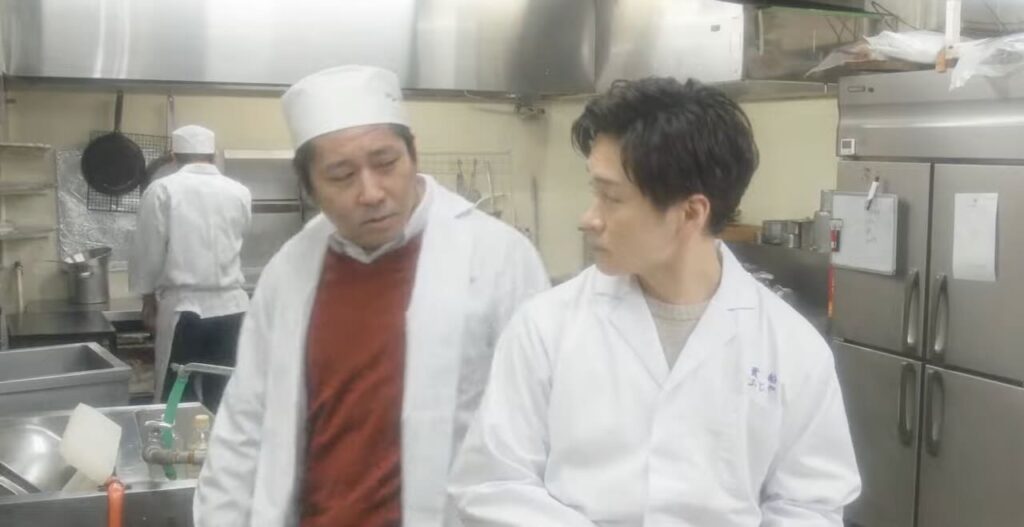
So River is about the staff and guests at a ryokan (basically, a traditional Japanese inn) and restaurant near Kyoto who suddenly, in the middle of their day, find themselves experiencing a two minute time loop. It’s a lot like every other time loop movie you’ve seen, where everything resets after the given amount of time and nothing that happened during the reset period has any consequences. The difference is the short amount of time that each loop consists of, and the fact that it happening to everyone in the vicinity, and they are all aware of it.

Our focal character is Mikoto, a waitress, who starts each loop looking out in a pensive mood at the Kibune River behind the ryokan. What is she thinking about? The film will unpack that, but for now there are guests to be taken care of. Even though everyone is going through this bizarre phenomenon, it’s important to Mikoto and her fellow staff to make sure they are well-taken care of and having the smoothest possible experience at their facility.
This is where a lot of the humor comes from in the movie, at least initially. Everyone is trying to figure out what is going on and how it might be stopped, but in the meantime the guests require their tea and need someone who will listen to them complaining about how their work on their novel keeps disappearing, or marvelling at how their rice bowl keeps refilling itself.

Personally, I find it all fascinating. I have Japanese background, but very little overt Japanese culture, so any time I see this kind of thing I feel like bits of the undercurrents of my worldview are on display. But that wouldn’t be enough by itself to make me recommend the movie. I recommend it because it is really cleverly scripted, a fun puzzle made up of lots of moving pieces that are all fun and funny to watch. But in the midst of all this conceptual deftness, there is an emotionally engaging story being told about Mikoto’s desires to hold onto the things that matter to her.
A lot of this has to do with her relationship with Taku, a young man who works in the kitchen but who aspires to travel and do something more with his life (ie learn to cook French food). There is something in Mikoto’s soul (the Japanese soul?) that can’t quite allow herself to fully live out those hopes and desires until the mechanism of the time loop both forces her to and liberates her to. It’s beautiful and heartfelt, and I’d say overall more successful at this side of things than either of the other two films I’ve seen by the same writer.

Much of the movie’s success is thanks to an outstandingly sweet and animated performance by Riko Fujitani as Mikoto. The cast around her are all good as well, particularly Munenori Nagano as one of her fellow employees (both actors were also in Beyond the Infinite Two Minutes, and Munenori Nagano also co-starred in Summer Time Machine Blues).
The directing is also interesting: each iteration of the time loop is presented in single continuous two minute shot. All these elements come together to make a movie that is never boring, in spite of it’s intrinsically repetitive nature.

Something else I love about River is that at the end, there is no ambiguity about what is going on. In spite of all the work the time loop is doing in the emotional lives of the characters, this isn’t of those films where some sort of semi-supernatural thing is just randomly happening to teach our characters a lesson. I mean, it is of course, but the movie takes the time to deliver a satisfying conclusion to the plot that wraps up everything quite neatly.
To be clear, I don’t mind those semi-supernatural life lesson movies (I made one that was even also about a time loop, after all), but one of the things I’ve enjoyed about Ueda’s work is how well the narrative jigsaws actually fit together. The ultimately concrete nature of his stories are a feature that I really enjoy.
Because within this clear structure, there is already plenty of poetry. Honestly, it’s a lovely movie that is well worth your time.

And if you live in Australia, anyway, it’s freely available to stream (time of writing) on SBS!
Additional Thought:
There is a quirky feature of the movie that in the various time loops, the weather doesn’t remain consistent. This is explained away through a bit of a dialogue, and there is an effort to tie the weather into Mikoto’s emotional state. But the real reason is apparently there was an unexpected snowstorm that the filmmakers had to adapt themselves to. In the end it just becomes part of the film’s magic.
PakarPBN
A Private Blog Network (PBN) is a collection of websites that are controlled by a single individual or organization and used primarily to build backlinks to a “money site” in order to influence its ranking in search engines such as Google. The core idea behind a PBN is based on the importance of backlinks in Google’s ranking algorithm. Since Google views backlinks as signals of authority and trust, some website owners attempt to artificially create these signals through a controlled network of sites.
In a typical PBN setup, the owner acquires expired or aged domains that already have existing authority, backlinks, and history. These domains are rebuilt with new content and hosted separately, often using different IP addresses, hosting providers, themes, and ownership details to make them appear unrelated. Within the content published on these sites, links are strategically placed that point to the main website the owner wants to rank higher. By doing this, the owner attempts to pass link equity (also known as “link juice”) from the PBN sites to the target website.
The purpose of a PBN is to give the impression that the target website is naturally earning links from multiple independent sources. If done effectively, this can temporarily improve keyword rankings, increase organic visibility, and drive more traffic from search results.