Doctor Who has long been my favorite show, but my actual viewing it over the years has been very on-again / off-again. Lately, it’s been all-on, as I’m actually closing in on finishing re-watching all of the classic episodes (at least the ones that are easily available for me to stream), whilst blogging about each serial.
Frontios is my second-to-last Fifth Doctor story to rewatch. It’s directed by Ron Jones, who, interestingly, also directed both the last story from this era that I watched (Time-Flight) and the only story I still have left to do (Ark of Infinity). What a goofy coincidence–I did not do this on purpose.
Frontios
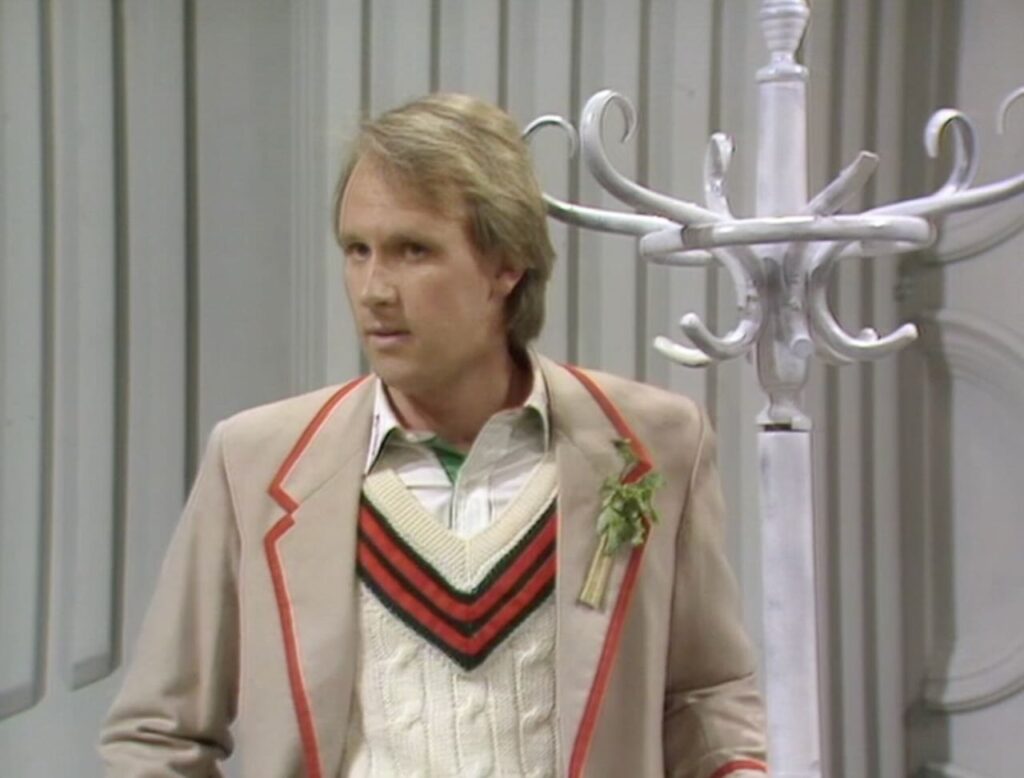
Starring Peter Davison as the Fifth Doctor.
Companions: Janet Fielding as Tegan Jovanka and Mark Strickson as Turlough
Written by Christopher H. Bidmead. Directed by Ron Jones. Produced by John Nathan-Turner. Script Edited by Eric Saward.
Format: 4 episodes, each about 25 minutes long
Originally Aired: January – February 1984 (Episodes 7-10 of Season 21)

Spoilers Ahead!
Frontios is written by former script editor Christopher H. Bidmead, and it reflects the generally grounded tone that he brought to the show (or attempted to, anyway). We get some nifty concepts like the last vestiges of humanity on the brink of societal collapse, and an alien threat that uses control over gravity to attack a colony and drag victims under the ground. None of it is exactly “hard science fiction,” but it’s a story that takes itself seriously and wants the audience to do the same. Sure there are monsters that are up to no good, but the story has got a lot more going on than just showing people getting killed by another invading force.
Speaking of those monster, the Tractators are one of the more impressive original creations of this era. Resembling giant wood lice, they’ve got all the limitations that one would expect of 80s Doctor Who, but they are quite well designed and effective in their appearance.

The fact that the fear of them is somehow buried in Turlough’s race-memory adds to their gravitas (I’m not trying to be funny here, it’s just the term that fits). Apparently Christopher H. Bidmead was approached about developing other stories featuring the creatures, but sadly this never came to be and this was Bidmead’s last contribution to the series.
I think one of the things that the story excels at is the characterization of the regulars. I really liked seeing Peter Davison’s Doctor work so hard to find ways to help the colonists (including medically) all while trying to keep off the Time Lord’s radar. And while Tegan has a solid presence throughout the action as the character who is just the most in the thick of everything, it’s Turlough who really stands out. Mark Strickson does a good job taking the the guy into new places.

He gets to play blindingly traumatised, of course, but he also has the opportunity to show some growth in the normally fretful and occasionally treacherous companion, as Turlough displays unexpected backbone by going back into the thick of danger to help others.
Although arguably, his presence is what gets Brazen killed–it seems to be panicked reaction to the Tractator’s excavation machine that leads to Brazen being caught by the thing. I’d chalk this up to poor direction, however. Most of Ron Jones’ work as director I think is pretty strong in this serial, but this one sequence in the final episode is needlessly clunky and not fully believable.
In general though, I like the way the serial is able to create the sense that it’s setting is real and populated, even with its limited budget. The main guest characters–Brazen, Norna, Range, Plantagenet and the Gravis–have all got clearly defined personalities and roles in the story, and all performed well. There are some effective moments of horror, particularly with people being dragged under the ground and the reveal Captain Revere attached to the excavation machine.

And there are some unexpectedly funny quirks in the midst of generally serious tone–I’m thinking of the Doctor claiming that Tegan is a malfunctioning android to pull of his deception of the Gravis, and the way Turlough pretends the TARDIS coat rack is a weapon.
The serial does, arguably, try to fit too much into its run-time. The story of Cockerill, the orderly who comes to be viewed as some sort of messianic figure by the rabble of Frontios, does not really pay off, for instance. And that’s a pity because I thought it was an interesting complication. And what exactly is going on with the TARDIS, having somehow been demolished and scattered around the planet, and then reformed by the Gravis’ mastery of gravity, is never quite clear. And given that that turns out to be key to the Doctor’s victory in the end, that is a genuine weakness to the story.

But overall I quite liked Frontios as a story with some unique ideas, solid characterization and good performances. Given that this season also includes Resurrection of the Daleks (overly-violent but strong) and The Caves of Androzani (the era’s very best story), it might mean Season 21 is Peter Davison’s best, in spite of the fact that it was kicked off with Warriors of the Deep.

Other Thoughts
• Christopher H. Bidmead wrote three Doctor Who serials, and all of them had one-word titles named after the story’s most important location (the others being Logopolis and Castrovalva). Of the three, Frontios is by far the one that spends the most time on its titular planet.
• The pre-production of Frontios was marked by several tragic events. Apparently, Barrie Dobbins was originally slated to be the story’s designer, but committed suicide due to some sort of mental health breakdown, prompting him to be replaced by the credited David Buckingham. And before William Lucas was cast, Peter Arne was meant to play Range–but he was murdered on the day of his costume fitting!
• Actress Lesley Dunlop, who played Norna, later played Susan Q in The Happiness Patrol.
PakarPBN
A Private Blog Network (PBN) is a collection of websites that are controlled by a single individual or organization and used primarily to build backlinks to a “money site” in order to influence its ranking in search engines such as Google. The core idea behind a PBN is based on the importance of backlinks in Google’s ranking algorithm. Since Google views backlinks as signals of authority and trust, some website owners attempt to artificially create these signals through a controlled network of sites.
In a typical PBN setup, the owner acquires expired or aged domains that already have existing authority, backlinks, and history. These domains are rebuilt with new content and hosted separately, often using different IP addresses, hosting providers, themes, and ownership details to make them appear unrelated. Within the content published on these sites, links are strategically placed that point to the main website the owner wants to rank higher. By doing this, the owner attempts to pass link equity (also known as “link juice”) from the PBN sites to the target website.
The purpose of a PBN is to give the impression that the target website is naturally earning links from multiple independent sources. If done effectively, this can temporarily improve keyword rankings, increase organic visibility, and drive more traffic from search results.