Doctor Who has long been my favorite show, but my actual viewing it over the years has been very on-again / off-again. Lately, it’s been all-on, as I’m actually closing in on finishing re-watching all of the classic episodes (at least the ones that are easily available for me to stream), whilst blogging about each serial.
The Android Invasion comes in the middle of season 13 of classic Doctor Who, and thus in the middle of a year that saw UNIT being phased out of the show’s regular format. This is visible over three serials–Terror of the Zygons at the start, The Seeds of Doom at the end, and this one, pretty much right in the middle.
The Android Invasion
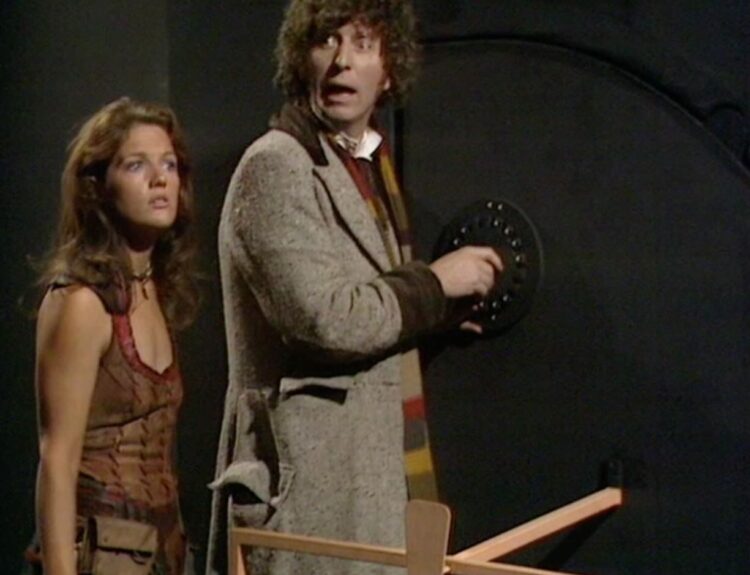
Starring Tom Baker as the Fourth Doctor.
Companion: Elisabeth Sladen as Sarah Jane Smith
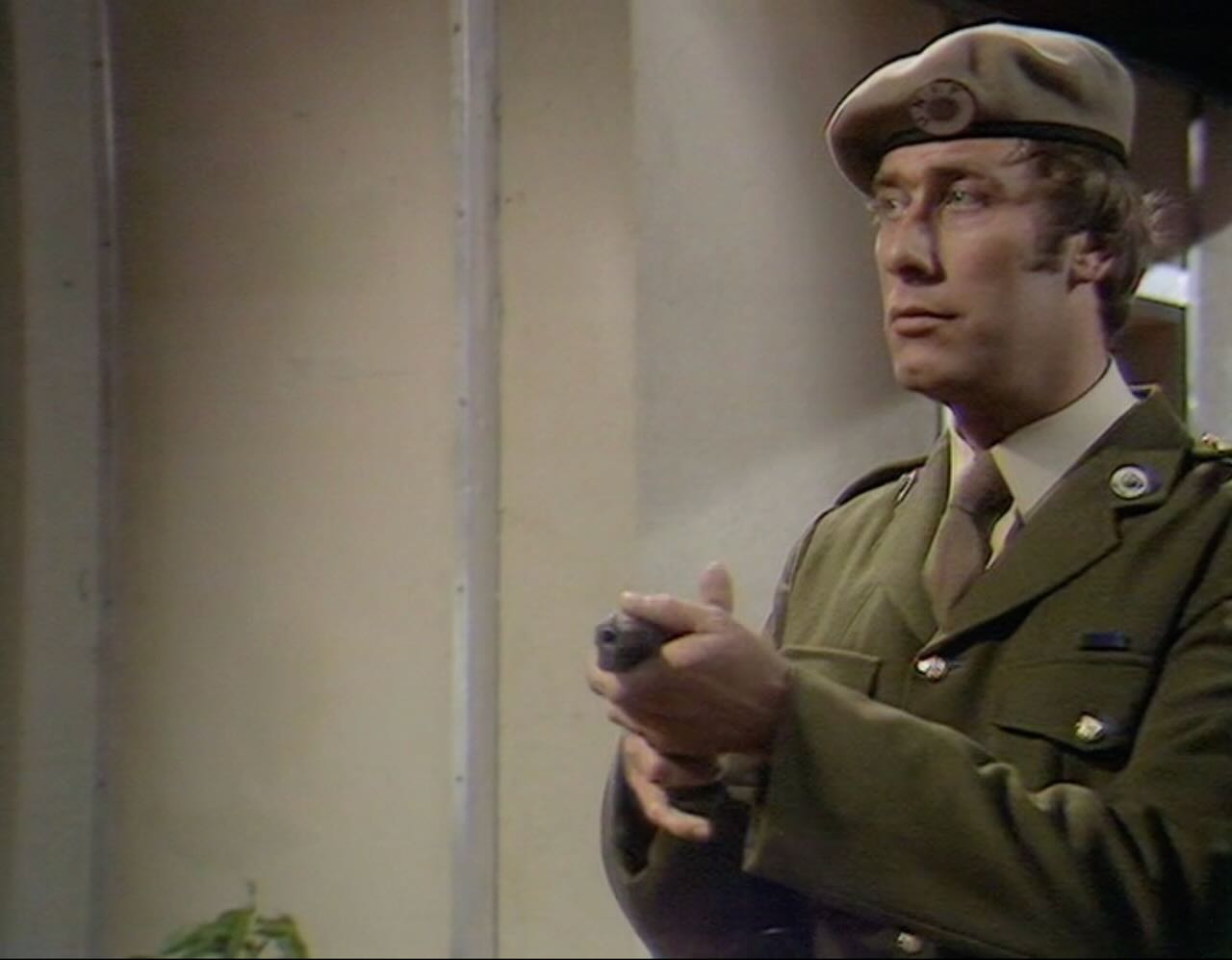
Recurring Characters: Ian Marter as Harry Sullivan and John Levene as RSM Benton
Written by Terry Nation. Directed by Barry Letts. Produced by Philip Hinchcliffe. Script Edited by Robert Holmes.
Format: 4 episodes, each about 25 minutes long
Originally Aired: November – December 1975 (Episodes 13-16 of Season 13)

Spoilers Ahead!
This era of Doctor Who was characterised by a lot of stories that were reminiscent, or even straight-up lifted, from classic horror. The Brain of Morbius is a lot like Frankentein, for instance, and The Planet of Evil is like Forbidden Planet, and The Seeds of Doom is like The Thing from Another World. With all that in mind, it seems like The Android Invasion is supposed to be a bit like Invasion of the Body Snatchers, with familiar people drained of their humanity and turned into something unnervingly alien.

Of course, The Android Invasion doesn’t get nearly as unsettling as Body Snatchers is famous for being. There is some intriguing stuff, as the Doctor and Sarah find their way around the strange facsimile of the village they wander into, complete with the threatening dudes in space suits.
But even though it’s all weird and mysterious, there’s no real build-up that core idea of taking a familiar and safe place and turning it into something foreboding. By the time we actually meet familiar characters, like Benton and Harry, we have a pretty clear idea of what is going on already.

I think in some ways that’s a lost opportunity. If the script had taken longer to put its cards on the table (and maybe avoided spoiling things in the title!) it might stand out more.
Imagine for instance if our heroes had met the UNIT guys straight away, and only gradually gotten the idea that something was not right about the world. Then Sarah ends upon her own, has some near escapes, and finally meets the Doctor out by the TARDIS, only then realising that he is now her enemy as well. Then that image of the android Sarah rising up out of her pod behind the Doctor, staring at her with emotionless malevolence, would have really packed a punch.

But it might have been too slow a build-up for a serialized story like this. I can understand the producers not wanting to spend a whole episode not moving past the “foreboding” stage of the action, and wanting to put the monsters and androids more front and centre.
But given that, more work was needed on The Android Invasion’s script to to give it a greater sense of urgency. There are interesting ideas afoot, and there are a few memorable images now and again (android-Sarah rising out of her sarcophagus, as I mentioned, and also tripping and having her face-plate fall off), but it lacks urgency. At the very least the middle of the story should have been tightened up so there was time to have the Doctor address the issue of the Kraal invasion fleet, which at the end of the story is apparently still just flying around out there someplace.

It’s also a pretty inauspicious final appearance for both Harry and Benton.

I like both characters, and it’s always nice to them, but in this case it adds very little. The real versions of the characters are barely involved (they don’t show up until the last episode!) and I already mentioned how much more the story could used their mechanical duplicates to emphasise the story’s creepiness factor. Harry’s appearance marks the first time in the show’s history that a full-time companion ever returned to the series after departing the Doctor, but it barely amounts to anything. And the real Benton departs the series unconscious the floor. Of course this was probably not specifically intended as a send-off for either character, but it turned out to be, and so that’s pretty lame.

The Android Invasion isn’t a terrible story, but it’s not a strong one, and given that it came out in the same years as Terror of the Zygons, The Pyramids of Mars, The Seeds of Doom and The Brain of Morbius (going by that one’s reputation; I haven’t rewatched it yet), it’s hard not to see it as a let-down.
That said, there are positive qualities: the plot with the Kraal’s stealth-invasion is interesting; the Kraal designs are perfectly fine and in another world they could have ended up recurring in the same as say, the Sontarans; there are the occasionally smatterings of creepy atmosphere to be enjoyed’ and Tom Baker and Elisabeth Sladen are both solid as the story’s leads.

And there is at least one really fun exchange of dialogue, when the Doctor is explaining his intention to use Kraal “cargo shuttle ejectors” to get to the earth before the Kraals do. After the Doctor explains how perilous this will be, Sarah says, “So, providing we don’t burn up on re-entry, and aren’t suffocated on the way down, we’ll probably be smashed to a pulp when we land.” With a cheeky grin, the Doctor replies, “Exactly. Sarah, you’ve put your finger on the one tiny flaw in our plan.”
Other Thoughts
• This is the second appearance in a row (after Terror of the Zygons) where Ian Marter spends a good amount of time playing an evil duplicate of Harry. Of course, this time he is joined by Tom Baker, Elisabeth Sladen and John Levene who all play evil duplicates of their normal characters.

• I find it improbably weird that the Kraals lied to Crayford about not being able to repair his eye (in order to add credibility to their story of rescuing him, apparently) but didn’t go to the bother of making sure he couldn’t just look under his eyepatch to see if they were telling the truth.
• I was also confused when at the end of the story, Styggron dies as he breaks the vial containing the virus that he is threatening to use to wipe out all life on earth, and nobody seems the slightest bit concerned by this. It seemed like the episode treated the virus like a poison or something, as if it was only dangerous if you touched it directly. It felt like a big oversight, unless I missed something.

• The guest cast for this story include Milton Johns (Crayford), who previously played Benik in The Enemy of the World and would later be Castellan Kelner in The Invasion of Time.
Also, Patrick Newell plays Colonel Faraday, a stand-in (basically) for the Brigadier. Newell didn’t appear on Doctor Who at any other time, but he did play “Mother”, the boss of John Steed, in the latter seasons of The Avengers.

• This was one of only two serials written by Terry Nation not to feature his most famous creation, the Daleks (the other being The Keys of Marinus).
• This was also the last story to be directed by former Doctor Who producer Barry Letts, although he did return in Season 18 to serve as Executive Producer.
PakarPBN
A Private Blog Network (PBN) is a collection of websites that are controlled by a single individual or organization and used primarily to build backlinks to a “money site” in order to influence its ranking in search engines such as Google. The core idea behind a PBN is based on the importance of backlinks in Google’s ranking algorithm. Since Google views backlinks as signals of authority and trust, some website owners attempt to artificially create these signals through a controlled network of sites.
In a typical PBN setup, the owner acquires expired or aged domains that already have existing authority, backlinks, and history. These domains are rebuilt with new content and hosted separately, often using different IP addresses, hosting providers, themes, and ownership details to make them appear unrelated. Within the content published on these sites, links are strategically placed that point to the main website the owner wants to rank higher. By doing this, the owner attempts to pass link equity (also known as “link juice”) from the PBN sites to the target website.
The purpose of a PBN is to give the impression that the target website is naturally earning links from multiple independent sources. If done effectively, this can temporarily improve keyword rankings, increase organic visibility, and drive more traffic from search results.