Doctor Who has long been my favorite show, but my actual viewing it over the years has been very on-again / off-again. Lately, it’s been all-on, as I’m actually closing in on finishing re-watching all of the classic episodes (at least the ones that are easily available for me to stream), whilst blogging about each serial.
The Sun Makers is written by the great Robert Holmes, who was classic Doctor Who‘s most prolific writing contributor. He was also a script editor for the series, and presumably wrote this script while he was still in that role, although technically The Sun Makers is the first serial in which his successor, Anthony Read, is credited for that position. It’s also the last Robert Holmes script in my overall Doctor Who rewatch, with the exception of the Second Doctor serial The Space Pirates, which is largely missing from the archives and hasn’t been restores via animation as of yet.

The Sun Makers
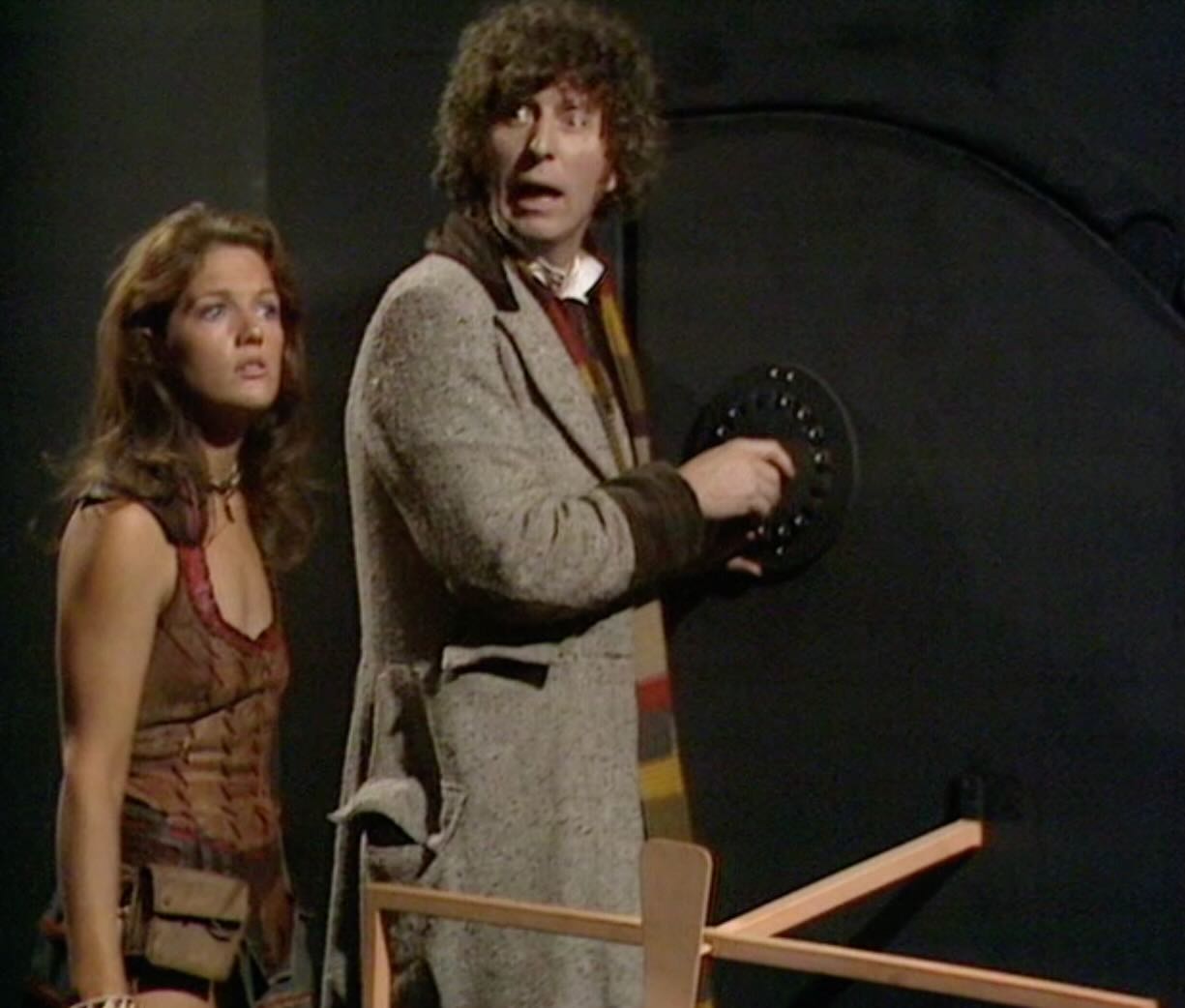
Starring Tom Baker as the Fourth Doctor.
Companions: Louise Jameson as Leela and John Leeson as the voice of K9.
Written by Robert Holmes. Directed by Pennant Roberts. Produced by Graham Williams. Script Edited by Anthony Read.
Format: 4 episodes, each about 25 minutes long
Originally Aired: November – December 1977 (Episodes 7-10 of Season 15)

Spoilers Ahead!
The Sun Makers is a decent Doctor Who serial–not exactly a classic, but far from a disaster.
Some of the credit for the way The Sun Makers succeeds is due to its concept, specifically the idea of an aggressive alien power subjugating its victims through primarily economic rather than military control. The story is famously inspired by Robert Holmes’ frustration with British taxes, and apparently includes multiple subtle jabs directed toward the policies of Inland Revenue (the name of the UK’s government tax department, at the time). I don’t know enough to actually get the specifics of the jokes, but the social satire is not exactly subtle. But still I enjoyed it–a story that expresses its real-world opinion without actually failing to still be a story is rarely a bad thing, in my experience.

(Incidentally, the Beatles song Taxman was written by George Harrison, also in frustration over Inland Revenue’s policies (although one assumes the Beatles were making more money than Robert Holmes was). So I guess we have Inland Revenue to thank for at least a couple of decent pieces of media / entertainment.)
All of this adds a different flavor to the story than we usually get, and Holmes’ script rises to the occasion by delivering a whole lot of witty dialogue alongside some strong characterisation. Tom Baker’s Doctor is rock solid as ever, particularly in his unflappable responses to Mandrel’s threats, and as he faces off with the Collector. And Louise Jameson’s Leela seems to be having loads of fun being almost gleefully violent at times.

In particular, she gets a great moment where she stops a guard from releasing a deadly poison at the climax of the story.
The guest characters are more of a mixed bag. Many of the performances I enjoyed, including William Simons as Mandrel and Roy Macready as the passionate but naive Cordo. Michael Keating is so strong as Goudry that I really wish he’d been in the story more.

And Henry Woolf is fascinatingly weird as the Collector.

Apparently, Robert Holmes envisioned the character as more of a Sidney Greenstreet-type, and given the character’s greed and heartlessness you can certainly imagine that. But turning the character into the five foot tall snivelling figure that we got was a great choice. You can almost see him as a precursor for both Sil from 1980s Doctor Who and Star Trek’s Ferengi, both of whom have got similar profit-obsessions, albeit on opposite ends of the cruelty-spectrum.
On the negative side, I think Bisham ends up being something of a limp biscuit of a screen presence, which is a shame because he starts off well as the spaced-out prisoner that the Doctor encounters. But as the story goes along he becomes redundant, taking away lines that maybe could have gone to Cordo or one of the rebels.

The same is true of an engineer that joins the rebellion late in the game named Synge. It feels like at least one of these guys should have been thinned out of the plot just to keep things from becoming cluttered.
But by the far the most controversial personality on screen is gatherer Hade. He’s critical to the story as the sort of fat cat in the middle of the system who benefits from the oppression of others, but ends up paying for it when everything goes wrong. But the performance by Richard Leech is at times so over the top that it can feel like pantomime. The idea of a larger-then-life villain is fine, and even good at times, but Leech’s delivery becomes increasingly goofy as the story continues and begins to pull me out of things. His death scene, where the angry workers full-on chuck him off a roof doesn’t have the impact it should because Leech seems to play it all for laughs.

I seem to have pivoted into talking about The Sun Maker’s weaknesses, which is good because there are quite a few of them. In addition to what I’ve mentioned, I think the biggest problem is that sparkling dialogue aside, there’s not a lot about the serial that is particularly memorable. The design work (as well as the settings used for the location shooting) is serviceable, but besides the Collector, nothing is especially interesting.
That includes the plot, which involves more running down corridors than one wants.

Of course, pretty much all Doctor Who involves running down corridors, but here it’s all too much routine back-and-forth to really justify it–the Doctor is captured, so Leela goes to rescue him, then she is captured, so the Doctor has to rescue her, etc.
And this might be a nit-pick but I think it’s one worth making: the serial features precious little making of suns, giving that it’s actually titled The Sun Makers. The Company (the economically-oppressive force) made a bunch of artificial suns which allows people to live on Pluto as if it were really Bristol, but it ultimately has nothing to do with the story. The drama could have been set anywhere, including on earth.

So again there is plenty to enjoy about The Sun Makers, and I think the elements that are good are very good. But it’s surrounded by a bunch of stuff that isn’t especially bad, but just sort of average, all of which pulls down how strong it could have been.
One final thing–apparently at one point the idea was that Leela would die during the fourth episode, in the scene where she is stunned breaking into the safe. I’ve heard before that Louise Jameson wanted to have Leela die saving the Doctor, but if that had happened at that point in this story, it would have been really weird. Maybe if The Sun Makers were at the end of the season, it could have been worked, but I’m not convinced. Her ultimate departure in The Invasion of Time is pretty bad, but I don’t think this would have been particularly better.

Other Thoughts
• For whatever reason, the novelisation of this story, by Terrance Dicks, changed the title to The Sunmakers. I actually thought that was the story’s name, until I started working on this post.
• The guest cast for this story includes David Rowlands as Bisham–he played the hairdresser from the “B” Ark in the last episode of The Hitch Hiker’s Guide to the Galaxy TV show.
• Also Michael Keating appears as Goudry. It was only a short time later that he started appearing in Blake’s 7, another British science fiction show that ran for four seasons, which has a lot of crossover both in front of the camera and behind it with Doctor Who (including writer Robert Holmes).

Keating played Vila in all 52 episodes, and was the only actor to appear in the series’ entire run.
PakarPBN
A Private Blog Network (PBN) is a collection of websites that are controlled by a single individual or organization and used primarily to build backlinks to a “money site” in order to influence its ranking in search engines such as Google. The core idea behind a PBN is based on the importance of backlinks in Google’s ranking algorithm. Since Google views backlinks as signals of authority and trust, some website owners attempt to artificially create these signals through a controlled network of sites.
In a typical PBN setup, the owner acquires expired or aged domains that already have existing authority, backlinks, and history. These domains are rebuilt with new content and hosted separately, often using different IP addresses, hosting providers, themes, and ownership details to make them appear unrelated. Within the content published on these sites, links are strategically placed that point to the main website the owner wants to rank higher. By doing this, the owner attempts to pass link equity (also known as “link juice”) from the PBN sites to the target website.
The purpose of a PBN is to give the impression that the target website is naturally earning links from multiple independent sources. If done effectively, this can temporarily improve keyword rankings, increase organic visibility, and drive more traffic from search results.