As mentioned previously, in “Impossible Voyages” I’m watching and writing about a run of new (to me) science fiction films to be watched over last year, which has extended to this year (2026). You can read the rationale and ground rules here. In the meantime, we are advancing from 1958 to 1959 with this movie, #37 in this series.
Way back in post #11 for this series I just skipped watching the 1931 Dr. Jekyll and Mr. Hyde, simply because I’d only recently seen the 1920 John Barrymore version of the same movie. Well, now it’s a bunch of posts and a lot of real time since then, and I’ve finally decided to go back to the Robert Louis Stevenson well of that famous story, with this lesser known and more comedic entry.
Spoilers Ahead

The Ugly Duckling (1958)
Directed by Lance Comfort
The Story: Henry Jekyll, an awkward and oafish young man discovers the formula created by his infamous ancestor with whom he shares a name, and transforms himself into the suave but immoral Teddy Hyde. In this persona he gets involved in with some jewel thieves, and ends up accidentally keeping a bunch of stolen goods with him when he turns back to Henry. This leads to Henry and his brother Victor having to risk life and limb to return he stolen jewels to where they were taken from before they get into trouble with either the police or the thieves.

Starring: Bernard Bresslaw as Henry Jekyll and Teddy Hyde, Jon Pertwee as Victor Jekyll, Maudie Edwards as Henrietta Jekyll (their sister), Reginald Beckwith as Reginald Bannister (Henrietta’s potential fiancé, an ambition which is constantly threatened by Henry’s bumbling), Jean Muir as Snouty (Henry’s petite love interest), and Elwyn Brook-Jones as Dandy (the leader of the gang of thieves).
Comments: Only a few of the movies that I’ve watched for this series have been outright comedies, and so far, none of them have been particularly funny, at least not to my jaded modern eyes. The Ugly Duckling‘s surface-level storytelling and slapstick style never lands with me. It’s got moments of cuteness and some inventive staging, but is rarely genuinely funny. I can see how Bernard Bresslaw’s Henry is meant to be likeable and maybe kind of endearing in a dim-witted way, but he quickly wears out his welcome and never becomes the kind of protagonist that one actually cares for. His alter-ego, “Teddy Hyde”, shows that Bresslaw’s got a bit of range, but isn’t actually any more interesting, and if he was he’s on-screen for such a short amount of time that it wouldnt’ matter anyway.

As far as “Jekyll & Hyde” narratives go, this one is particularly lacking in bite. Teddy Hyde is less nervous than Henry, less caring for others, and a better dancer, but he isn’t especially menacing or anything. Other than stealing some jewels, the worst thing he does is pour a drink down his brother’s pants–not exactly the picture of evil and self-indulgence that we commonly think of with Mr. Hyde.

Although I guess as the movie’s credits declare the story is based on ideas stolen from Robert Louis Stevenson, I shouldn’t be surprised.
This movie’s version of Henry’s darker half is more just what Henry could be if he was more confident. Of course, this also makes him a jerk, but the story never explores this or ponders these implications. It’s just not that kind of movie. So this means all that’s left is the implicit humor in the situation, and of that as I’ve said there is precious little worth noting.

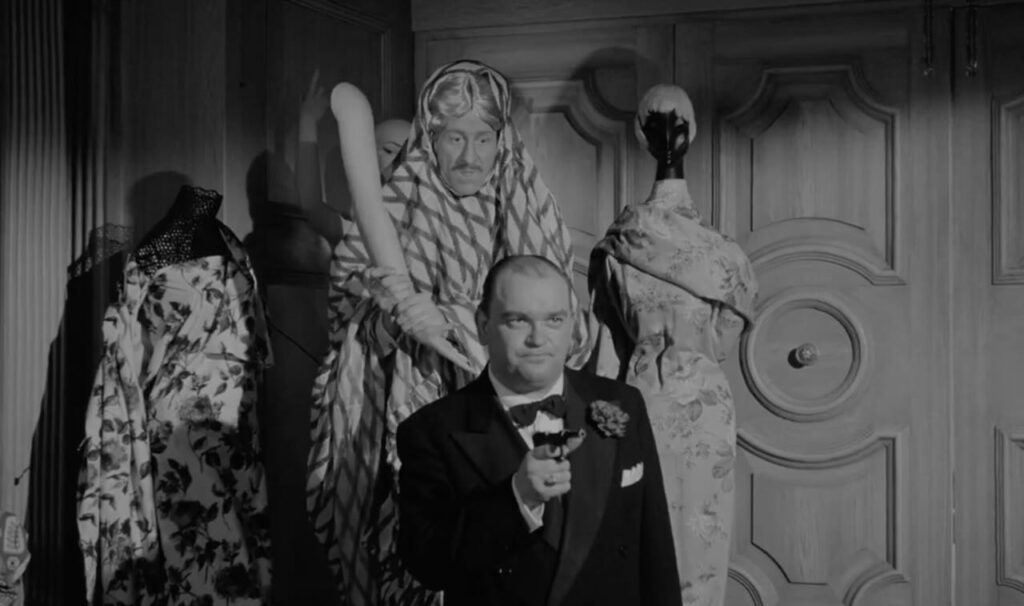
Like I said there are some moments where the movie is trying to have fun beyond just having Henry’s clumsiness make a mess of things. There is an attempt at zaniness in the climax, as Henry and Victor have to navigate a treacherous girder together, and then there’s a goofy runaround at a fashion show with the Jekyll’s, the police and the jewel thieves all trying to out-maneuver each other. It’s nice that it picks up the pace at this point but it’s mostly pretty standard stuff, although there is a bit I enjoyed where Snouty (Henry’s potential girlfriend, who has gotten herself in trouble along the way) bites one of the crook’s fingers.

Character-wise the idea is that it’s all meaningful because Henry has to be daring as himself rather than as Hyde to return the jewels and rescue Snout, but this barely goes anywhere and in the end it’s mostly Victor who actually saves the day.
I watched The Ugly Duckling mostly because it was something different and also because Jon Pertwee (best known as the Third Doctor from Doctor Who) is in it. As Victor, Pertwee speaks in an unconvincing (to my non-British ears) accent (Cockney, I think?) but I was rewarded as he does have quite a major role in the movie.

Along with Snouty, he’s the one who becomes the most aware of what is going and provides the needed dose of sensible thinking to Henry’s cluelessness.
And it turns out that lead actor Bernard Bresslaw is also important to Doctor Who (my favorite show) as he was the actor who played Varga, the series’ very first Ice Warrior, in 1967, several years prior to Pertwee taking the lead role. He’s not the series’ most iconic Ice Warrior actor–that’s certainly Alan Bennion who played a variety of Ice Lords in three later serials–but Bresslaw was first!
Incidentally, I have seen sources online that list this film’s main characters’ name as Jekyll (as it’s spelled in the original source material) but also one or more that names them “Jeckle”. It turns out that both spellings are used in the movie. We see “Jekyll” on the outside of the pharmacy that Victor runs (which is meant to be the same practice the more famous Dr. Jekyll started)

but we also see “Henry Jeckle” at the end of the film, when Henry is honoured by the community at the dance hall that he’s now the manager of.

I’m not sure if I missed something that would have explained this? Something about Henry wanting to distance himself from his great-great-grandfather’s legacy?
One final detail that I thought was cute–the cast for the movie is listed over shots of the main characters dancing at the above-named event. They are listed in pairs as they dance for the camera, often then giving a little nod to the audience before they dance off. It’s kind of like the all taking a bow at the end of a stage play.

I thought that was neat.
PakarPBN
A Private Blog Network (PBN) is a collection of websites that are controlled by a single individual or organization and used primarily to build backlinks to a “money site” in order to influence its ranking in search engines such as Google. The core idea behind a PBN is based on the importance of backlinks in Google’s ranking algorithm. Since Google views backlinks as signals of authority and trust, some website owners attempt to artificially create these signals through a controlled network of sites.
In a typical PBN setup, the owner acquires expired or aged domains that already have existing authority, backlinks, and history. These domains are rebuilt with new content and hosted separately, often using different IP addresses, hosting providers, themes, and ownership details to make them appear unrelated. Within the content published on these sites, links are strategically placed that point to the main website the owner wants to rank higher. By doing this, the owner attempts to pass link equity (also known as “link juice”) from the PBN sites to the target website.
The purpose of a PBN is to give the impression that the target website is naturally earning links from multiple independent sources. If done effectively, this can temporarily improve keyword rankings, increase organic visibility, and drive more traffic from search results.