Doctor Who has long been my favorite show, but my actual viewing it over the years has been very on-again / off-again. Lately, it’s been all-on, as I’m actually closing in on finishing re-watching all of the classic episodes (at least the ones that are easily available for me to stream), whilst blogging about each serial.
The Mutants is a story I’ve found on the bottom of more than one fan’s rankings of Third Doctor stories. Does it deserve that ignominy? I don’t know. It’s arguable. It’s certainly not amongst the best.
The Mutants
Starring Jon Pertwee as the Third Doctor.
Companion: Katy Manning as Jo Grant.
Written by Bob Baker and Dave Martin. Directed by Christopher Barry. Produced by Barry Letts. Story Edited by Terrance Dicks.
Format: 6 episodes, each about 25 minutes long
Originally Aired: April – May 1972 (Episodes 15-20 of Season 9)

Spoilers Ahead!
Like many serials from this era, political and social commentary plays a big role in the story construction of The Mutants. Apparently, writers Dave Martin and Bob Baker were inspired by South Africa and its Apartheid policies in their writing of their scripts, while at the same time, script editor Terrance Dicks was interested in telling a story about British colonialism. I’d say this latter thread is the stronger one in the final product, or at least the one that to me hits harder. There’s a bit here and there about Apartheid-style segregation, and certainly the story is anti-racist, but the more impactful part is all the stuff going on with earth preparing to shut down its colonial operations on Solos.
The public relations spin that gets put on this, particularly in the Administrator’s speech at the big summit, drives the point home. Referring to humanity’s arrival on Solos, he says, “Our ancestors, yours and mine, made a solemn treaty.

A pact, a bond, an act of friendship and mutual cooperation between our two peoples.” He’s heckled by the discontent Ky, but continues on regardless: “A bold concept. Two different cultures, far apart in terms of development, uniting together to create a new society, a new and richer world. Now after five hundred years of expert scientific and technical aid, we have steered you to the verge of independence.”
What’s interesting about this is that the Administrator is not a villain–he’s a mostly sympathetic and reasonable character who is trying to do his job in the best way he can. But of course the Empire that he serves that has got serious problems, and the fact that he seems unaware of this is a key point in story’s anti-colonialism messaging.

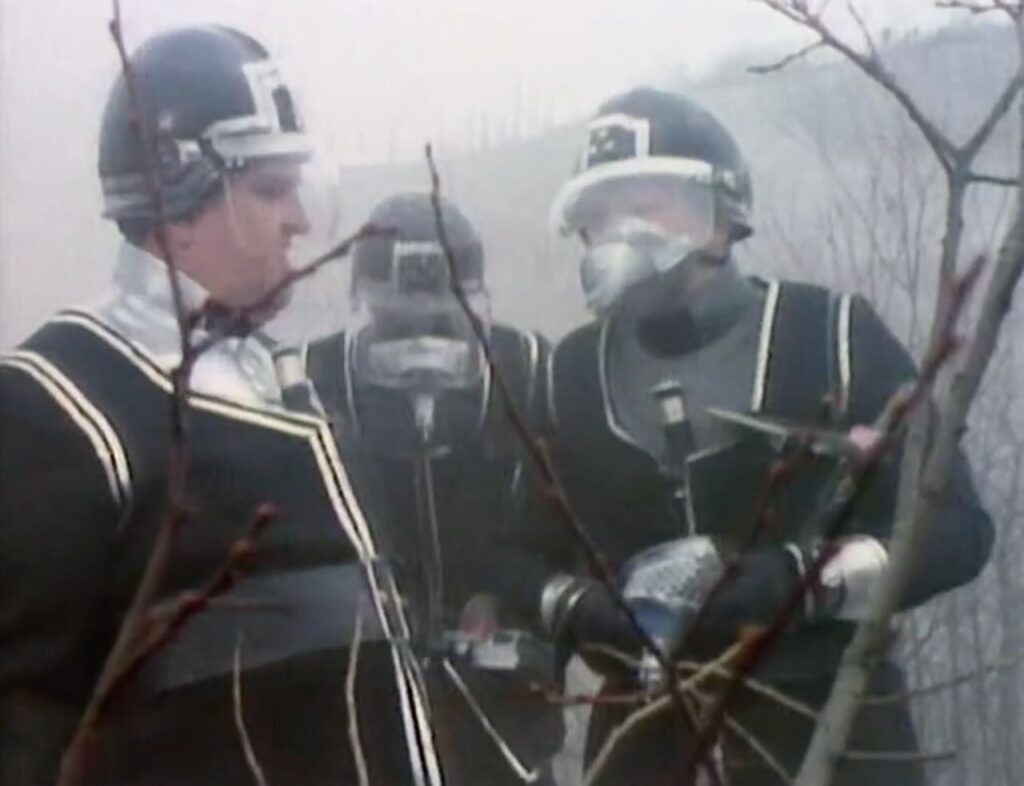
Unfortunately, once the Administrator is assassinated, the story goes into much more pedestrian territory. It’s still trying to say things, although it’s shifted from political allegory to heady science fiction, but it’s couched in a dull story that moves forward at something like a snail’s pace. There’s only so many scenes of characters wandering through the mists of Solos, characters wandering through caves, characters wandering through the hallways of the Skybase, before you just stop caring.
There was a fun scene where Jo Grant gets to show off some of her security training and disarm a guard.

I got pretty excited at this point–something exciting was happening! But then they just got captured again almost immediately and I realized that this is just padding. You expect a bit of padding in a six-parter from the Pertwee era, but this isn’t the fun sort of padding like in Frontier in Space where the Doctor gets to go to the moon and such. This is the boring sort of padding where you are just waiting for the Doctor to stop tinkering in a lab and to make a big discovery.
But at the same time, it’s earnest. The Mutants really wants to tell an imaginative and thoughtful story, with the various political points it wants to make plus the interesting ideas about the seasonal cycle on Solos and what the mutations represent. But it can’t quite commit to what that story is supposed to be, and it struggles to keep things afloat for its runtime. This is maybe most conspicuous with the character of Varan, a loud over-the-top warlord who seems like he is going to be important but ends up getting blown out of not-completely-convincing hole in the Skybase and into the vacuum of space. You know the character was mostly just taking up space when he is killed and you just think, “Oh well, I guess he’s not in it anymore.”

Also loud and over-the-top is Paul Whitsun-Jones as the Marshal. I’m of two minds about him–on one hand you he’s the kind of obstinate self-serving bureaucrat you can imagine really existing in this sort of situation. But at the same time he leans too far toward buffoonish to feel like a real threat for the Doctor. The titular mutants also, though they look quite good, are a menace that are usually pretty easily pushed back, so the story is rarely as dramatic as you want it to be.
There are some performances in The Mutants that I really liked, starting with Jon Pertwee himself, who brings his usually commanding presence to the role. Katy Manning also does well as Jo although her role in the story is nothing revolutionary.
As far as the guest cast goes, I appreciated Geoffrey Palmer as the Administrator.

It’s a small role that had to die for the purposes of plot, but that I wish had had more screen time because Palmer is so authentic at everything he does. I also like Christopher Coll as Stubbs, one of the two guards under the Marshal’s command who quickly come to realize something is seriously wrong with their boss. Rick James has the larger role as Cotten, but Stubbs felt more like a real person whenever he was in the scene, and I was impressed by the performance especially considering how little characterization is baked into the script.
And then I quite liked Garrick Hagon as Ky, and I’m glad he turned out to be the more central Solonian character, as opposed to more annoying Varan.

Although I feel like the character is just lost at the end when he transcends into the glowy angelic figure that turns out to be his people’s next biological phase. The fact that the insectoid mutants are just a transitional phase is obviously the heart of the whole story (or at least that part of the story), but it might have been nice to have had more of a sense of him still being the same person at the end, rather than just hearing what he’s up to now that the Marshal has been disintegrated or whatever.

So The Mutants isn’t a great story, but does it deserve the bottom spot on a ranking of Third Doctor serials? I don’t know, it might be smarter than any of the era’s Dalek adventures. But on the other hand, it might still be duller than they were. So possibly it’s not the worst story, but it might be the most flat.

Other Thoughts
• There’s quite a few notable actors in this serial, including two people who are well known for small roles in the Star Wars franchise. First, Garrick Hagon (Ky) was Biggs, aka Red Three, in the first Star Wars movie. He was Luke’s friend from Tatooine who’s early role was cut out of the film, but still appeared during the final battle against the Death Star, and was the last of the Rebel pilots that we see killed by Darth Vader.
Then John Hollis (Sondergaard) played Lobot in The Empire Strikes Back.

He was the aide to Lando Calrissian during the Cloud City sequence in the movie’s third act.
• Geoffrey Palmer, who played the Administrator, also appeared in Doctor Who in Doctor Who and the Silurians a few seasons prior, and Voyage of the Damned some forty-five years later! He is one of the best known (to me, anyway) British television actors, having featured or co-starred in The Fall and Rise of Reginald Perrin, Butterlfies and As Time Goes By. He also appeared in a movies such as A Fish Called Wanda and Tomorrow Never Dies.

• Christopher Coll (Stubbs) was Phipps in The Seeds of Death. George Pravda (Jaeger) was Alexander Denes in The Enemy of the World and Castellan Spandrell in The Deadly Assassin. James Mellor (Varan) was Sean Flannigan, one of my favorite parts of The Wheel in Space. Peter Howell, who plays the Investigator, is not the same Peter Howell who years later would arrange the Doctor Who theme heard during the first five seasons of stories produced in the 80s, the one with the starfield opening credits.
• According to the internet, one of the actors considered for Varan was William Russell, aka Ian Chesterton! That would have been crazy. I guess I’m glad that didn’t happen or I’d be forever annoyed that the producers didn’t just take the opportunity to bring Ian back to the show for a story.
PakarPBN
A Private Blog Network (PBN) is a collection of websites that are controlled by a single individual or organization and used primarily to build backlinks to a “money site” in order to influence its ranking in search engines such as Google. The core idea behind a PBN is based on the importance of backlinks in Google’s ranking algorithm. Since Google views backlinks as signals of authority and trust, some website owners attempt to artificially create these signals through a controlled network of sites.
In a typical PBN setup, the owner acquires expired or aged domains that already have existing authority, backlinks, and history. These domains are rebuilt with new content and hosted separately, often using different IP addresses, hosting providers, themes, and ownership details to make them appear unrelated. Within the content published on these sites, links are strategically placed that point to the main website the owner wants to rank higher. By doing this, the owner attempts to pass link equity (also known as “link juice”) from the PBN sites to the target website.
The purpose of a PBN is to give the impression that the target website is naturally earning links from multiple independent sources. If done effectively, this can temporarily improve keyword rankings, increase organic visibility, and drive more traffic from search results.