Doctor Who has long been my favorite show, but my actual viewing it over the years has been very on-again / off-again. Lately, it’s been all-on, as I’m actually closing in on finishing re-watching all of the classic episodes (at least the ones that are easily available for me to stream), whilst blogging about each serial.
I’m getting close to finishing this whole watch / rewatch of classic Doctor Who. Indeed, this is the second-to-last story starring Jon Pertwee’s Third Doctor to have a look at, with my very last one being his first serial ever, Spearhead from Space. That means that The Time Monster is the last story that I’ll watch featuring a lot of the staple figures of this era–Jo Grant, Sgt. Benton, Captain Yates and possibly most significantly, Roger Delgado as the Master. And, er, what a story to go out on!

The Time Monster
Starring Jon Pertwee as the Third Doctor
Companion: Katy Manning as Jo Grant
Recurring Characters: Roger Delgado as the Master, John Levene as Sgt. Benton, Nicholas Courtney as Brigadier Lethbridge-Stewart and Richard Franklin as Captain Mike Yates.
Written by Robert Sloman. Directed by Paul Bernard. Produced by Barry Letts. Script Edited by Terrance Dicks..
Format: 4 episodes, each about 25 minutes long
Originally Aired: May-June 1972 (Episodes 21-26 of Season 9)

Spoilers Ahead!
Like a several other Third Doctor stories before this one, I have never properly seen The Time Monster before. What I mean by that is that I watched most of these adventures back when I was first discovering Doctor Who–all edited into a giant movie, on a black & white TV tuned into a fuzzy UHF station. Under those circumstances it was impossible to judge the serial properly, and often that was to the show’s advantage. You can’t really see the problems in a given story’s production values when you can barely see the story at all. Thus, I was just not prepared for the sight of Kronos, the titular Time Monster.
Kronos, we are told, is the most fearsome of the Chronovores, a species which devours time itself. Or to put it another way, a guy in a cheap looking bird suit vigorously flapping his wings. It looks not unlike something a parent would make for their kid’s school play, and thus decidedly non-threatening and silly, in spite of the best efforts of the production team to shoot and edit it to its advantage.

I was also surprised at how small Kronos is (at least until the very end of the serial when it becomes a woman’s giant face). For some reason I expected something more kaiju-like.
Now it is possibly unfair to judge Doctor Who on its effects to severely. The show always operated until very tight restrictions and generally to its credit, did not let that hamper its ambitions.
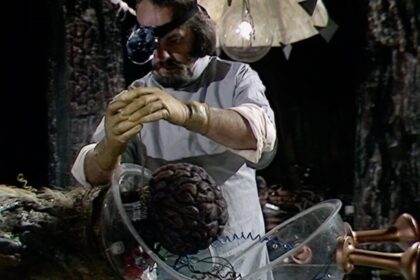
But there is a quality that certain serials have, which I haven’t identified, which allows them to overcome these limitations. I just watched and commented on The Brain of Morbius, which has a comically over-the-top “monster body / brain in a jar” form for its main threat, but there is such a conviction to that drama that it doesn’t matter–you happily get swept up in the heightened nonsense of it all. There is just nothing like that going on in The Time Monster. Instead everything seems to conspire to highlight how bad Kronos looks, which is all the more notable since for most of the story, Kronos is the only significant special effect going on.
Still, all this could be forgiven if the story overall was gripping and meaningful. Unfortunately, it’s anything but.

I’ve heard it said that The Time Monster is the worst Pertwee story, with only The Mutants giving it any competition. From my memory (I’ve watched these stories over several years) I’d agree, except I don’t think there really is any other competition. And the main problems with The Time Monster are not the effects (as notable as they are), but with the writing. The pacing in particular is just glacial over the first four episodes, with the story involving mostly the Doctor and his friends running back and forth around a scientific institute trying and failing to stop the Master from using a special crystal to force Kronos to obey him. The concepts are fine but the things drag on endlessly, which multiple filler-moments and various pointless characters taking up screen time (such as the scientists who come to see the TOMTIT process at work, whom the Brigadier has to posture against, and so on).
It doesn’t help that there isn’t a lot of good character writing in this section. The UNIT regulars do not come off well and the scientist guest stars are either boring or annoying. The one with the most to do is Ruth Ingram, but I never warmed up to her with her constant harping on about how annoying all the men around her are. I don’t know if this would have read differently for 1972 audiences, but for me watching from 54 years later she feels like some guy’s bad idea of a feminist, rather than like a real person.
The one UNIT character who gets an uncharacteristically large part is Sergeant Benton, as played by John Levene.

This is nice to see in theory and indeed would have been awesome if The Time Monster had just been any good. Instead we watch him get bullied around by Ruth Ingram and also almost succeed in stopping the Master twice.


But that just means we get to watch him fail twice, so it’s not as rewarding as one would like.
A lot of the heavy lifting for that early (ie first two thirds) of the story falls on the shoulders of Roger Delgado, as most of the plot is driven and explained by the Master. And Roger Delgado of course has got loads of personality and is more than capable, but his material is again not very interesting, and is not helped that he is awkwardly paired with first one boring lackey (Percival)

and then another one (Krasis)

and almost nobody else. He ends up as much a moustache-twirling caricature of a villain here as he ever was, which is not the look we are aiming for.
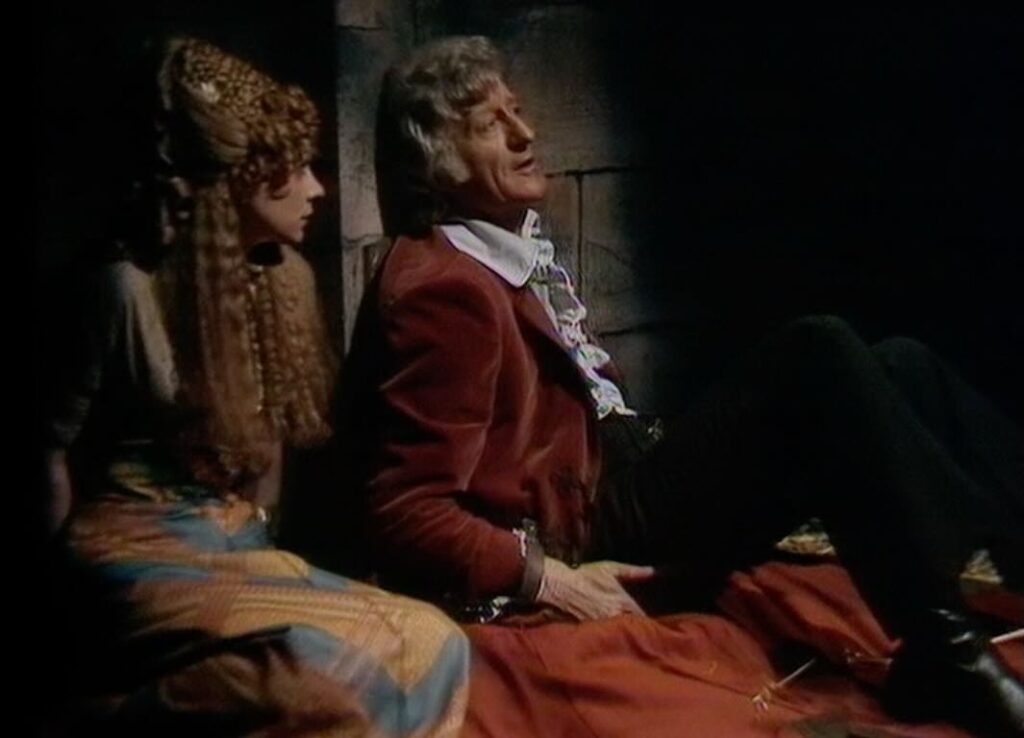
As the story hits episode five, the setting shifts to Atlantis, and the overall story picks up considerably. Suddenly there feels like some real stakes and there is some stuff for the Master to actually do. We also get some a better group of supporting characters, especially George Cormack as King Dalios.

He’s got a lot of flashes of wit, as when he challenges the Master’s claims of coming from the gods: “What of great Poseidon? What did he have for breakfast? Fish, I suppose. And what of Zeus and Hera? What is the latest gossip from Olympus? Do tell me.” We also get to watch easily shrug off the Master’s attempts to put him under a hypnotic spell–“A very elementary technique of fascination. I’m too old a fish, too old in years and in the hidden ways to be caught in such a net.”
And then finally at the end of this scene, the Master leaves with “I have nothing more to say to you,” to which Dalios replies, “You have said nothing to met yet. When you find the true words to speak, I will listen.”
This is also the part of the story that gives us horror-icon Ingrid Pitt as Queen Galleia. She vamps up the screen like almost nobody that I’ve seen on Doctor Who, and gives the Master someone meaningful to do his little manipulation game on.

Atlantis also gives us some interesting sets to look at, and even a Minotaur! It’s by far the most interesting part of the adventure.
The problem as I’ve mentioned is just the fact that it is so short-lived. We spend about an episode and a half there, which is a huge waste given we spent so much time in a generic scientific institute in England. If The Time Monster had gotten us to Atlantis at the end of episode two and then meaningfully developed the political drama going on there, the results might have been much, much different.

And maybe we could have had a better resolution to the threat of the Minotaur than the Doctor just jumping out of its way and karate-chopping it on the neck. Like so much else in The Time Monster, that is really a big let-down.
To end on a positive note I guess I should acknowledge there are some nice moments for Jo Grant in the story.

Katy Manning is cute and charming as ever, and Jo has a neat moment where she gets to show she’s willing to sacrifice everything by initiating a “time ram” between the Doctor’s and Master’s TARDISes. This is interesting because it’s not just that she was willing to sacrifice herself–if what she had done had worked, she, the Master and the Doctor would all have been dead.
Indeed, that’s what she think has happened at first, until the Doctor disabuses her of that idea.

This story also features the gag of Sergeant Benton being reduced to an infant because of the timey-wimey stuff going on. It’s silly but I think works just because it makes things lively, especially at the end when he is confused about what in the world is going on.
I think that might make this the only serial in which Benton has the last line.

Other Thoughts
• This story features a scene where the Doctor tells Jo a story from his childhood, how on a really bad day he went to visit a monk who lived halfway up a mountain who taught him a new perspective on life by showing him the beauty of a daisy (a Time Lord daisy, I guess). We actually meet a character in Planet of the Spiders, K’anpo, who it is implied is this monk. Planet of the Spiders is also credited to Robert Sloman (although it was also written uncredited by producer Barry Letts), and K’anpo is played by George Cormack, who plays King Dalios in this story.

• I have mentioned in the past on a wish-list of things for the Third Doctor era (here) that it would have been nice to see Liz Shaw, the Doctor’s companion / assistant for his first season, back again in a guest role later on. I’d suggested The Claws of Axos as a suitable story for this, but I hadn’t actually rewatched that serial at that time. The Time Monster is actually perfect for this, as Liz could have been swapped in for Ruth Ingram with hardly any rewrites at all. And of course seeing her reunite with the Doctor would have provided those earlier episodes with a bit more substance.
• A minor point of note about The Time Monster is that it features a different design for the interior of the TARDIS, used for both the Doctor and the Master’s time machines.

The traditional flat “roundels” are replaced big bowl-like features. Apparently producer Barry Letts didn’t like it (I don’t think it looks all that great either) and anyway it got damaged in storage so we never saw it again.
• Incidentally, the other time that I can remember Doctor Who giving us a special effect as immersion-breaking as Kronos was in the Fifth Doctor story, Warriors of the Deep, with the Myrka. By a curious coincidence, that story also guest starred Ingrid Pitt. What’s up with that?
• Ian Collier, who plays Stuart Hyde, also was Omega in Arc of Infinity. Neville Barber (Dr. Cook) also played Howard Baker in the one episode of K9 and Company that was produced. Barry Ashton (Proctor) had small roles in The Moonbase (as Schultz) and Frontier in Space (as Kemp).

• Dave Prowse, who plays the Minotaur, was a bodyguard in one episode of The Hitchhiker’s Guide to the Galaxy, and of course is most famous as the body of Darth Vader in the original Star Wars trilogy.
• Darren Plant is the name of the bay who played the infant version of Benton.

Sadly, he apparently died of SIDS shortly after his first birthday, which gives him the unfortunate distinction of being the shortest-lived performer to ever appear on Doctor Who.