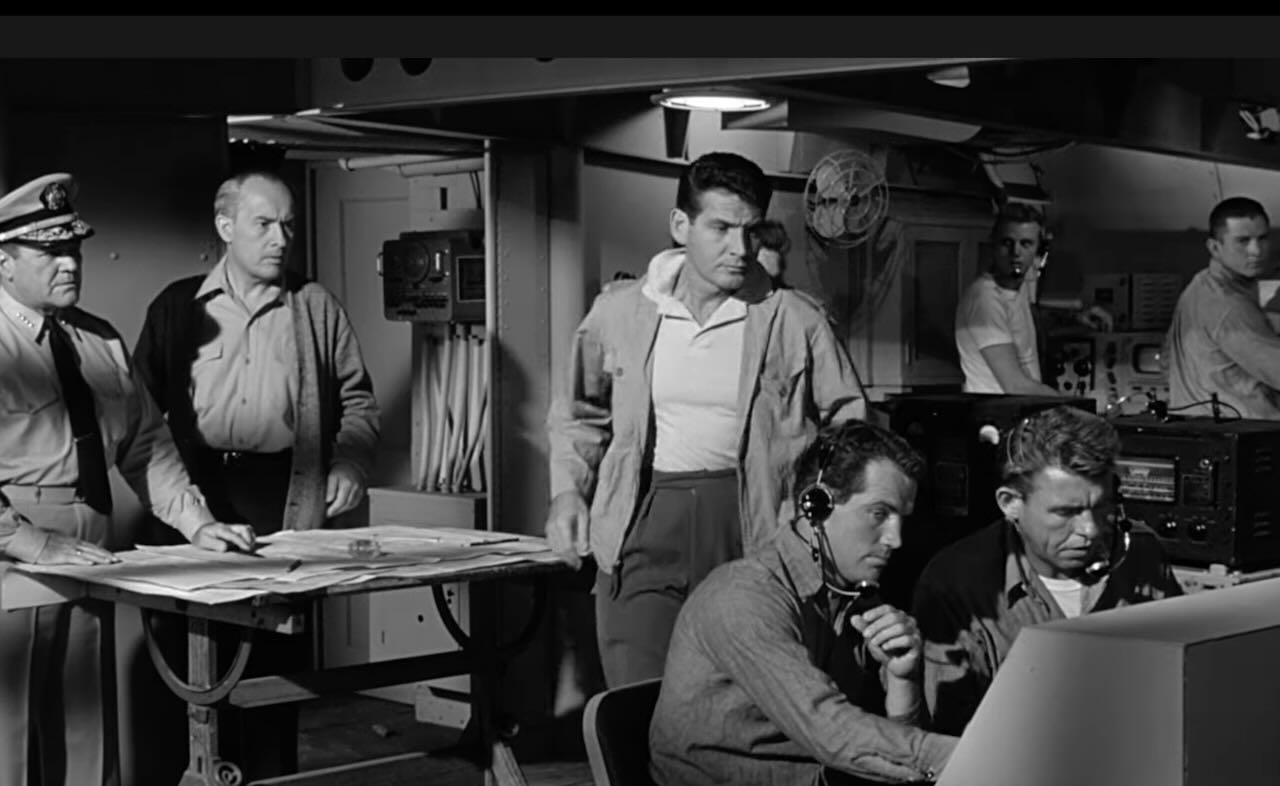
As mentioned previously, in “Impossible Voyages” I’m watching and writing about a run of new (to me) science fiction films to be watched over last year, which has extended to this year (2026). You can read the rationale and ground rules here. In the meantime, we are advancing from 1956 to 1957 with this movie, #35 in this series.
A lot of the movies I’ve watched for this series have been about goofy monsters of different shapes and sizes, but a few have been focused more on asking interesting questions about humanity–for instance Things To Come and The World Will Tremble. The 27th Day is certainly one of that latter variety–the questions is brings up are fascinating. But asking interesting questions and answering them in interesting ways are two different things; how well does this movie achieve that latter goal?
Spoilers Ahead
The 27th Day (1957)
Directed by William Asher

The Story: Mysterious aliens from a dying world kidnap a group of five disparate humans and give to each of them the means to destroy the earth. They claim that since humans are probably going to destroy themselves anyway, if these five people choose to do the deed in the next 27 days, it will allow their race to have a new place to live–otherwise their enlightened and peaceful race will certainly die. The presence of these weapons and their potential users causes chaos on the earth, and nearly brings about its destruction as rival political powers consider using them on each other before the deadline passes. However, one of the original subjects, German physicist Professor Klaus Bechner, figures out that the aliens have given the humans the means to alter the capsules so that they kill only “enemies of human freedom”. He activates them and brings about a period of cooperation that the earth has never known before. Humanity demonstrates this by inviting the aliens to share the earth before their own world meets its end.

Starring: Gene Barry as Jonathan Clark, an American journalist who is one of the alien’s subjects. Valerie French plays Eve Wingate, an Englishwoman who is also a subject, and who falls in love with Jonathan. George Voscovec plays Professor Bechner. The other two subjects are Soviet soldier Ivan Godofsky (played by Azemat Janti) and Chinese peasant Su Tan (played by Marie Tsien). Ralph Clanton, Paul Birch and Friedrich von Ledebur play various people investigating the situation for the US government, while Stefan Schnabel plays a Soviet General determined to use the weapons to destroy the United States. Arnold Moss plays the Alien.
Comments: The 27th Day is a movie I was hoping I would like a lot.

I mean, I always hope I’m going to like a movie. Or almost always. But The 27th Day had such an intriguing premise that, a heightened science fiction idea that seems to me kind of unusual for movies from this era: five people from all over the world are kidnapped by aliens and given the bizarre opportunity to choose to bring about the destruction of the human race at any point over the next twenty-seven days, with no real incentive to do so except that it will give the seemingly enlightened aliens a new place to live.
The twist comes shortly afterwards when the aliens then broadcast to the entire world what they’ve done, and exactly who they have given the weapons to. This is a really effective moment, because suddenly it all goes from a weird thought experiment to a fight for survival. Governments begin to scramble for control of these weapons, and suddenly humanity’s survival is genuinely at risk.

There is a lot of nifty development of this idea, including the extended sequence when the Americans decide to test to see if the weapons really work. The pragmatic Dr, Neuhaus decides to bypass any moral objections to him serving as a human guinea pig by fatally exposing himself to radiation–watching him get instantly vaporised certainly helps to up the movie’s stakes. And then the real conflict comes into focus, as the unnamed Soviet army general plays true to type and threatens all US forces back inside their own borders, all with the intention then using the weapons to wipe their sworn enemy off of the globe.
But it takes more than all of this to make a good movie. It also takes interesting characters, a steady storytelling hand, and the creative imagination to make the dramatic journey feel worthwhile. The 27th Day has got some of that, but not all.
The initial area of disappointment comes with the characters. I was intrigued by the idea of this international collection of subjects chosen by the aliens.

They are not actually representative of the world, as there is nobody from Africa or South America, and including two people from Western Europe (one from Britain, one from Germany) is pretty lopsided. But still it was cool that the group included as much diversity as there was, such as the Chinese girl, Su Tan, and a Russian soldier, Private Godofsky. Thus is was particularly disappointing when Su Tan’s immediate response to the situation was to kill herself (thus rendering her weapon useless). It’s a dramatic moment, to be sure, but not as interesting as it would have been to see her story play out more thoroughly.
Private Godofsky fares a bit better, but only just. He is immediately accosted by his superiors once the situation becomes public, and then gives up all his weapon’s secrets under brainwashing and torture. In the end he gets a significant bit of business when he delays the general from using the weapon for a critical few minutes, but he still winds up being more of a plot device than a character. It all amounts to wasted potential, especially since our “main” characters, Jonathan Clark and Eve Wingate, don’t actually do that much in the story besides fall in love. They stand around and participate in things here and there, but they don’t do anything important, and we never really see what makes them interesting as people.

Instead all the significant action falls to the German Professor Bechner, who is ends up figuring out that the whole thing is giant intelligence / morality test. But this final twist is not satisfying because it’s so underdeveloped. Bechner finds a bunch of mathematical symbols on the little weapons and from that is somehow able to deduce that the weapons can be repurposed into a form that is actually beneficial to the world to use. None of this is explained–he just uses them without telling anyone, but thankfully only “enemies of human freedom” are affected.
Maybe actual explanations would have been pedantic, but what the movie really lacks is any sort of exploration of what this means or how the world is affected by it. Exactly one person is seen dying–the war-mongering Soviet general–with everything else being consigned to a news broadcast. How many people died? Did any American die, or was it only Russians? What exactly qualifies one to be “an enemy of human freedom”? In the movie, everyone treats this as a positive turn of events: humanity has narrowly avoided the apocalypse and now has a new opportunity to make something good of itself. But I am left with so many questions.

Because of these flaws, I have to call The 27th Day a pretty big disappointment. It’s better made than a lot of films that I’ve watched for this series but it feels like something that should have been delivered a lot more in terms of characters, plot and themes than it did. And when those things let you down, all you’ve got left are some pretty neat ideas.
And that great plot twist when the aliens broadcast to everyone on earth the identities of the people they gave their doomsday weapons to. That was awesome.
PakarPBN
A Private Blog Network (PBN) is a collection of websites that are controlled by a single individual or organization and used primarily to build backlinks to a “money site” in order to influence its ranking in search engines such as Google. The core idea behind a PBN is based on the importance of backlinks in Google’s ranking algorithm. Since Google views backlinks as signals of authority and trust, some website owners attempt to artificially create these signals through a controlled network of sites.
In a typical PBN setup, the owner acquires expired or aged domains that already have existing authority, backlinks, and history. These domains are rebuilt with new content and hosted separately, often using different IP addresses, hosting providers, themes, and ownership details to make them appear unrelated. Within the content published on these sites, links are strategically placed that point to the main website the owner wants to rank higher. By doing this, the owner attempts to pass link equity (also known as “link juice”) from the PBN sites to the target website.
The purpose of a PBN is to give the impression that the target website is naturally earning links from multiple independent sources. If done effectively, this can temporarily improve keyword rankings, increase organic visibility, and drive more traffic from search results.