Doctor Who has long been my favorite show, but my actual viewing it over the years has been very on-again / off-again. Lately, it’s been all-on, as I’m actually closing in on finishing re-watching all of the classic episodes (at least the ones that are easily available for me to stream), whilst blogging about each serial.
The Horns of Nimon
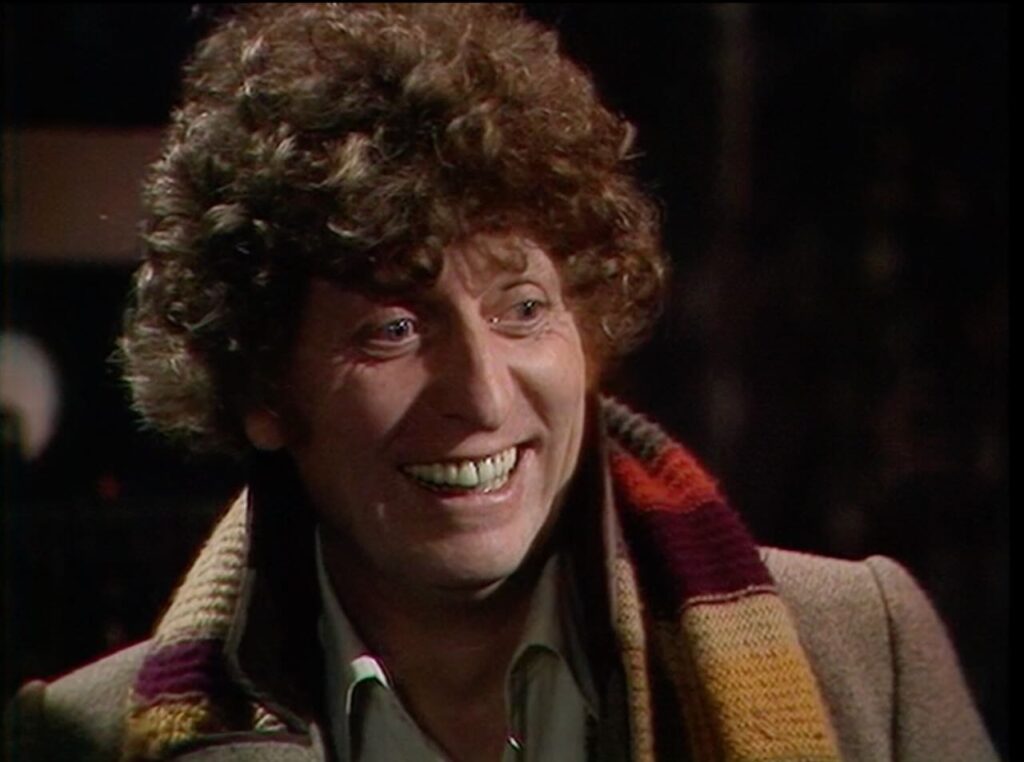
Starring Tom Baker as the Fourth Doctor.
Companions: Lalla Ward as Romana and David Brierley as the voice of K9.
Written by Anthony Read. Directed by Kenny McBain. Produced by Graham Williams. Script Edited by Douglas Adams
Format: 4 episodes, each about 25 minutes long
Originally Aired: December 1979 – January 1980 (Episodes 17-20 of Season 17)

The Horns of Nimon is notable story in the history of Doctor Who for a bunch of reasons. It ended up being the last story of the season and thus the last one before the show went through a whole design revamp. Tom Baker’s fourth Doctor had his entire costume overhauled, so this was the last time we saw him in his original jacket / scarf combo. It was also the last story produced by Graham Williams, script edited by Douglas Adams, and scored by long-term composer Dudley Simpson. It was the last story to use the TARDIS / time tunnel title sequence that had been going since the beginning of the ear, the last one to feature Delia Derbyshire’s arrangement of the title them, and the last story before the revival era to use the diamond-shaped logo. It also the last time that David Brierley provided the voice of K9.
And interestingly, none of that had been intended. Graham Williams, who wasn’t crazy about the story intended to “bury it” in the season’s penultimate slot, but after Shada was cancelled due to industrial action, it ended being the finale instead.
And then in addition to all of that, it was also the last story to air in the 1970s (the first two episodes) and the first one to air in the 1980s (the last two episodes). That’s a lot of things to note about a story that even the producer wasn’t that much of a fan of.

Spoilers Ahead!
I’ve mentioned before that I’ve always had a bit of a low impression of Season 17 of the classic series. My sense was that it was made up of one great story (City of Death), four mediocre to bad ones, and one that was never finished (Shada, as I’ve mentioned). Now in my non-linear re-visiting of classic Doctor Who, I’ve now seen the entire season, and found myself being surprised on more than one occasion. While Destiny of the Daleks is genuinely bad, and Shada is nothing to write home about, The Creature from the Pit was a lot more enjoyable than I remembered, and Nightmare of Eden was almost legitimately good. So how, I wondered, was The Horns of Nimon going to hold up, a story I would have named from my memory as being one of the dullest and least interesting?
Well the answer is I had a solidly good time watching The Horns of Nimon. I don’t know if it just caught me in the right mood or something, but for the vast majority of it I was thinking, yeah, this is good fun! And there are some elements that elevate it even higher than that.

To start off with I have to give credit to a story element that I’m increasingly of the opinion is critical to the success of these classic stories, which is the pacing. The story doesn’t keep me waiting for the plot and action to advance, and I never found myself bored as loads of tedious exposition was being unloaded. The script unpacks the essential context in ways that never felt forced or unmotivated. It shouldn’t be a high bar to clear but a lot of these rewatches have proven otherwise.
And then the story itself is reasonably interesting. A fading interplanetary empire falls victim to a parasitic race that plays on their hunger to rekindle their former military glory in exchange for access to their world. There are three different civilisations at play here–the Skonnan Empire, whose leader Soldeed is separate to reclaim the past at any cost; the Anethans, the peaceful and helpless victims of the Skonnans, who are forced to send their own people as doomed tributes to the third race, the Nimons–bull-like creatures who resort to deception to find new world’s whose resources they can consume. Into all this arrives the Doctor, Romana and K9, who spend their time trying not to fall victim to the Soldeed and the other Skonnans while also attempting to rescue the tributes and to figure out just what the Nimons are up to and to stop it.

I like the idea of the Nimons–a conquering alien race who aren’t looking at establishing an empire. They just go from world to world and basically eat it. Their design is pretty good, although I feel like the legs of these monsters seem a bit skinny compared to the rest of them. But they are effectively voiced by Clifford Norgate, who gives them one of the show’s more effective monster voices, in my opinion.
The biggest weakness to all of this is how over-the-top and silly certain aspects of the production are. I’m thinking primarily of some of the performances. Graham Crowden’s performance as Soldeed is extreme, to say the least–he’s loud, wide-eyed and animated to the point of goofiness.

Malcolm Terris’ unnamed co-pilot is the similar–he’s menacing but full of outrageous amounts of bluster. Even Tom Baker gets in on the act sometimes, like when he hugs K9 when he becomes afraid that a planet is going to crash into the TARDIS, or when he tries to give K9 mouth-to-mouth resuscitation when the robot dog gets damaged at one point.

None of this means he’s giving a bad performance, but it does add to the general “sending up” feel of it all.
But you know who plays things rock-solid straight and is awesome at it? Lalla Ward as Romana, that’s who!

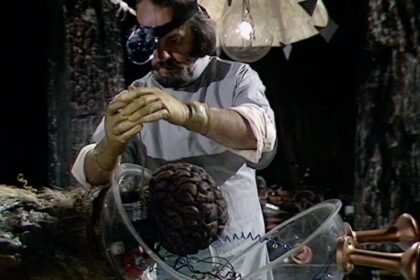
The Horns of Nimon turns out to be one of her very best outings as the character, certainly one of the stories where she gets the most to do. Indeed, while the Doctor has to spend much of the adventure either trying to fix the TARDIS or fiddling around in a laboratory, Romana gets loads of bits of where she’s at the heart of the story’s action.

It’s Romana who gets to figure out what is going on with Seth and Teka and the other tributes, as well as the Nimon’s larder. And in the last episode it’s Romana who gets to go to Crinoth (where the Nimons are coming from) to run around with her new friend Sezom, fighting the Nimons and figuring out the full extent of their plan.

I liked the whole idea of Sezom, incidentally, who is obviously an indication of what Soldeed is going to become if he’s allowed to continue to aid the Nimon, thinking he’s using it for his own purposes. It was a bit disappointing to me then that Soldeed never gets to see this himself. That would have obviously involved changing the trajectory of that character quite a bit.
But back to Romana, I was also a big of fan of the fact that she got not one but two scenes where she gets to face down some of the story’s villains and confront them with righteous anger. Right near the start she has serious words to say to the Co-Pilot for abandoning the Doctor after he saved his ship. And then toward the end she gets to face off with Soldeed and tell him off for how his stupidity has doomed his people.

This is some good stuff for Lalla Ward, and she brings the goods. I really enjoyed seeing her take such an active lead in the story.
This story also features one of my favorite Romana costumes. Romana, both of them, is possibly the most fashionable character to have ever graced the TARDIS, wearing a different outfit in every serial (maybe the 15th Doctor outpaces her), and in this one she’s wearing a riding / hunting outfit with a striking red jacket. It’s very much a female-Doctor kind of vibe, without just being a feminized version of the Doctor’s costume (as she wore in Destiny of the Daleks).

Of course the other element worth noting about the story is the way the whole thing apes Greek mythology. The Nimon are obviously the Minotaur, and other names like Skonnos, Aneth, Seth and Crinoth are taken from Knossos, Athens, Theseus and Corinth. And of course the giant positronic circuit that Nimon operates out of is similar the mythological Labyrinth of the Minotaur. I would say all of the explicit naming parallels doesn’t really add to the serial, but drawing the plot itself from the mythology doesn’t take away from it, anymore than other serial’s similarities to other established monster narratives hurts them. It is, however, the second time that I’m aware of that this gimmick is used with Greek mythology in particular, and overall I’d say it’s more successful than the first, which was the abysmal Underworld.
So on the whole I’d deem The Horns of Nimon to be a flawed serial, but an extremely worthy one. This sentiment could also be applied to Season 17 overall. It’s got its problems (it’s biggest one is named Destiny of the Daleks), but there is a lot more that I’m forced to recognise (in opposition to my prior opinion) is just solid fun.

Other Thoughts
• This is the story where we learn Romana has built her own sonic screwdriver.

Unfortunately, she also appears to lose it in this story, and it wasn’t heard from again (on TV anyway).
• The story’s title is a bit strange when you think about it. Saying “The Horns of Nimon” makes Nimon sound like either a place or someone’s name, but it’s neither. The enemy alien in this story are repeatedly referred to as “Nimons” (it’s like saying “humans” or “Martians”), and none of them are given names. Other characters do call it “the Nimon” when they are talking about just the one monster, or when they think there is literally only one Nimon left, but that doesn’t change my point. The title would have been more accurately titled “The Horns of the Nimon” or “The Horns of the Nimons,” or maybe “The Horns of Nimons.” As it is, the title is has the equivalent structure of a phrase like “The Ears of Human,” which is, face it, weird.
• The main guest actor in this story who is recognisable to Doctor Who fans is John Bailey, who plays Sezom.

Previously, he was the Commander during the latter part of The Sensorites, way back in the show’s first season, and Victoria’s father Edward Waterfield in The Evil of the Daleks.
PakarPBN
A Private Blog Network (PBN) is a collection of websites that are controlled by a single individual or organization and used primarily to build backlinks to a “money site” in order to influence its ranking in search engines such as Google. The core idea behind a PBN is based on the importance of backlinks in Google’s ranking algorithm. Since Google views backlinks as signals of authority and trust, some website owners attempt to artificially create these signals through a controlled network of sites.
In a typical PBN setup, the owner acquires expired or aged domains that already have existing authority, backlinks, and history. These domains are rebuilt with new content and hosted separately, often using different IP addresses, hosting providers, themes, and ownership details to make them appear unrelated. Within the content published on these sites, links are strategically placed that point to the main website the owner wants to rank higher. By doing this, the owner attempts to pass link equity (also known as “link juice”) from the PBN sites to the target website.
The purpose of a PBN is to give the impression that the target website is naturally earning links from multiple independent sources. If done effectively, this can temporarily improve keyword rankings, increase organic visibility, and drive more traffic from search results.