Doctor Who has long been my favorite show, but my actual viewing it over the years has been very on-again / off-again. Lately, it’s been all-on, as I’m actually closing in on finishing re-watching all of the classic episodes (at least the ones that are easily available for me to stream), whilst blogging about each serial.
The Leisure Hive is the first Doctor Who story to air entirely in the 80s (half of the previous story, The Horns of Nimon, also squeaked in), and it represents the start of a massive point of re-invention for the show. Indeed, it is possibly the story that kicked off the most obvious change in style that the series has ever had that did not also include a new Doctor. So even though Tom Baker and Lalla Ward were both back from the previous year (and John Leeson from the year before that), there is a new creative team, a new music composer, a new title design, and an overall new approach to the show, in terms of visual design, tone, and pretty much everything. So much of this is presumably down to the influence of incoming producer John Nathan-Turner, and to a lesser degree, to new script editor Christopher H. Bidmead.

The Leisure Hive
Starring Tom Baker as the Fourth Doctor.
Companions: Lalla Ward as Romana and John Leeson (very briefly) as the voice of K9.
Written by David Fisher. Directed by Lovett Bickford. Produced by John Nathan-Turner. Script Edited by Christopher H. Bidmead. Executive Produced by Barry Letts.
Format: 4 episodes, each about 25 minutes long
Originally Aired: August – September 1980 (Episodes 1-4 of Season 18)

Spoilers Ahead!
The Leisure Hive is a story that tok me by surprise in a lot of ways. For a good chunk of time I was thinking…yeah, this has got that harder sci-fi edge that Christopher H. Bidmead wanted to bring to the show, it’s got kind of neat cinematic style that director Lovett Bickford seemed to be going for, it’s got some nifty science fiction ideas and overall a more serious tone than the previous season (ie The Horns of Nimon, The Creature from the Pit, etc) delivered.
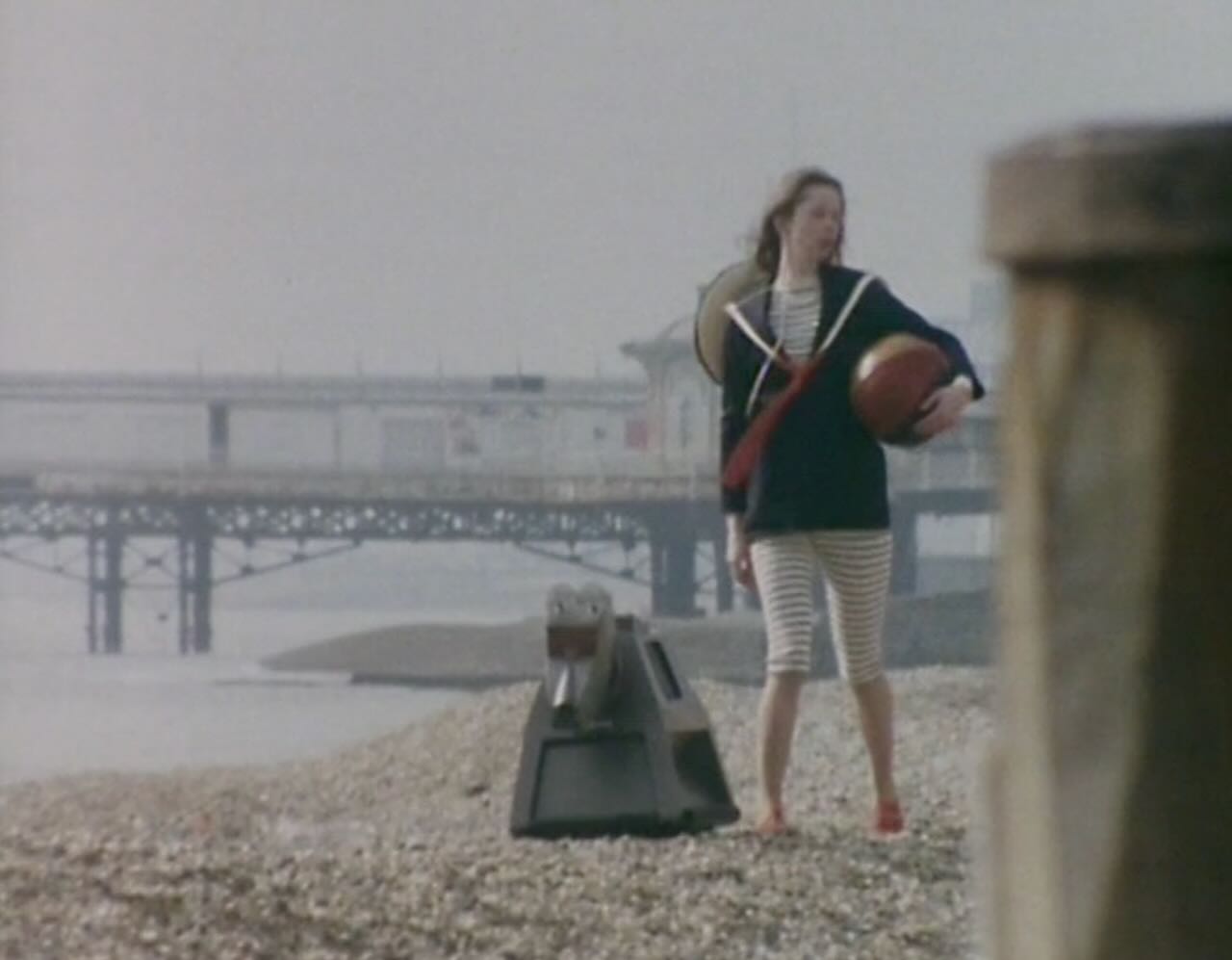
But I was also thinking…this is boring. It has far too many bits that just drag unnecessarily. The opening shot panning along the chairs at the beach look something from Monty Python, like you are waiting for John Cleese to be revealed, sitting at an incongruous desk and then hanging up a phone before announcing “And now for something completely different.” Instead of course it’s the TARDIS that is revealed, but its arrival doesn’t bring any sort of accompanying payoff, more just a sigh of relief that the show is finally starting. Heaven forbid someone tuned into this as their first episode, or even worse, tried to use the story to introduce someone else to the show.

There’s also a lengthy and not terribly interesting shot of a spaceship docking, and numerous instances of the claws of the story’s monster-of-the-week doing suspicious things at the edge of the frame. And much of the plot of the first episode is taken by extended explanations of what the Tachyon Recreation Generator is and how it works, before the hapless volunteer gets killed and things start getting dramatic. All the other plot set-up that we get at the start–the Argolins dealing with the offer from the supposed humans to buy the Leisure Hive, the dubious nature of scientist Hardin’s experiments, the backstory about the Argolins war with the Foamasi–it’s all fine as far as it goes, but it’s a lot of a lot, and tends to drag on. The serial’s first two cliffhangers, with the Doctor being first ripped apart by the TRG and then super-aged by it, both reek of an effort to create excitement and tension when in reality there is very little.
Basically, all of this preparing me to expect the whole story to be dull and poorly paced story. So where was the surprise? It came in the way that as things progressed, I found myself becoming more and more invested, to the point where I’d say that I actually that in the end I quite enjoyed the thing.

Somewhere around the third episode all that set-up started to payoff for me. The fact that Argolins were so traumatised by their war-line past made them unique and interesting. The ethos of the Leisure Hive, to create an environment where different species could enjoy learning about each other, all to avoid ever repeating that devastating history, stood out as surprisingly mature. The fact that the main villain of the story turned out not to be the “monstrous” Foamasi but rather the disaffected Pangol, the sole member of a new generation of Argolins who fails to remember the lessons of the past, was an intelligent piece of storytelling.
And all the attention that is given to the TRG throughout the story ends up feeling meaningful as the device is really is central to everything going on. It becomes the means by which Pangol hopes to effect his plan (by producing an army of clones) and ultimately becomes a big part of his defeat (turning him back into a child). In this and other ways, The Leisure Hive is quite cohesive, with all of its story elements ultimately feeling meaningful, like they genuinely belong. That helps to make it a satisfying watch, in spite of the slow build up one has to get through in the first half.

Apparently David Fisher wrote the script with more humorous, as was more the way of things under the producer-ship of Graham Williams over the show’s preceding three seasons. As such there were efforts to make the whole thing something of a spoof of gangster stories, with “Foamasi” even being an anagram of “mafiosa”. As the script developed under script editor Christopher H. Bidmead, it had to change, but I wonder if the fact that the script was written with a different era in mind accounts for the utter goofiness of the reveal that the humans Brock and Klout are actually Foamasi in disguise.
The directing and editing do their best to make it work, but there is no hiding the fact that the Foamasi would never fit inside their human costumes. Having the Foamasi police officer using Brock’s voice synthesiser and thus speaking with John Collin’s mannered voice for the rest of the story just adds to the surreal quality of it all. I’m not complaining, mind you, as these more fantastical elements are Doctor Who‘s bread and butter, and I’m just glad they weren’t totally lost as the show moved in a new direction.

Another thing I’ve read is that this story was produced when Tom Baker and Lalla Ward’s real-life relationship was at its worst. I can understand how that might have made production difficult but I don’t feel like you can see signs of any of that tension on screen. Both Baker and Ward’s performances as are as strong and charming as we have come to expect, as are that of pretty much all the guest cast.
Finally, there is something about The Leisure Hive which brings to mind the series Babylon 5. The titular space station in Babylon 5 is also about providing a place where different aliens races can intermingle and learn to understand each other and live in peace. And that show also required a kind of perseverance as it set things up for the first one or two seasons, before providing a really exciting payoff in parts three and four. Fortunately The Leisure Hive avoided having the fifth part that Babylon 5 did, which often felt tacked-on and struggling for relevance.

Other Thoughts
• The guest cast for this serial include Laurence Payne as Morix, who also played Dastari in The Two Doctors and Johnny Ringo in The Gunfighters. Nigel Lambert (Hardin) voiced the Priest Triangles in two episodes of Doctor Who Flux, the modern show’s 13th series. David Allister (Stimson) was Bruchner in Terror of the Vervoids, meaning that he twice has played dodgy guys who were killed by the show’s monsters. Finally, Adrienne Corri plays Mena here in her only Doctor Who appearance–but people may remember her as Mary Alexander, one of the unfortunate victims of Alex and the Droogs in the film A Clockwork Orange.

• Later, in The Visitation, John Nathan-Turner would deliberately get rid of the sonic screwdriver from the show’s format, in part because it was too easy for writers to use it to get the Doctor out of dangerous situations. This always struck me as funny given that the very first cliffhanger in Nathan-Turner’s era has the Doctor doing exactly that. Maybe that’s part of what inspired the move.
PakarPBN
A Private Blog Network (PBN) is a collection of websites that are controlled by a single individual or organization and used primarily to build backlinks to a “money site” in order to influence its ranking in search engines such as Google. The core idea behind a PBN is based on the importance of backlinks in Google’s ranking algorithm. Since Google views backlinks as signals of authority and trust, some website owners attempt to artificially create these signals through a controlled network of sites.
In a typical PBN setup, the owner acquires expired or aged domains that already have existing authority, backlinks, and history. These domains are rebuilt with new content and hosted separately, often using different IP addresses, hosting providers, themes, and ownership details to make them appear unrelated. Within the content published on these sites, links are strategically placed that point to the main website the owner wants to rank higher. By doing this, the owner attempts to pass link equity (also known as “link juice”) from the PBN sites to the target website.
The purpose of a PBN is to give the impression that the target website is naturally earning links from multiple independent sources. If done effectively, this can temporarily improve keyword rankings, increase organic visibility, and drive more traffic from search results.