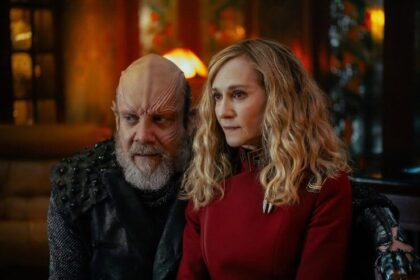
Doctor Who has long been my favorite show, but my actual viewing it over the years has been very on-again / off-again. Lately, it’s been all-on, as I’m actually closing in on finishing re-watching all of the classic episodes (at least the ones that are easily available for me to stream), whilst blogging about each serial.
So I did a little experiment with AI related to this response, which I already published here. But this is the mostly the article I wrote before I saw what AI would have come up with, although with a few tweaks which are more attributable to just looking at it again after some has past as much as anything else.
Revelation of the Daleks
Starring Colin Baker as the Sixth Doctor.
Companion: Nicola Bryant as Peri.
Written by Eric Saward. Directed by Graeme Harper. Produced by John Nathan-Turner. Script Edited by Eric Saward.
Format: 2 episodes, each about 45 minutes long
Originally Aired: March 1985 (Episodes 12-13 of Season 22)

Spoilers Ahead!
Revelation of the Daleks has a lot of qualities that I would normally point out as weaknesses of its era, but in spite of this I’d say the serial is more a success than a failure. I guess that goes to show that if the execution is strong enough, lots of story problems can be overcome, at least to a degree.
I’m talking about things like the fact that we spends almost as much time with the Doctor and Peri traveling to the adventure as it we do with them in the adventure, and about the habit of spending ages with supporting characters whose stories end perfunctorily and unsatisfactorily. Revelation of the Daleks does have these problems, but it makes up for them with other strengths. Or at least it makes the weaknesses feel less egregious.

Take for instance the long time it takes the Doctor and Peri to arrive at Tranquil Repose. It’s not until the end of the first half of the story that they actually get to the outside of the centre, and not until the start of the second half that they interact with any of the other characters that we’ve been spending time with. That sort of thing has been a big drawback of a number of Colin Baker stories, but here it’s helped by the fact that the the Doctor and Peri are far less “catty” than they often are. It is still sarcastic and biting, but balanced out an affectionate tone that the actors are able to convey, if not the script.
Also, the encounter with the doomed mutant, and the clues that this gives them about the Great Healer, are meaningful and significant enough to give these scenes the sense that they matter to the story.

More importantly, all the other stuff that the first episode spends its time on–Davros’ machinations, Kara’s hiring of Orcini, Jobel’s casual cruelty to Tasambaker, and all of Natasha and Grigory’s efforts–is all compelling enough to hold our attention. Like some other stories of this era the script feels at times like it’s almost frustrated that it has to include the Doctor at all, but at least what it’s presenting instead is interesting.
And for the most part, it’s really well-performed. Most of the cast is solid, with special praise to be given to William Gaunt as Orcini. He does an excellent job taking this character that could have been hackneyed (tired old assassin with a heart of gold) and makes him seem fully formed, imbuing him with depth and dignity.

His interaction with his squire Bostock (John Ogwen) is great, and he’s one of the few guest characters that I’ve ever seen on this series that made me genuinely wish had more screen time.
Of the guest characters, only Clive Swift’s Jobel is full-blown cartoonishly ridiculous, but in isolation this feels more like a creative choice than a flaw in overall tone. Jenny Tomasin’s Tasambeker threatens to go this way at times (particularly when she is yelling at Takis and Lilt, for instance), but most of the time she comes across believably pathetic. And given the way she idolises Jobel, it’s maybe not surprising that under the right circumstances she acts a bit like him.
Another character who is worth scrutinising is the DJ, played by Alexie Sayle. He seems like an over-the-top caricature at first, with his absurd radio personality and series of silly costumes.


But when Peri actually meets up with him, Sayle is able to give us another side of the man. Outside of his on-air persona, the DJ seems like a genuinely nice guy–down to earth, relatable, and probably just a little bit lonely.
Of course, it has been said that everyone is who they are at the moment of their death, and if that’s true, then the DJ is in reality a goofball, because he has got one of the sillier Dalek-deaths that I can remember, flinging his arms out and screaming like he’s in some sort of pantomime.

And this after he just walks out into the open during the middle of a battle with the Daleks, like he wants to be shot.
This is particularly annoying because if there is one character you don’t want to get killed in this story, it’s the DJ. His death, though dramatically justified, seems the most gratuitous. He’s practically the only sympathetic character; why not find a way to let him stick around?

Anyway, all this strong character work (I haven’t even mentioned everyone) helps the story to dodge the second weakness I mentioned, which is the frustrating habit of introducing characters to fulfil some sort of story purpose, and then abruptly killing them off once that purpose is over (this might be mainly an Eric Saward thing, but this is an Eric Saward story, so it’s still relevant). We do get this in Revelation of the Daleks, but the problem is lessened by how well-developed everyone is.
The only characters who truly seem to be unnecessary–who are there just to get through their subplot and then get killed–are Jobel and Tasambeker: two characters with quite a lot of screen time but with almost no impact upon the main plot of the story at all. Indeed, the main plot of Revelation is almost absurdly simple, once you strip away all its bells and whistles: Davros lures the Doctor into a trap, but gets himself captured by other Daleks instead, and then everything blows up. But even with that, almost everyone–Orcini, Bastock, Kara, Takes, Lilt, Grigory, Natasha–has something to do with it.

Not so Jobel or Tasambeker, whose biggest contribution to the overall plot is that Jobel shows Peri the way to the DJ. But their side-story is interesting enough that I’m willing to accept it, even if it ends up going nowhere. I guess others have felt the same way because as far as I can tell, this is where the weird idea comes from that Davros seems really good at manipulating everyone around him even though he’s so blatantly evil–something that comes up at least in Big Finish’s approach to the character.
The other characters who might fall into this general category are Natasha and Grigory, who occupy an unfortunate space in Eric Saward’s list of favorite character-types: people who spend a lot of time trying to do something significant only to get abruptly killed at the last moment. They are not the worst examples of this (that would be Griffiths, Bates and Stratton in Attack of the Cybermen), but neither are they the best (probably Styles from Resurrection of the Daleks). At least Grigory and Natasha’s deaths are shown to have an impact on the Doctor himself.

There’s a lot about Eric Saward’s approach to his stories that I’m not a big fan of, but I have to admit that he pulls it all off quite well here. The “resolution” to the main crisis, when Takis gets a different faction of Daleks involved who don’t like Davros, is very clever–even if that does mean that the Doctor is really only minimally involved in solving anything that is going on.
One of the common problems from this era that does not rear its head in this story is the tendency toward gaudy and excessive design. Indeed, by the standards of most of Doctor Who in the mid 80s, Revelation of the Daleks is positively restrained. The Doctor wears a relatively mild looking blue cloak for the first half of the story, Peri is dressed normally and not like a showgirl (mostly), and Tranquil Repose itself looks pretty much like the kind of place its supposed to be. So kudos to designer Alan Spaulding for his work in the only Doctor Who story that he was part of.

But credit is also deserved for director Graeme Harper, who would have had something to do with that, and who does strong work throughout. Harper is one of the more celebrated directors in the series, certainly in this era, who put together The Caves of Androzani, one of the shows strongest serials. He does a great job here, always finding interesting ways to frame things to highlight the various dilemmas that the characters find themselves in, and to maximise the sense of threat posed by the Daleks.


I was particularly impressed by an extended tracking shot near the start of the first episode which first introduces us to Jobel, Tasambeker, Takes and Lilt, which starts on Jobel’s work on his latest corpse and moves down to follow him and the other characters as they walk away. I also loved the way that Harper made Tranquil Repose feel like a big place full of a lot of people, particularly at the end when we see loads of extras running for their lives before the explosion. It’s the sort of detail that could easily get lost in the middle of a complicated production.
Speaking of the Daleks, I’ve never been the biggest fan of the galactic exterminators, but that actually works in Revelation’s favor. In some ways, they are as incidental to the story as the Doctor is–present, but not necessarily driving anything that happens. That only changes when the second faction of Daleks show up toward the end and cart Davros off to face his comeuppance.

I both enjoy the fact that this all ties into their previous televised appearance, but that it doesn’t bog down the events of this story unduly.
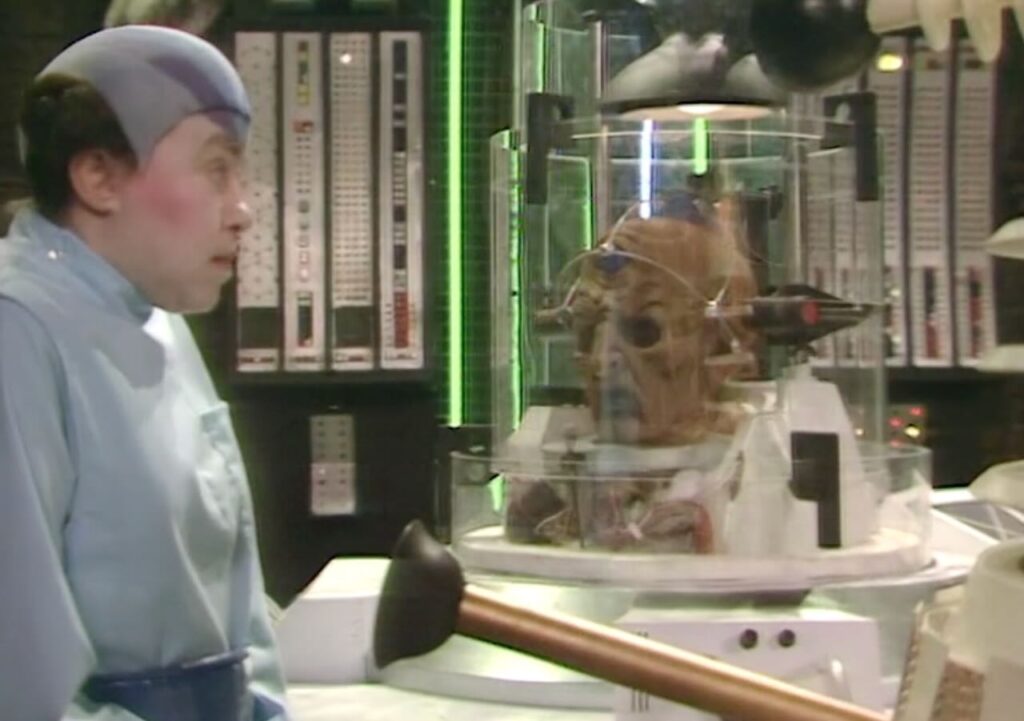
Are there other weaknesses to Revelation of the Daleks? Sure. There is a whole thread about the President of something or another showing up to get assassinated that doesn’t seem to really matter. No explanation is given for why Davros is interacting with everyone through a proxy clone head of some sort.

And the idea that all the not-quite-dead inhabitants of Tranquil Repose have been turned into food is so underdeveloped that it’s almost an afterthought.
(Quick note: the AI versions of this post both highlighted this particular element as the story’s main theme; ie that the idea of people becoming a commodity and an overall sense of capitalist satire was thing that made the story interesting. I agree that that is probably what the writer was hoping for, but I still hold my opinion that the idea is pretty lost in the background to all the other busy-ness taking up the screen time).
But really all of that is nit-picking. In general, Revelation holds interest very well, thanks to the combination of solid scripting, strong direction and excellent performances.

Other Thoughts
• I joked up above about the DJ’s over-the-top manner of death. On the opposite side of the spectrum is Hugh Walters as Vogel, who gets a really sad last look at Kara, his boss, before he fully dies.
• Characters (particularly Davros and the DJ) spend a lot of time watching things on TV in this story.
• It’s a bit icky when the Doctor encourages Peri to go off with the clearly lecherous Jobel.

It’s for her own safety of course, as the Doctor has realized the Great Healer is probably a lot worse, but still, it’s not a good look for the Doctor to seem so flippant about the situation.
• Bostock shoots off Davros’ hand in this story.

In an interesting continuity detail, when Davros reappears in the modern series, in The Stolen Earth, he has a robotic hand.
• This story features a transparent or glass Dalek, which was apparently similar to an unproduced idea either from Terry Nation for the Daleks in their original story, or just something David Whitaker came up with for the novelisation of that story.

It also featured the first unequivocal image of a Dalek hovering, the limitations of the show’s production budget meant that it wasn’t fully clear to me that that was what was happening on my first glance.
• Revelation of the Daleks was the last serial for Season 22, and as it turned out, almost the last classic Doctor Who story ever. The show was basically cancelled at that point, although that was quickly turned into an 18 month hiatus to give space for the show to retool itself. This meant that there were plans for the following season that were all completely scrapped sort of at the last minute. Consequently, this story ends with a slightly strange freeze-frame, before the Doctor offers to take Peri to Blackpool, where the following season opener was set to take place (see The Nightmare Fair, which eventually was produced as an audio drama).

As an American, I don’t know anything about Blackpool, so the reference would have been completely lost on me. After doing a bit of research, I find that it’s a seaside town in England that has been a popular tourist destination, and was where a real life Doctor Who Exhibition was held.
• It’s become my habit in my more recent Classic Doctor Who posts to point out some of the more interesting cast members who appear in these stories. Revelation of the Daleks has got lots to talk about:
Terry Molloy, of course, plays Davros, which he did one time before this story (Resurrection of the Daleks) and one time after (Remembrance of the Daleks). He also played him a bunch for Big Finish, and played Russell the police officer in Attack of the Cybermen.
Eleanor Bron, who brings an elegance to Kara in this story, previously cameoed in City of Death next to John Cleese as a museum patron who mistook the TARDIS for a piece of art.

Hugh Walters (Vogel) was William Shakespeare way back in The Chase and Runcible in The Deadly Assassin.
Clive Swift (Jobel), who is best known as Richard Bucket on Keeping up Appearances, was also Mr. Copper in Voyage of the Damned in the modern series.
Trevor Cooper (Takis) also appeared in the modern series, as Friar Tuck in Robot of Sherwood. He’s best known to me as Colin Devis in the short-lived series Star Cops.

Colin Spaull (Lilt) also appeared in the modern series, as Mr. Crane in Rise of the Cybermen / The Age of Steel.
Jenny Tomasin (Tasambeker) didn’t have any other Doctor Who roles but was a regular on Upstairs, Downstairs as Ruby the maid, alongside Doctor Who alum Jean Marsh.
Alexie Sayle (the DJ) has done lots of stuff but is well-known to me as the fifth guy from The Young Ones, where he played a variety of characters, most notably members of the Balowski family (the boys’ landlord).
Alec Linstead (the “Head of Arthur Stengos”) previously appeared as Sgt. Osgood in The Daemons and Arnold Jellicoe in Robot.
And finally, Penelope Lee, who has the tiny part of a computer voice, was apparently offered the role that became Barbara Wright but turned it down. She also played “9th Elder” in Superman the Movie, which would put her right next to William Russell, who had played Ian Chesterton, and was credited as “8th Elder.”

• Director Graeme Harper is the only director for the show who has worked on both the classic series and the revival series. His contributions to the revival as a director include such notable stories as the Rise of the Cybermen two parter, the Doomsday two parter, 42, Utopia, Planet of the Ood, The Unicorn and the Wasp, Turn Left, the Journey’s End two parter and The Waters of Mars. He also played, via a still photograph, one of the so-called Morbius Doctors from The Brain of Morbius and The Timeless Children.
PakarPBN
A Private Blog Network (PBN) is a collection of websites that are controlled by a single individual or organization and used primarily to build backlinks to a “money site” in order to influence its ranking in search engines such as Google. The core idea behind a PBN is based on the importance of backlinks in Google’s ranking algorithm. Since Google views backlinks as signals of authority and trust, some website owners attempt to artificially create these signals through a controlled network of sites.
In a typical PBN setup, the owner acquires expired or aged domains that already have existing authority, backlinks, and history. These domains are rebuilt with new content and hosted separately, often using different IP addresses, hosting providers, themes, and ownership details to make them appear unrelated. Within the content published on these sites, links are strategically placed that point to the main website the owner wants to rank higher. By doing this, the owner attempts to pass link equity (also known as “link juice”) from the PBN sites to the target website.
The purpose of a PBN is to give the impression that the target website is naturally earning links from multiple independent sources. If done effectively, this can temporarily improve keyword rankings, increase organic visibility, and drive more traffic from search results.