Doctor Who has long been my favorite show, but my actual viewing it over the years has been very on-again / off-again. Lately, it’s been all-on, as I’m actually closing in on finishing re-watching all of the classic episodes (at least the ones that are easily available for me to stream), whilst blogging about each serial.
I’ve only got a few more classic Doctor Who serials to go through on this general rewatch (at least if we only count those stories that are generally available to stream). Some of them are reputed to be good, and some to be bad. Delta and the Bannermen is one of the bad ones. Some have called it their least favorite story. Is it that bad? Is the worst story that I have left? Is it the worst story ever? Let’s try to find out.

Delta and the Bannermen
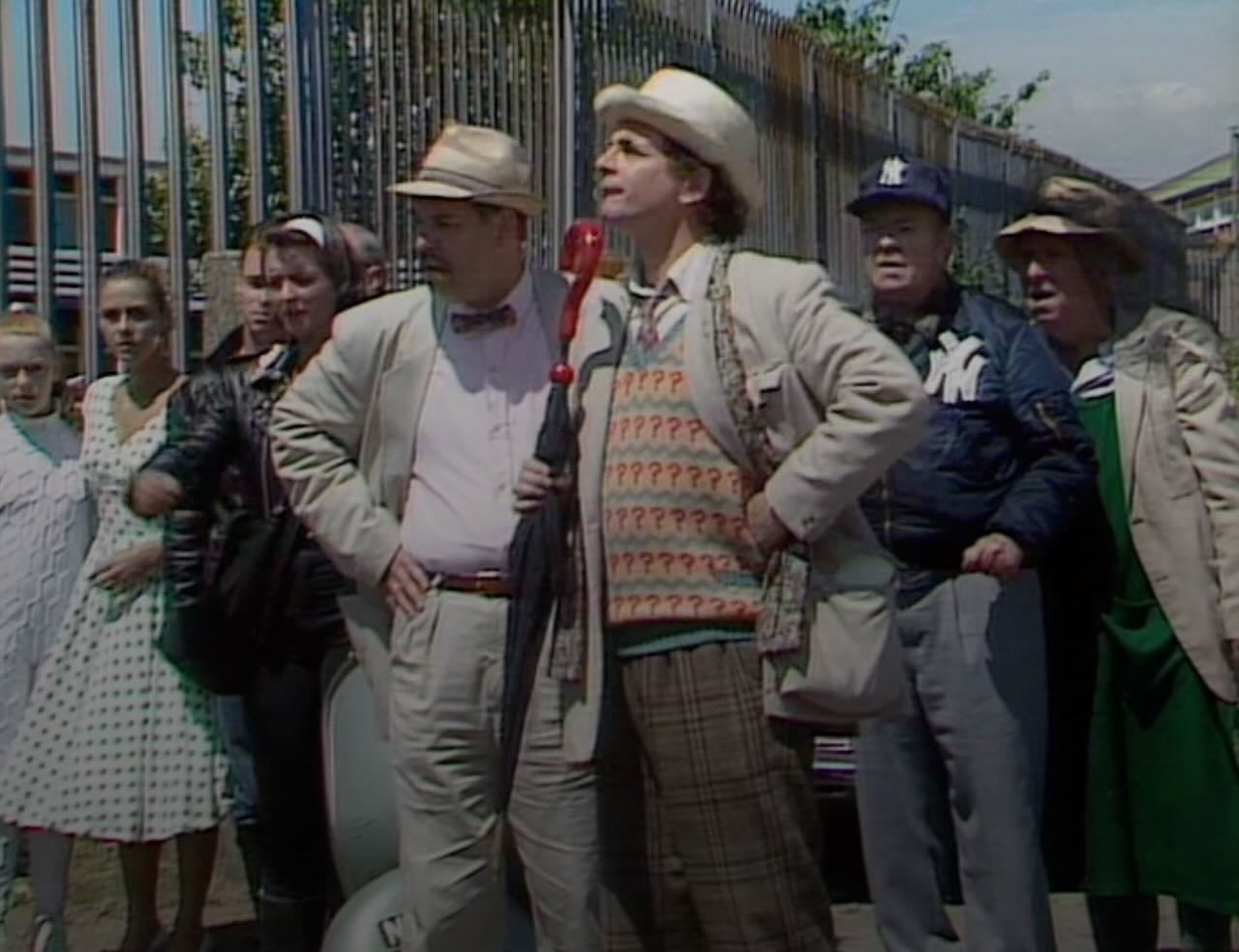
Starring Sylvester McCoy as the Seventh Doctor.
Companion: Bonnie Langford as Mel.
Written by Malcolm Kohll. Directed by Chris Clough. Produced by John Nathan-Turner. Script Edited by Andrew Cartmel.
Format: 3 episodes, each about 25 minutes long
Originally Aired: November 1987 (Episodes 9-11 of Season 24)

Spoilers Ahead!
Delta and Bannermen is, in fact, bad. I don’t know if it’s the worst story ever but I think it might be the one that is bad in the most bewildering ways. I mean, Underworld is probably worse, but it’s bad by being cheap and drab and dull. Delta and the Bannermen isn’t cheap, or at least isn’t cheap-looking, not by the standards of the era anyway. It’s not drab-it’s got the same sort of gaudy excess that you’d later see under the worst of Russell T. Davies or Chris Chibnall. And it’s not especially dull–the story move along at a jaunty pace. And yet, it’s still bad–a rambling, cobbled-together mess of a story that feels like, at best, that someone had an idea for a story but no desire to develop it to the point where it would feel authentic, and so they threw in a bunch of unrelated business to fill out the runtime.
Delta and the Bannermen aims for a rock ‘n’ roll vibe, with the late 50s setting, the liberal use of covers of real 50s songs, the “get-to-know-you dance” sequence and the fact that Billy is actually a singer who drives a motorcycle. But it’s not successful. When I think of rock ‘n’ roll, I think vibrant energy and a touch of edginess. Here all of that is lost in the general silliness of things. The story is riddled with over-the-top performances and some ridiculous design. The rock-themed incidental music feels try-hard and often clashes with whatever is going on. The end result is just that it all feels weird.

But my biggest criticism of this serial is the uncaring way the story is put together. Things start off well enough, with the last survivor of a hunted alien species hitching a ride on a space-bus tour to earth to escape marauding attackers. The Doctor and Mel are also there–this is a coincidence, but that’s okay since the Doctor is always turning up to the places by coincidence. But then all these other things start to happen, also by
Actually, scratch that. I was going to say other things just happen by coincidence. But that’s not really the issue, it’s more like a bunch of unrelated incidences take place, with the only thing tying them together being the fact that they are all this set of scripts. Like the space-bus crashes into a satellite, which doesn’t matter to anything. A couple of CIA agents are around looking for the satellite, but they don’t matter to anything else. There’s a daft beekeeper who pups up abruptly who doesn’t really matter. Even all the people on the space-bus don’t really matter as they all are just summarily killed in the second episode, and then are never mentioned again.

(This is one of my biggest pet peeves with Doctor Who, which is the flippancy with which it treats some of the guest characters. Poor bus driver Murray, poor all those other passengers. Mel gets to be upset but the Doctor never even knows they were killed).
Now, obviously I’m not saying all the above events literally have no bearing on the story. The two Americans, Weismuller and Hawk, are the most egregious examples of what I’m talking about, but clearly they are on screen a lot, so ipso facto they are part of the episode’s plot.

But they don’t contribute anything meaningful. They don’t do anything to advance the story, or to reveal theme or character. They just take up space which should have been used elsewhere, because the parallel issue with the story is that the stuff that does matter, or feels like it should matter, is flippant and underdeveloped.
Most obviously, we never found out anything about Delta, her people the Chimerons, or Garvak and his people the Bannermen. Who are these people? Why are they so grumpy with each other? Why does Delta look like an attractive earth female while her people are all covered in green insect makeup? I’m not saying we need loads of development here, but some sort of context would be nice.
But there is even a bigger example than this, or at least an example with a bigger impact on the story’s success. Arguably the central relationship to the whole plot is the one between Delta and Billy.

He is supposed to be so attracted to her that he ends up being willing to leave earth for her and to undergo a risky experimental procedure to change into her species. And yet nothing on screen ever justifies any of this. If you don’t blink, you’ll see him sit with her at lunch, and then he sings a song to her at the dance. The next thing you know he is popping into to visit her and barely batting an eye at her her little green baby. She immediately starts to reveal her life secrets to him, and then they are off onto what sure was pop-culture’s most clumsy romantic picnic until Star Wars Episode II: Attack of the Clones came out 15 years later.

Didn’t anyone realize how essential it was to make this relationship meaningful, anywhere in the process of putting together this story? Instead, the episode is mostly interested in Ray’s reaction to being rejected. That would have been fine if that was what the episode was about. Instead, like most of the pieces of Delta and the Bannermen, Ray ends up not really mattering that much to things; once they escape from the doomed bounty hunter she doesn’t do much but stand around with the group being Welsh.
This is too bad because Sara Griffiths probably turns in one of the episode’s more engaging performances.

Now I think I’ve heard that the serial’s Welsh characters are over-the-top caricatures, but I can’t say that with any authority because I just don’t know (though I’m willing to believe it). But I do know that Weismuller and Hawk are over-the-top Americans caricatures who don’t come across as authentic at all. And other personalities like the Tollmaster or Goronwy (the beekeeper) are written and performed as extreme goofballs (so is Gavrok, but as the main villain I can kind of justify that one). By contrast, Billy is too bland to be interesting, and Delta too underdeveloped. With Ray, at least I have some sense of who she is and her personality is bright and lively. I’m not saying I’d have preferred her as a companion to Ace (as might have happened) but she does play off the Seventh Doctor reasonably well.
Speaking of the Doctor, Sylvester McCoy is mostly fine here, but he hasn’t really found his stride in the roll yet. Or maybe it’s that the writing hasn’t found its stride, but either way things will markedly improve in season 25. Bonnie Langford’s Mel, is, I’m sad to say, my least favorite TV companion, and nothing that happens in this story challenges that assessment, as she she spends a lot of time screaming her way through things.

She has exactly one moment where she does something kind of cool, which is when she lies to Gavrok about whether he was successful in killing Delta or not. It’s a good moment, but not enough to redeem the character after we’ve seen her casually walk away from Delta after she has pulled a gun on her, as if it’s a concern but not really that big a deal, and then later screams her head off when she sees that little green alien puppet emerging from a space-egg.
Oh speaking of that, the little Chimeron Queen whose hatching and development is a big part of the plot is one of the most notable things in the whole serial. It starts off as a little puppet, but then later, without any warning, it turns into a human baby in a funny costume with green make-up.


Eventually this is explained as part of the baby’s rapid (and expected) aging, but there’s no warning about this before the baby appears. All I can say is that the surprise sight of this little girl (an actress named Jessica McGough, apparently) all dressed up like this is just hilarious. She looks just like a baby whose mother has made her up for Halloween as an avocado, or maybe Slimer from The Real Ghostbusters.
And the fact that I found this to be the funniest part of the story’s design is saying something because this is also the one that features bad guys called Bannermen who have literal flags on their backs, and who start sticking their tongues out and hissing at one point.

Other thoughts:
• There are a lot interesting people in the guest cast here. I’m not familiar with Ken Dodd (the Tollmaster) at all but he’s apparently a very famous actor and singer who is best known for his live stand up performances, and who has sold over 100 million records as a singer. According to the internet, his appearance has been cited as the show’s one of the “most egregious example of stunt-casting” ever.

• Stubby Kaye plays Weismuller. He’s another well-known comedian and singer who originated the role of Nicely-Nicely Johnson in Guys and Dolls and also played him in the movie. I first became aware of Kaye from his final film, Who Framed Roger Rabbit where he played murder victim Marvin Acme.
• Playing opposite Kaye here is Morgan Deare as Hawk. I knew Kaye was American but was surprised to discover that Deare is as well, which took me off-guard because I thought his accent sounded so unbelievable. Deare also had a small role in Who Framed Roger Rabbit, briefly played Ethan Hunt’s uncle in the first Mission Impossible movie, and appeared in the Thirteenth Doctor story Rosa.
• Don Henderson plays Garvok here.

He’s best known to me as General Tagge in the first Star Wars movie–he’s the imperial officer in the conference room scene whom Darth Vader does not force choke. But he’s the one warning everyone about the danger to the Death Star now that the rebels have stolen the plans–if Grand Moff Tarkin had listened to him, things might have turned out quite differently!
• Hugh Lloyd (Goronwy) is apparently also a famous actor who would have been recognisable to British TV audiences back in the day, but I’m not familiar with anything he’s been in. HIs longest series seems to be a sitcom called Hugh and I, in which he played a variation of himself.
• Keff McCulloch was one of the Lorell’s band members. He is the guy who arranged the Seventh Doctor-version of the Doctor Who theme music, and did the incidental music for this story and more than half of the Seventh Doctor’s era.
PakarPBN
A Private Blog Network (PBN) is a collection of websites that are controlled by a single individual or organization and used primarily to build backlinks to a “money site” in order to influence its ranking in search engines such as Google. The core idea behind a PBN is based on the importance of backlinks in Google’s ranking algorithm. Since Google views backlinks as signals of authority and trust, some website owners attempt to artificially create these signals through a controlled network of sites.
In a typical PBN setup, the owner acquires expired or aged domains that already have existing authority, backlinks, and history. These domains are rebuilt with new content and hosted separately, often using different IP addresses, hosting providers, themes, and ownership details to make them appear unrelated. Within the content published on these sites, links are strategically placed that point to the main website the owner wants to rank higher. By doing this, the owner attempts to pass link equity (also known as “link juice”) from the PBN sites to the target website.
The purpose of a PBN is to give the impression that the target website is naturally earning links from multiple independent sources. If done effectively, this can temporarily improve keyword rankings, increase organic visibility, and drive more traffic from search results.