So this is one of those months that had lots of stuff that I read and watched.
DuckTales, season 2
This is specifically the 2017 revamp of the classic animated series about Scrooge McDuck and his escapades with his identical triplet nephews, Huey, Dewey and Louie. My daughter and I watched the first season some time ago, and took the opportunity that we had of being the open people in the house for a while to watch through all of season 2. Both of these first two years (of three) are made up of 20 episodes which have lots of standalone plots, but which also build together toward one long-term story–one of the best ways to structure a TV show, I think.
In this case the focus is on Della Duck, the long-missing mother of Huey, Dewey and Louie who it turns out has not been dead all these years, but stuck on the moon. We found that out in the previous year but this time around we learn what she’s been up to, which includes meeting a whole race of moon beings who are ruled by a being who seems friendly at first, but turns out to be war-mongering villain.
Della escapes to earth in the middle of the year and we get some interesting stories of everyone adjusting to her return, before the season hits its climax with a big alien invasion story. It’s good stuff. Individual episodes are mostly fun and the longer story arcs are really well-paced (a trait many of the animated shows my kids have introduced me to shares).
The cast for DuckTales includes Community alums Danny Pudi as Huey Duck, Jim Rash as Gyro Gearloose, and Paget Brewster as Della Duck. And of course the 10th/14th/ Meta-Crisis Doctor himself, David Tennant, as Scrooge McDuck.

Legion season 2
The other thing that we took the opportunity to continue watching was Legion, another show we’d previously made our way through the first season of. This a story somewhere in the X-Men universe (apparently, Charles Xavier is in the third season?) about a super-mutant named David Haller who has semi-untapped godlike mental abilities. The show is called Legion because David has multiple personalities inside of him, a fact that actually isn’t that important to this season until the end. The bulk of the series is about David and his colleagues dealing with an existential threat from an ancient mutant called the Shadow King, whose mental psyche is trying to reunite with his dead body in order to become invincible.
The plot of the show matters of course but what one really remembers about it is the tone, which super-surrealist and bizarre. Episodes are just jammed-pack with oblique and unsettling imagery which seems utterly confusing at first, but which by the end of each episode sort of makes sense. I don’t have the time or energy to dig into it here, but it is quite simply unlike anything I have ever seen on TV. It’s probably a little more coherent than Twin Peaks, but only a little.
Dan Stevens (former of Downton Abbey!) plays David, and does a good job as our point-of-view character who is often as bewildered as the audience. Aubrey Plaza plays his sort-of-dead drug addict / fellow mental patient friend who is sometimes a host to the Shadow King. And Bill Irwin, who recently played the Cyclops in The Odyssey, appears as a scientist named Cary, who has a mutant girl named Kerry living inside his body. This is one of the weird things in the show, but only one of them, which maybe gives you an idea of just how strange things are here.

Suicide Squad
One night this month, when my daughter and I were scrounging a bit for something to watch, we ended up streaming 2016’s Suicide Squad, directed by David Ayer, which for me was an exercise in finding out if that movie was as bad as I remembered, and for her if it was as bad as its reputed. I’m not 100% sure of the answers to those questions, but if it’s “no” it’s only because it’s actually worse.
Really, this is a serious contender for the worst mainstream superhero movie ever, or at the one that is the worst in the most bewildering way. Like, it has big name actors in it and it looks like it had a budget behind it, but it is so incompetently paced and so inanely edited that it just beggars belief. The only other major comic book adaptation that I can think of that gave me the same feeling was 2015’s Fant4stic, but in some ways it’s a bit easier to comprehend how that movie got to be the mess that it is.
Suicide Squad sends an obscene amount of time in an endless series of introductions and set-up scenes before it finally gets to its story (a group of expendable villains are tasked to be government operatives for dangerous missions). The mission they are on–to stop an ancient witch that went rogue on a similar operation–is developed through a series of uninspired action scenes interspersed with unearned “character moments” that don’t mean anything because the movie doesn’t do anything to develop those characters. The movie’s tone hops all over the place (presumably due to reshoots and studio re-editing, but who knows), features one of the dopiest looking and acting villains to ever grace the screen, and makes you just hope that it will end soon pretty much all the way through.
Will Smith is somehow utterly devoid of charisma as Deadshot, the movie’s ostensible main character. Jared Leto shows up for a few scenes as the most obnoxious Joker ever put to film. Viola Davis turns in a reasonable performance as the brains behind the squad, Amanda Waller, a brilliantly conflicted character in the Suicide Squad comics, but here just a horrible person that you spend the whole time wishing she’d just get killed off, but somehow never does. Only Margot Robbie transcends the material as she plays Harley Quinn with inescapable charm, but the material is still so bad that it doesn’t matter.

The Untouchables
To contrast this, we also watched 1987’s The Untouchables, a movie that is a bit cavalier with its visual continuity and extremely suspect in terms of historical accuracy, but just an incredible amount of fun. It’s a crime thriller about the takedown of Al Capone by US Treasury agent Eliot Ness and his handpicked squad of “Untouchables.” Kevin Costner plays Ness but it’s Sean Connery as an older beat cop named Jimmy Malone who really steals the show. Malone becomes Ness’ mentor in the movie, teaching him how to fight “the Chicago way.” Charles Martin Smith and Andy Garcia play the other two members of Ness’ squad, while Robert De Niro does his magic making Al Capone both loathsome and compelling.
David Mamet turns in a very literary script and Brian de Palma just directs the hell out of this thing. There are so many standout moments and an incredible use of all the tools of cinema–composition, sound, editing, etc. The showstopping scene is certainly the big shootout at the Chicago train station with the baby carriage. It’s an obvious homage to the famous scene in Battleship Potemkin, but it’s not just a carbon copy. It uses a similar technique, but in an advanced form with more modern filmmaking techniques (slow motion, sound effects, etc) and I love it.
Speaking of music, the score is also excellent, thanks to the exceptional Ennio Morricone doing this thing.

Columbo: A Friend in Deed and Any Old Port in a Storm
These are two episodes of he legendary detective show, Columbo, starring Peter Falk as a disheveled homicide detective who is constantly underestimated by the smug Los Angeles elites whom he is investigating. We picked two episodes semi-randomly to watch when we needed a break from our regular offerings, and ended up with these two stories from the third season (1973-1974). Columbo, if you don’t know, is a series of movie-length mysteries which have the twist that the full story of who the murderer is and how the crime was committed are fully spelled out for the audience at the start of each episode. The interest of each story is not finding out what happened, but in seeing how Columbo identifies and traps the killer.
Any Old Port in a Storm has Columbo figuring out how a wine connoisseur played by Donald Pleasance murdered his half-brother when he apparently drowned while scuba diving while Pleasance was on a business trip in France. The story is reasonably good even though there are some serious holes in the murderer’s efforts to create an alibi. Pleasance is an interesting actor because he can play a fairly odious guy who is still somehow likeable and sympathetic.
A Friend in Deed has the interesting wrinkle that the murderer, Mark Halperin (Richard Kiley), is actually Columbo’s superior on the police force. He ends up murdering his wife with the assistance of a friend who also murdered his wife, and then covered it up with Halperin’s help. Again there are things in forensics and science of it all that don’t hold up (ie the guy’s attempt to make it look like his wife died in way different than she did should never have fooled anyone) but the ending zinger of how Columbo tricks Halperin into giving himself away was just brilliant, and so very very satisfying.
Moving away now from things that I watched with the one daughter to things that I watched with various family combinations, depending on who was around…

The Ark – seasons 1 & 2
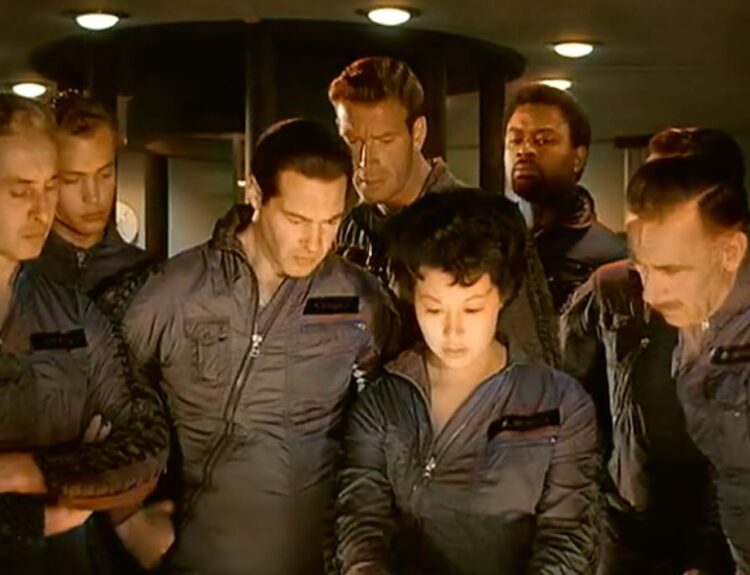
The Ark is a really cheesy science fiction show that I started watching because I was looking for something to make my way through at my own pace whenever I was looking for something to watch. But then one of my daughter started watching it with me, and then another daughter as well, and so it became one of those things we had to watch together. That’s fine, I like watching stuff with my family, but it still means I need to figure out what I can watch when the right combination of people aren’t around.
Anyway, The Ark is about “Ark One”– a colony ship fleeing a dying earth in the future in which all the crew and passengers are traveling in suspended animation, which suddenly experiences a great disaster which kills the captain and the command staff. The survivors awake have to reorganise under the leadership of the only three junior officers who remain. The show is about their efforts to survive, about their efforts to get along, and about a variety of mysteries regarding their mission and what has happened on earth since they left.
A lot of the writing of this show is pretty shallow, the special effects are cheap, and much of the acting leaves something to be desired, but the show has got a breezy pace and plotting which is strangely addictive. In spite of the productions’ many weaknesses it’s become an undemanding but rewarding comfort viewing, and my daughters and I quite enjoyed the first two seasons. A third season got underway right around the time we finished season 2, but we put it on hold for now just because I’ve been juggling streaming services to pay for and it was time to jump onto Paramount+ so I could watch some Star Trek content (more on that next month, probably).

Patience – season two
Another show that we finished this month was the second season of Patience, the British mystery show about an autistic archivist who helps the police solve crimes and murders. Ella Maisy Purvis plays Patience Evans, and in the second season the main detective that she works with is played by Jessica Hynes (replacing Laura Fraser who co-starred in season 1). It’s a good show that does a generally good job with its mysteries and features excellent character work and solid representation of neurodivergence (as affirmed by my neurodivergent daughter). It also features one of my favorite TV series theme songs, by Hannes de Mayer, a sweet-sounding composition that is a perfect fit for the series.
The second season featured eight episodes instead of the first season’s six. And a third season, which is already in or maybe has completed production, reportedly has ten episodes. That’s more episodes each season, which when looking at a show that I like is both a rare and a good thing.

Supergirl: The Silver Age volume two
As I mentioned somewhere last month, I recently picked and up and read this second collection of Silver Age Supergirl stories, running in Action Comic from #285-307. As before it’s a book full of a lot of silliness because the Silver Age was a silly place, but it’s also full of a lot of awesomeness because there was also plenty of that floating around those days as well.
The book–written by Leo Dorfman and Jerry Siegel, and drawn by Jim Mooney–begins with the story where Superman reveals Supergirl’s existence to the world. At the same time, Supergirl lets her adopted parents, Fred & Edna Danvers (who adopted her in brief period when she was powerless) know who she really is. The Danvers are super-nice and excited about it all, which is kind of sweet to see. Supergirl goes on to defeat an “Infinite Monster” and to meet the US President and his wife (Jack & Jackie Kennedy–Supergirl notes how gorgeous the First Lady is).
As the book continues stories feature Supergirl facing off with Lex Luthor, Mr. Mxyzptlk, some Phantom Zone villains, and two different evil female scientists from Kandor–Lesla-Lar and Zora, aka Black Flame. We are also introduced to Lena Thorul, Lex Luthor’s secret sister who has telepathic powers, and there are some appearances by the Legion of Super-Heroes, including a couple that are not collected in the Legion of Super-Heroes archives, which means that I’m not as familiar with them as the others.
This book features a little bit of Streaky the super-cat, and the one and only appearance (that I know of) of Streaky’s 30th Century descendant Whizzy. But the super-pet who gets the most attention is Comet the Super-Horse, which is one of the stranger products of the Silver Age that I can remember. Comet was actually a centaur named Biron who met up with the witch Circe. She attempted to turn him into a human but interference from a rival which caused him to become a horse instead. Circe gave him superpowers but he was trapped in the constellation Sagittarius until by chance Supergirl’s passing spaceship set him free. He becomes Supergirl’s friend but insists that she not reveal his secrets or backstory to anybody. For a while he loses his memory becomes the property of a beautiful movie star, but that doesn’t stick.
The thing is…none of tha tis the really weird part. The really weird part is that at one point Supergirl and Comet travel to Zerox, the sorcerer’s world (I thought this was a Legion of Super-Heroes concept, in other words just the homeworld of their enemy Mordru, but apparently the idea precedes Mordru). Unbeknownst to Supergirl, Comet is able to use some magic there to turn himself in a full human finally, but only temporarily. Supergirl doesn’t realize this however, and during this time Comet saves Supergirl’s life and she is somewhat bedazzled by this handsome stranger. For whatever reason, once he’s back to being a horse Comet doesn’t explain this to her,
However, an ongoing effect of this magic is now, Comet turns back into a human whenever there is a comet nearby. Back on earth, this happens, and so Comet, under the name Bronco Bill, goes a gets a job at a rodeo since he has such a good understanding of horses. Supergirl meets him (not knowing who he is), saves him from an accident, and then…they kiss.
Supergirl of course never knows who this guy is. Comet thinks to himself, “I could have told her who I was, but I wanted to keep my other identity secret! It could help me in my super-tasks someday!”

Really, Comet? Could it? Hmm. That’s pretty suss.
Anyway, all this goofiness is part of the package with the Silver Age, and part of the fun. I really enjoyed this book and just wish there were more volumes. There’s not, but there is an omnibus (volume 2) that basically picks up from where this one leaves off.

Justice League of America: The Nail & JLA: Another Nail
This one was a re-read for me–I was looking over the increasingly extensive comic collection on my bookshelf and thought this would be a fun to look at. The Nail is by Alan Davis, and hails from 1998 where it was originally published as an “Elseworlds” story, using familiar DC concepts and characters and mixing them in a new way. In this case it’s all due to a nail in Jonathan & Martha Kent’s car tire–this causes them to not go for a drive on the day that they were supposed to find Superman’s rocket as it landed on Krypton. Consequently, young babies Kal-El is found and raised by an Amish family who teach him to stay away from the world at large, so there is no Superman and things in the world of DC develop differently.
The Nail is great. It’s a really fun story featuring most of the DC mainstays trying to figure out exactly what crazy and horrible thing is happening to their world. It’s well paced, well drawn, and features great takes on a lot of characters which, even though it’s an “alternate universe”, feel very close to their classic forms.
Davis followed this up with Another Nail, which came out in 2004. It’s also fun but not nearly as memorable or as cohesive. The story follows up the original with a bunch of stuff about the New Gods and the forces of Apokolips and another menace that threatens all of reality. But it seems like one of the motivations is to cram as many DC concepts that didn’t make it into the first story in their someplace. So rather than a focused story a lot of the pages come across as a tour through a DC encyclopaedia. Remember the Metal Men? The Legion of Super-Heroes? The Doom Patrol? Here they all are, and more.
Still, it all together makes for a nice volume and a diverting read. If I have one complaint about the collection itself it’s just that the way it’s printed means the two stories just run into each other. Like one the left side of one spread is the last page of The Nail, and right next to it is the first page of Another Nail, rather than doing something like putting the Another Nail covers in between.

It just does something funny to the pacing of the reading experience. But obviously, that’s a pretty minor quibble.

The Flash #226-230, All-Flash #1, The Flash #231-247 (2005-2008)
I’m always in the business of seeing what comics of mine I can thin out of my collection, and that led me to having a look at these books from the latter days of Wally West’s run as the character before Barry Allen was brought back the dead in the main DC continuity. #226-230 came after Geoff John’s celebrated run on the title, when DC didn’t seem to have a lot invested in Wally as a character anymore. He abruptly was written out of things during the big Infinite Crisis crossover, and was replaced as the Flash by an aged-up Bart Allen, in a movie that I think is pretty much universally considered to be a mistake. After a year of this, Bart was killed and Wally brought back, this time with his twin babies aged up to tweens and running around with super powers of their own.
All-Flash #1 started off this later period, followed by a continuation of The Flash, now by returning writer Mark Waid. Waid didn’t stick around that long, and was later replaced by the likes of Tom Peyer and Alan Burnett, who both did a good job continuing the story of Wally and his wife Linda as parents of super-powered kids that Waid had started. I probably will sell off these comics when I get the chance, but it’s not because I don’t enjoy them. This re-read has been sufficient for me, and I don’t need to keep them forever.

The Mystery Agency–The Bookshop Murder by Henry Lewis and Can You Solve the Murder?–The Forest of Death by Anthony Johnston
I didn’t read any proper books this month, but I did read two different “Solve it yourself” mystery books. Both of them were the second in their respective series, which means if I like them enough there are other volumes that I could get ahold of.
The Bookshop Murders is an illustrated puzzle book which uses its various challenges to reveal clues about suspects in a murder which, if you notice them, allow your eliminate all but one of the possibilities from the running so you can identify the actual murderer. There are eight suspects and I was able to cross five of them off my list, but a couple of the clues eluded me, so it was a bit trickier than I thought. And I didn’t actually solve all the puzzles without looking at hints or looking at the answers, though I got quite a few. To be fair, I was thrown off on one due to some very not-to-scale illustrations…

Sometimes solving all the various four-digit codes in the book got a little tedious, but overall it was a fun process, just not one you want to try to do all at once. I was a little disappointed not to get more of it without help, but I was pleased that there was a cryptogram at the end that supposedly I needed information from the previous book to solve, but I was able to decipher it anyway.

The Forest of Death is more of an actual detective novel with some Choose-Your-Own-Adventure elements to it (you decide, for instance, which suspect you want to interview first and that leads to some variation in the sorts of clues you come away with). I enjoyed reading it and mostly found the most helpful clues and avoided the more meaningless ones, but I did in fact make one completely wrong move that ended the story prematurely. On a redo (where I just made all the same choices except for the last one) I got to the end and solved the murder, but didn’t get the highest possible score.
I could imagine eventually chasing up the other book in this series (maybe there’s more than just one, I’m not sure), but in some ways this isn’t that different from just reading a well-written murder mystery and paying attention as you go to see if you can figure it out before it’s revealed. The only real difference is that the interactive structure means that I took the whole thing a lot slower than I would a normal book, trying to make sure I’d done what I could to solve it rather than just letting the story unfold for me.
So…what else?

I did a Peanuts-themed jigsaw puzzle, that I got from my mother a while ago as a gift. Or I tried to do it. I ran out of time and so I never finished it, but I was hampered by the, I’d say, not great design of the puzzle itself. You can see from the picture above that it has large sections which don’t feature a lot of variation in the illustration (big fields of blue and brown, for instance) but that would be okay if it had been better constructed. The pieces are all mostly the same basic shape, for of all, but they don’t fit together in very “clear” ways, if that makes sense. In other words, it’s actually quite hard to tell which piece of generic brown wall fits into which other piece of generic brown wall, since it seems there are so many possible ones that sort of fit. It all adds up to a pretty unsatisfying experience. And like I said, because we needed the table and because it was getting more and more annoying, I eventually gave up and probably will never return to it.

I also attended a Quiz Night for a friend’s birthday. We came in third out of 15 teams, so we felt pretty good about the whole thing even if we didn’t know who was Australian Prime Minister in 2013 and I couldn’t remember who sang Ocean Eyes.

And finally, to finish off, this is a drink I recently found in an up-for-grabs area at the missions community that I work in. Yes, it’s Schweppe’s lemonade with Mandalorian-themed packaging, which advertises itself as “Galactic Lemonade – Mystery Flavour.”
Basically, it tasted kind of like grape, which is not a very common flavour in Australia.
PakarPBN
A Private Blog Network (PBN) is a collection of websites that are controlled by a single individual or organization and used primarily to build backlinks to a “money site” in order to influence its ranking in search engines such as Google. The core idea behind a PBN is based on the importance of backlinks in Google’s ranking algorithm. Since Google views backlinks as signals of authority and trust, some website owners attempt to artificially create these signals through a controlled network of sites.
In a typical PBN setup, the owner acquires expired or aged domains that already have existing authority, backlinks, and history. These domains are rebuilt with new content and hosted separately, often using different IP addresses, hosting providers, themes, and ownership details to make them appear unrelated. Within the content published on these sites, links are strategically placed that point to the main website the owner wants to rank higher. By doing this, the owner attempts to pass link equity (also known as “link juice”) from the PBN sites to the target website.
The purpose of a PBN is to give the impression that the target website is naturally earning links from multiple independent sources. If done effectively, this can temporarily improve keyword rankings, increase organic visibility, and drive more traffic from search results.